A well-run security checkpoint is one most people barely remember. The line keeps moving. A guard knows where to look. The concert, school day or basketball game remains the main event. Alexandra Smith Ozerkis markets the technology inside that fleeting moment, which means she is paid to make an invisible benefit legible without making the entrance feel like a lecture.
Ozerkis is chief marketing officer at Evolv Technology, the Waltham company that makes AI-powered screening systems for places where people gather. Her job sits at an awkward and interesting intersection: hardware and software, reassurance and scrutiny, public promise and operational reality. A sensor can generate an alert. A person still has to understand it, respond to it and keep everyone else moving.
Her route to that intersection was not a straight march through security technology. It wound through technology advertising, New York public relations firms and a long stretch representing trade associations. One year the subject might be toys; another, juice or pasta. Categories changed. The craft was learning a room quickly, deciding what mattered to the people inside it and finding language that could travel outside.
Career figures are public record; screening totals are company-reported as of 2026.
A degree in people
At Cornell University, Ozerkis studied psychology, earning her bachelor’s degree in 1999. That is not the standard credential printed on a marketing job description, but it makes sense in retrospect. Marketing is partly a study of attention and trust: what people notice, what they fear, what they ignore and which signals help them act.
Her early career put that human question beside technical subject matter. At Grey Advertising, she focused on technology clients. She then worked at public relations firms in New York, including a turn as an account director at Janine Gordon Associates. The assignments demanded fluency, but not the sort earned by staying in one niche forever. They rewarded the ability to learn a new client’s vocabulary and translate it before the jargon hardened.
At Kellen, a professional services firm for associations, that translation muscle got a prolonged workout. Public materials place her on the Pasta Fits communications team as a senior account supervisor in 2014 and later identify her as the National Pasta Association’s communications director. By the time she left Kellen as vice president of communications, she had managed clients whose shared problem was easy to state and hard to solve: an entire industry needed to explain itself.
Four rooms, one transferable skill
Turn features into reasons to care.
Make complex clients understandable in public.
Find one voice across many interests.
Connect product claims to operations.
The association years also gave her a stage. Ozerkis has spoken about public relations, crisis communications and issues management at The New School, the Fashion Institute of Technology, the American Society of Association Executives and New York Women in Communications. Those topics point to a professional preoccupation: the message matters most when the room is difficult.
Two quieter lines on her public record broaden the picture. From 1999 to 2003, Ozerkis volunteered as a Big Sister through Big Brothers Big Sisters of America. From 1999 to 2007, she served Cornell as an alumni admissions ambassador. Both commitments began around graduation and continued alongside the early climb of her communications career. They placed her in recurring conversations with young people, families and prospective students, far from the controlled geometry of a campaign plan.
Those roles do not explain a career by themselves, and they need no grand moral attached. They do show a taste for work that depends on showing up repeatedly. Communications can look episodic from the outside: a launch, a statement, a presentation, then the next deadline. Mentoring and admissions work run on accumulation. One conversation earns the next. Trust arrives by installments. That same patience appears later in how Ozerkis describes the customer relationship at Evolv, as something observed on location and maintained through useful questions.
The product is also a doorway
Ozerkis joined Evolv in 2022 as vice president of corporate communications. The company’s product was technical, but the use case was ordinary in the most literal sense. People walk through an entrance. Sensors and software assess possible threats. Operators handle alerts. The venue hopes safety and hospitality can occupy the same few feet of floor.
That last part is the marketing problem. A conventional metal detector announces friction: stop, empty, wait. Evolv’s story is built around movement and the idea that screening can become less intrusive. To communicate that claim responsibly, the marketer has to show not only the machine but the system around it. Staffing, training, building layout and response plans do not fit neatly on a product card. They determine what the product means in practice.
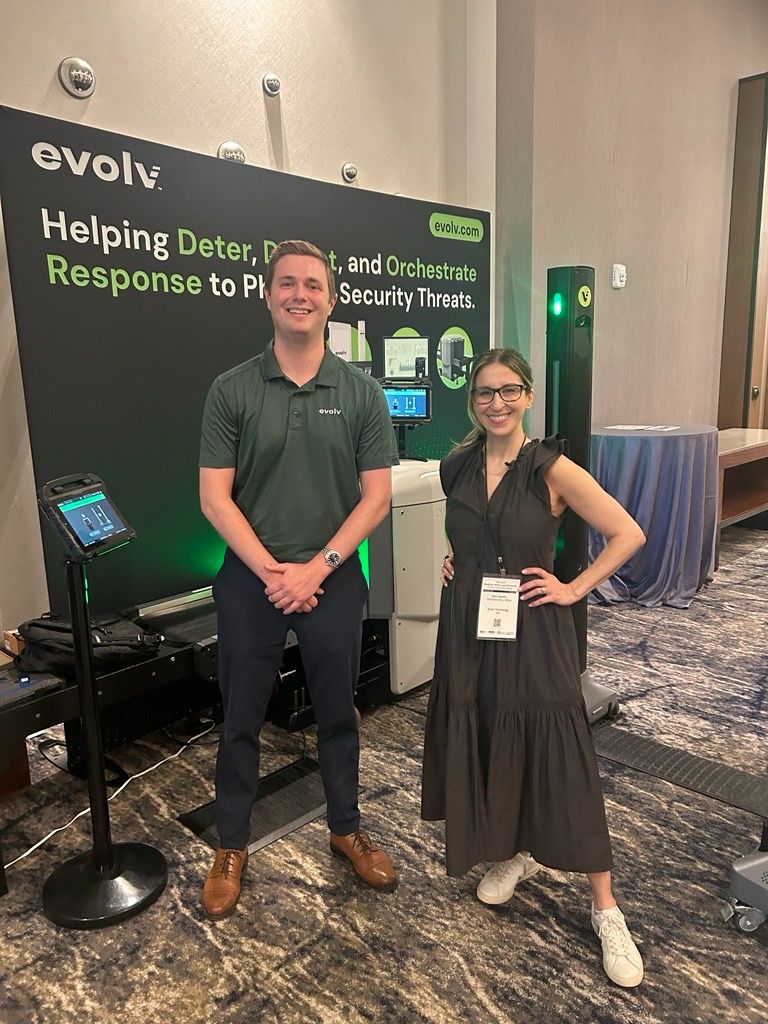
“Taking time to visit our customers and see how our tech works in real world environments is always a great moment to learn and connect.”Alexandra Ozerkis, after a Boston College game-day visit
At Evolv’s 2026 investor day, Ozerkis made the fieldwork concrete. She talked about school teams balancing security priorities with staffing constraints, and about the difference between an older campus building and a new one. Her favorite days, she said, involve watching students arrive, asking questions and working beside school districts. The marketer appears here less as a broadcaster than as an observer with a notebook.
It is an appealingly unglamorous operating rhythm. Go to the building. Watch the queue. Notice where a bag changes hands. Listen to the person responsible for the alert. Marketing often claims to speak for the customer; fieldwork supplies the inconvenient details that keep that phrase honest.
Operators, visitors and staff interpret what happens at the entrance.
Training and response plans turn an alert into an informed action.
Sensors, AI and analytics help teams focus their attention.
Trust needs a specification
By 2025, Ozerkis had moved into Evolv’s CMO role. The promotion expanded her brief from explaining the company to helping generate demand for it. At investor day the following June, she introduced herself as someone who had spent more than two decades driving demand and brand adoption across industries, then laid out why customers consider weapons detection and how Evolv approaches the market.
Her public language also shows the discipline required by the category. She has described advanced weapons detection as one layer in a school’s security plan and said no single technology should be the sole source of protection. That qualification is not a footnote to the story. It is part of the story. Security is an ecosystem, and confidence becomes brittle when a promise ignores the rest of the system.
Can the promise survive contact with the doorway, the staffing plan and the moment after an alert?
In 2026, Evolv introduced a “Screened by Evolv” seal for customer entrances. Ozerkis framed the announcement around responsibility and trust. The seal tells visitors that a venue uses the company’s technology as one part of its operation. It does not promise a perfect outcome. That distinction is less cinematic than certainty, but much more useful to the people making decisions at the door.
“Trust is at the center of what we do.”Alexandra Ozerkis on Evolv’s customer responsibility
The Security Industry Association named Ozerkis to its 2026 Women in Security Forum Power 100, recognition that arrived four years after she entered the sector. The short interval says something about the value of an outsider’s practiced eye. She did not arrive knowing only security. She arrived knowing how industries talk to themselves, how they talk past outsiders and how a careful communicator can build a bridge between the two.
The category-hopper’s advantage
There is a comic neatness to a résumé that runs from pasta to perimeter screening, but the contrast hides a serious continuity. Both assignments ask the communicator to work across a coalition. Association members may compete while sharing a public reputation. Security customers may use the same technology in schools, arenas or workplaces while operating under entirely different constraints. One message has to remain coherent without pretending every situation is identical.
Ozerkis’s practical answer is visible in her field comments: resist the generic customer. One school is one school. One building is one building. The old campus, the new campus, the Friday-night crowd and the Monday-morning arrival each reveal a different part of the product. A marketer who sees those differences can write a clearer promise and build a more useful demand engine.
Her career offers a playbook for anyone selling complex technology. Learn the category, but do not become trapped by its shorthand. Get close enough to operations that a phrase can be tested against reality. Treat trust as something built through accurate expectations, not merely warm adjectives. And remember that a useful outcome may be almost invisible: people moving through a doorway, attention pointed where it matters, the day continuing on the other side.