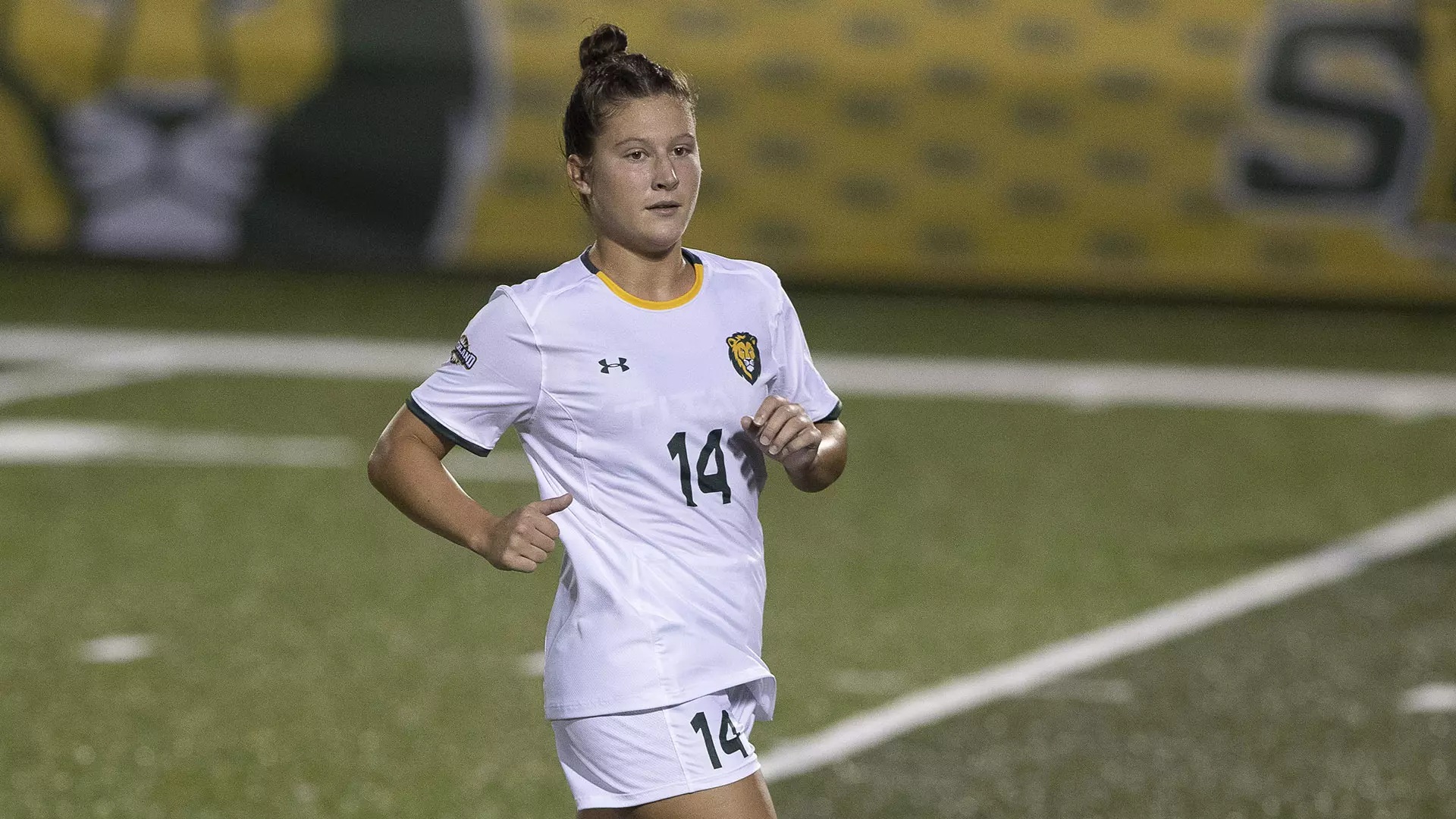
In a match report, a midfielder tends to arrive as a verb. Crossed. Pressed. Assisted. Shot. The nouns belong to the scorers and keepers; the midfielder supplies the connective tissue. Alexandra Gundersen spent six seasons in and around that grammar at Southeastern Louisiana University. She came south from Reading, Pennsylvania, wore number 14, studied kinesiology and learned how much consequential work happens before anyone applauds.
Today her public professional title is clinical exercise physiologist at Carda Health. It sounds like a clean pivot from college sport into digital health, but the line is straighter than it first appears. Both worlds concern movement translated into information. Both reward close observation. Both ask how a person responds to a plan once the plan meets a real body, a real room and an ordinary Tuesday.
Gundersen’s record is not built from keynote speeches or a busy personal brand. It lives in team sheets, match summaries, academic lists and a compact professional profile. That makes the interesting part less obvious, and perhaps more honest. Here is a career taking shape through repetition: an athlete studies the subject of movement, keeps studying it while competing, then makes it her work.
A redshirt year, then the 84th minute
Southeastern announced Gundersen among its 2016 recruits as a midfielder from Exeter High School. She had been an All-Berks player in Pennsylvania. Hammond was a long way from home and Division I soccer was an abrupt new scale. Her first college season became a redshirt year. The pause matters. Athletic biographies often hurry past the seasons when little appears in the box score, although those are the seasons that test whether a person will stay.
She stayed. In 2017, as a redshirt freshman, Gundersen played eight matches and started against Lamar. Her first college goal arrived against Northwestern State. Kim Porche sent in the cross; Gundersen finished it in the 84th minute to make the score 3-1. There is a pleasing neatness to a midfielder’s first goal beginning with somebody else’s delivery. Soccer, like most useful work, is an argument against doing everything alone.
“Nothing is given to anyone.”Coach Christopher McBride, describing the competition inside the 2017 squad
The following year supplied another small but telling entry. Against ULM, Southeastern scored six. Gundersen assisted Vanessa Arzaluz, playing the pass that made it 5-0 before halftime. Her 2018 line was steady rather than gaudy: 13 appearances, seven starts, 11 shots, three on target. By then she had also collected a third straight place on the Southland Conference Fall Commissioner’s Honor Roll.
The transcript beside the team sheet
There are two versions of Gundersen in the university archive. The roster calls her Lexie. The graduation list calls her Lexie too, but her professional life now uses Alexandra. One name belongs to the field, the other to the credential, and both point to the same unusually consistent subject.
She completed her kinesiology degree in spring 2020. By the next season, the roster listed her academic program as a master’s in health and kinesiology. The Southland honor roll recorded a 4.00 for spring 2021. It did so again for fall 2021, when it listed her as a graduate student. Those numbers are spare but eloquent. Training and travel do not negotiate with assignments. A semester keeps its own clock.
Kinesiology gave formal names to matters an athlete encounters every day: mechanics, workload, adaptation, feedback. A training plan can look authoritative on paper and still require revision once a person begins. The field offers its own laboratory, though not a controlled one. Opponents interfere. Weather happens. Fatigue tells the truth more bluntly than a spreadsheet.
Gundersen did not leave competition neatly behind when undergraduate study ended. She remained on the team through graduate school, part of a college career extended by a redshirt beginning and the distorted sports calendar of 2020. The long route let the classroom and the field overlap. In her final listed season, 2021, she appeared in 17 matches.
A goal, a storm and one low shot
The 2021 season resisted tidiness. After Hurricane Ida, Southeastern went 38 days without a home match and played eight straight on the road. In September, against McNeese, Gundersen put a cross in front of goal for Makenzie Maher, whose effort went above the bar. Later, Gundersen had a shot saved inside the box. The Lady Lions lost 1-0. It is the sort of result soccer produces with wicked efficiency: abundant effort compressed into a single digit.
On October 29, in the final regular-season home match, the arithmetic turned generous. Southeastern beat Nicholls 4-0. Gundersen scored, with Halli Roe and Haylli Roe credited on the move. It was her one goal of the season and part of a late run that carried the Lady Lions into the Southland tournament.
They reached the semifinal against Northwestern State. In the 70th minute, with the match scoreless, Gundersen gathered a loose ball inside the box and drove a shot toward the bottom-left corner. Acelya Aydogmus, the conference’s goalkeeper of the year, managed to deflect it. Northwestern State scored nine minutes later. Southeastern’s season ended 1-0.
One final season held both versions of a chance: the goal that lands and the shot a goalkeeper just reaches.
Sport is useful partly because it refuses to turn every good effort into a reward. Gundersen’s last collegiate run included a goal, a semifinal and an almost. The record does not need polishing. Its unevenness is the point. Plans meet resistance. People adjust. Progress is usually legible only across a longer span.
When movement became the job
Gundersen’s current role brings her training into a different setting. Carda Health runs guided programs remotely, connecting people at home with a clinical team and digital tools. A clinical exercise physiologist works where measurement and coaching meet: exercise is not merely assigned; it is watched, interpreted and adjusted.
That work is not soccer by metaphor. Patients are not players, a home is not a stadium, and clinical responsibility is not a game. Still, experience can travel without pretending two settings are identical. The habits that mattered in midfield - reading a situation, choosing a pace, communicating clearly, responding to change - remain recognizable. So does the preference for useful contribution over theatrical display.
Her public footprint offers no manifesto about the transition, no packaged origin tale. What it offers instead is chronology. Reading to Hammond. Redshirt to starter. Kinesiology to graduate study. Number 14 to three letters after her name: CEP. Each step narrows the focus while widening the place where it can be applied.
Small numbers, properly read
Athletic statistics can make a midfielder look smaller than the match she played. Goals and assists count conclusions. They do not count the run that opened a lane, the pass before the assist, or the decision to slow an attack until support arrived. Gundersen’s public totals should be read with that modest limitation in mind. In 2017, she played eight times and scored once. In 2018, she made 13 appearances and seven starts, adding an assist. In 2021, she played 715 minutes across 17 appearances and took 12 shots. These are not claims to stardom. They are evidence of presence.
The academic lists work differently. There the result is unusually plain. Her name appeared on the conference honor roll as a first-year kinesiology student in 2016, then again in 2017 and 2018. In the graduate phase, the posted semester figure was 4.00. Sport loves the visible instant; education accumulates in private. Gundersen’s archive holds both kinds of labor side by side.
It also records changes in position and circumstance. She entered Southeastern as a midfielder, was listed in that role through her senior season, and occasionally appears around the forward line in summaries. She began with a season out of competition and finished in a year disrupted by a major storm. Between those points came a degree, graduate work and enough matches for a career to have texture rather than a single defining scene.
That texture matters because professional biographies tend to sand away the waiting. They prefer arrival: joined, graduated, became. Gundersen’s record contains the less glamorous verbs too. Redshirted. Returned. Traveled. Studied. Missed. Tried again. The career after college becomes more comprehensible when those verbs remain in view. Clinical work, like sport, is made of adjustments repeated more often than breakthroughs.
The finest joke in a career is often played by continuity. We announce a new chapter and discover the old subject waiting inside it. Gundersen’s subject was movement before it became a degree. It was teamwork before it became remote guidance. It was attention before it became a professional responsibility.
A midfielder’s work is to help the whole system move. The best pass may be the one that makes the next action possible, not the one the crowd remembers. Alexandra Gundersen’s second field has different lines and no scoreboard. Yet the essential question is familiar: What does this person need next, and how can I help them get there?