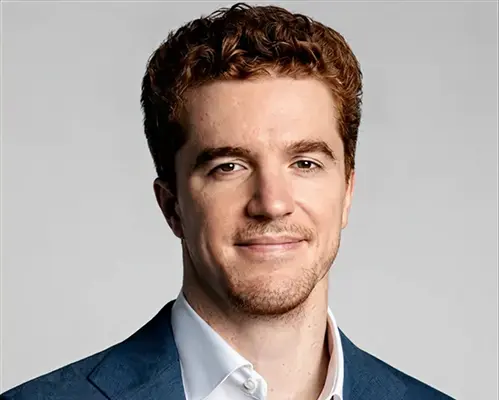
The Story
He left a payments giant to fix the part of healthcare nobody bills for.
Most founders pitch a market. Harry DiFrancesco started with a living room. Carda Health, the company he co-founded in 2020 and runs from New York, exists because recovery care - the unglamorous, repeatable, slow work that keeps people out of the hospital a second time - is the part of medicine that gets prescribed and then quietly never happens.
DiFrancesco's resume reads like four different people stapled together. He studied analytic philosophy at Cornell, the discipline of taking apart an argument until only the true part is left. He picked up a master's in computer science at Georgia Tech, so he could build the thing instead of describing it. He earned an MBA in statistics at Wharton and spent time at the Lauder Institute. Between the degrees, he taught in a classroom through Teach For America and helped co-found a school. The throughline is not a field. It is a habit of walking into systems that are supposed to work and asking, out loud, why they don't.
By 2018 that habit had carried him to Stripe, where he worked in business operations - the internal engine room of one of the most disciplined companies in tech. Stripe is famous for treating boring infrastructure as a moral cause: make the plumbing invisible and an entire economy moves faster. DiFrancesco took that lesson and pointed it somewhere stranger. Not commerce. Convalescence.
“Apps alone don't build trust. Human relationships do.”
// HARRY DiFRANCESCO ON WHY TECHNOLOGY ALONE ISN'T THE ANSWER
The Apprenticeship
Before the cap table, a classroom.
It is easy to skip past the first line of the resume, but it explains the rest of it. DiFrancesco's working life started in 2012 not in a startup but in front of a class, as a teacher through Teach For America - the program that drops top graduates into under-resourced schools and lets the experience reorganize their priorities. Teaching is the original lesson in behavior change. You cannot ship a feature that makes a teenager learn. You earn it, slowly, by showing up and being trusted, and you measure progress in increments small enough to miss if you blink. A decade later, that is almost word-for-word how he describes the work of getting a patient to finish a course of recovery.
In 2013 he went a step further and helped build the institution itself, co-founding the School of Innovation and Sustainable Design and serving as its chief product officer - a title that, in a school, means designing how learning actually happens rather than just delivering it. The pattern was already visible: don't just work inside the system, build a better version of it. Philosophy gave him the questions, teaching gave him the patience, and product gave him the appetite to construct an answer instead of complaining about the gap. By the time he reached Stripe, he wasn't switching careers so much as collecting tools.
The Spark
It began at home, as a caregiver.
The origin of Carda is not a hackathon or a whiteboard. DiFrancesco became a caregiver for a parent who, after a major medical event, was prescribed a course of recovery and then ran straight into a wall of logistics: appointments that were far away, schedules that didn't fit a life, a process designed for the convenience of the building rather than the person inside it. The care existed. The access didn't. He has described the gap bluntly - the overwhelming majority of patients who are entitled to rehabilitation never actually get it.
That number is the whole company in a sentence. If care is owed and not delivered, the failure isn't medical. It's design. Carda's answer is to move recovery into the home: supervised, monitored, scheduled around the patient, run by the same clinician each time so the relationship has somewhere to grow. DiFrancesco talks about “infrastructure for behavior change” the way an engineer talks about a bridge - something you build once, carefully, so that thousands of people can cross without thinking about it.
He also has an unusually clear-eyed take on why the gap exists in the first place, and it isn't villains. It's incentives. American healthcare, in his telling, is wired to pay handsomely for the dramatic intervention and to underfund the patient quiet recovery that prevents the next one. The economics reward the rescue and ignore the maintenance. Worse, access has been drifting the wrong way - in interviews he points out that getting an appointment can take longer now than it did a decade ago. Carda is, in effect, an argument with that arrangement, made not in a policy paper but in a product that simply delivers the recovery the system keeps promising and dropping.
“The system pays for sick care, not for the behavior change that keeps people out of the hospital.”
// ON THE STRUCTURAL FLAW HE'S TRYING TO RE-WIRE
The Machine
Clinicians first. AI as the thing that gets out of the way.
DiFrancesco has a contrarian read on artificial intelligence in medicine, and it is the opposite of the pitch deck consensus. He doesn't think the most valuable job for AI is replacing the person on the other end of the call. He thinks the real bottleneck is delivery and access - the friction between a patient and the care they've already been told to get. Used well, software removes that friction and hands the clinician back the one thing the system keeps stealing: time for an actual conversation.
The proof he points to is unfashionably simple: a Net Promoter Score of 89, the kind of number you earn by being relentlessly convenient, by staffing real tech support for older patients who didn't grow up with apps, and by refusing to rotate people through a carousel of strangers. Continuity, in other words, treated as a feature. It is a very Stripe idea wearing a stethoscope.
There's a reason the number matters so much to him. A satisfaction score isn't a vanity metric in this business - it is the entire flywheel. People only complete recovery they actually like, and they only like care that respects their time and remembers their name. Carda's whole model is a bet that convenience and continuity are not soft amenities bolted on top of medicine but the load-bearing walls of whether it works at all. DiFrancesco has built a company headquartered in New York with a team of roughly 180 people around exactly that thesis, growing it to a reported figure near $43.7M in revenue while keeping the experience personal enough that patients recommend it to each other.
Figures drawn from public company profiles and interviews; revenue reported near $43.7M.
The Long Run
An ultramarathoner does not optimize for mile one.
Away from the company, DiFrancesco runs ultramarathons and climbs mountains - endurance sports where the entire skill is managing the middle, the long ugly stretch after the adrenaline is gone and before the finish is in sight. It is hard to imagine a better mental model for building a healthcare company, where nothing compounds quickly and the reward for patience is that, eventually, the system bends. He treats a business the way he treats a hundred-mile course: the goal isn't to be fastest at the start. It's to still be moving when most people have stopped.
There's a tidy symmetry to the whole arc. The philosopher who interrogates assumptions, the engineer who builds the fix, the teacher who knows behavior change is slow and human, the operator who makes infrastructure invisible, and the mountaineer who is comfortable being uncomfortable for a very long time - all of them are useful when your job is convincing a country to value the recovery it keeps prescribing and forgetting. DiFrancesco didn't pick a lane. He collected the exact set of skills a problem this stubborn requires, and then went looking for the problem.
The Read
A patient skeptic of the easy fix.
What makes him interesting to listen to is that he refuses the two clean stories everyone else is selling. He won't say technology will save healthcare, and he won't say it's hopeless without it. He sits in the harder middle: technology is leverage, humans are the point, and the only durable wins come from pairing the two and then waiting longer than is comfortable. He is equally wary of miracle products that promise to replace the slow work of staying healthy - his consistent line is that quick fixes without a supporting program tend to unravel, and that lasting change needs scaffolding, not a single dramatic intervention.
It is a worldview that rewards the unglamorous. No viral launch, no overnight cure, no single feature that changes everything. Instead, a methodical accumulation of trust, one patient and one finished program at a time, compounding into a system that bends. For a founder, that is a uniquely uncomfortable place to stand, because the market loves a clean narrative and DiFrancesco keeps insisting on the messy true one. Then again, he runs a hundred miles for fun. Discomfort, sustained over a very long distance, is rather the whole point.
“AI's promise is removing friction and freeing clinicians for the conversations that matter - not replacing them.”
// THE THESIS, IN ONE LINE