Cate Woolsey had made a promise about New York: she would stay. After college, an opportunity at Alumni Ventures asked her to reconsider. Accepting it meant moving to New Hampshire, away from the friends and familiar surroundings she had expected to keep. She took the job. Later, looking back on her first months there, she described finding work she enjoyed and meeting people she would otherwise never have known.
It is an ordinary enough decision to be recognisable and a consequential enough one to deserve attention. First jobs come with titles, contracts and addresses. The address can be the part that surprises you. Woolsey’s is now Manchester, where she works as an AI Associate to CEO at Alumni Ventures. Before that title came a rather different collection of activities: computer science at Middlebury, midfield on its soccer team, and a student art project that put old paintings in conversation with modern life.
Her story begins well before the office. There is a painted diner in it, a college jersey, a ball arriving from a teammate and a city she had once considered non-negotiable. Taken together, they make a more interesting introduction than a job title alone.
An old master, with new company
In 2021, at Little Red School House and Elisabeth Irwin High School, Woolsey chose a senior project called Pastiches of Famous Paintings. She wanted to learn from existing compositions while making room for her own artistic choices. Her subjects included Edward Hopper’s Nighthawks and Raphael’s Three Graces, which she used to consider technology, social media and changing ideas of beauty.
Preparation involved sketching, colour studies, research and practice with pointillism. She read John Berger’s Ways of Seeing, Ben Shahn’s The Shape of Content and Jerry Saltz’s How to Be an Artist. At the end, she described better command of acrylic and oil paint, alongside continuing difficulties with proportion and colour. She wanted to carry on learning and making meaningful art.
Her project journals give the work a calendar. An April entry records a visit to the Metropolitan Museum of Art. Another describes spending much of a week reading. By late April, the pointillism painting was proving difficult, and she had spent less time on it than intended. Later entries show her working on several canvases, including one oil painting and two acrylics.
These are small details, but useful ones. A finished painting keeps its schedule to itself. A student journal is less discreet: it records the reading, the unfinished work and the technique that refuses to become easy merely because a deadline exists. By the final weeks, Woolsey was concentrating on pieces inspired by At the Seaside and Three Graces. The project made room for both the work and the record of doing it.
The second September
That autumn, Woolsey began at Middlebury College. Her soccer roster entry listed New York as her hometown and Elisabeth Irwin as her previous school. She was a midfielder. In her first season she wore number 39; from her sophomore year onward, the number was 27.
September 11, 2022 brought a goal against Wheaton in Middlebury’s home opener. The Panthers were playing their first match on the newly renovated Dragone Field. The score had been level at halftime. In the second half, Carolyn Days sent a low cross to Elizabeth Jack, who put Middlebury ahead. Less than a minute later, Woolsey found the ball in the six-yard box and finished into the bottom-left corner.
Middlebury won 3-1. Jack and Woolsey both recorded what the match account identified as their first career goals. The two scoring plays came at 60:41 and 61:38. Fifty-seven seconds separated them, a short interval in which a tied afternoon became a two-goal advantage.
Two weeks later, against Bates, Woolsey scored again. At 43:01, she met a ball from Fanny Lodge with a header that deflected off a defender. It put Middlebury ahead before halftime. Abby Ward added the other goal in a 2-0 win. Woolsey’s contribution was recorded as the game winner.
Her sophomore season’s overall numbers were compact: eight appearances, one start, 138 minutes, three shots and two goals. Those figures describe a particular season, with its own opportunities and outcomes. The scoring plays provide the scenes that the totals compress: one finish close to goal, one header before the break, and teammates involved in getting the ball there.
A summer roster and an autumn rebound
In May 2023, STA named Woolsey to its Women’s Premier Soccer League roster for the coming summer. The squad included more than 20 returning players as well as new additions. Its season was scheduled to begin against New York Dutch Lions FC at Fairleigh Dickinson University in Florham Park.
The club’s announcement placed its team in the Metropolitan Conference and described the setting as pre-professional competition. Woolsey appeared in a roster that also included Emerson Elgin, Aoi Kataoka and Sydney Masur. It was another team list with her name on it, this time outside the college autumn schedule.
Back at Middlebury, her junior season included nine appearances, two starts and an assist. She recorded seven shots, four on target. On October 8, against Babson, she followed up an early attempt by Baldwin Gittens. Goalkeeper Callahan Cottone had charged out to stop Gittens; Woolsey collected the rebound, but Cottone recovered and caught her attempt.
Middlebury went on to win 2-1. The episode is worth retaining precisely because it is a chance rather than a goal. Match accounts contain this sort of unfinished business: a rebound reached, an attempt made, a goalkeeper arriving in time. The final score belongs to the whole game. Woolsey’s early opportunity belongs to one passage within it.
A pass at 39:47
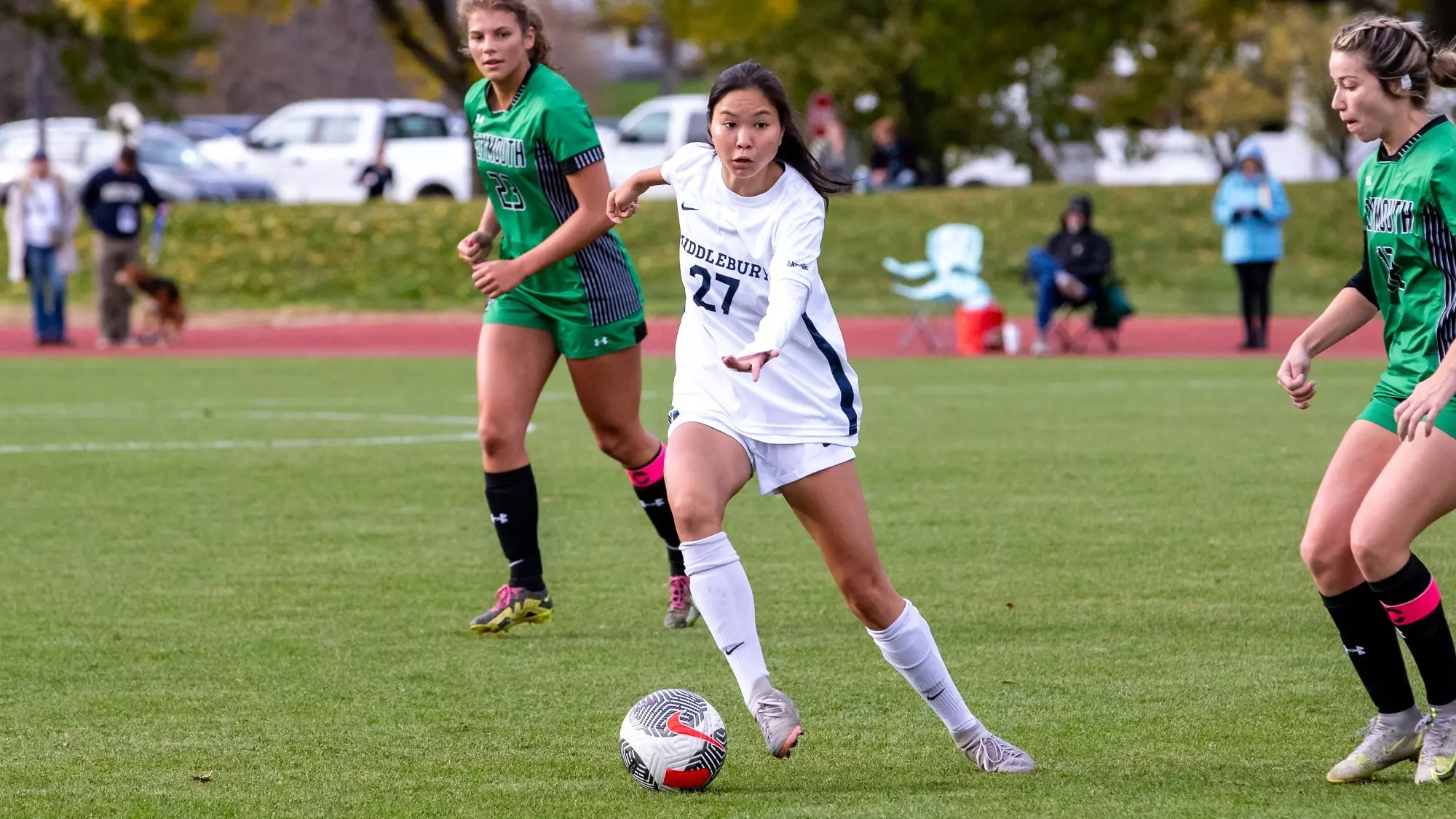
On October 9, 2024, Middlebury hosted Plymouth State. Chloe Swindle and Joely Virzi had put the Panthers two goals ahead within the opening ten minutes. Plymouth State then pulled one back. Late in the first half, Fiona Linnau sent a deep pass to Woolsey.
Woolsey went past two defenders and placed the ball into the bottom-right corner. The time was 39:47. Middlebury’s advantage was restored to two goals, and Woolsey had scored for the first time that season. Linnau, a first-year player, had her first career assist.
The Panthers added three more after the interval and won 6-1. The photograph from that afternoon catches Woolsey in motion, number 27 visible, with the ball in front of her. Her senior season ultimately included eleven appearances, two starts and 254 minutes. The Plymouth State finish was her one goal that autumn.
A scoring summary has little patience for atmosphere. It needs a name, a time and, where applicable, an assist. Here those three items preserve a connection between two players at different stages of college: the senior receiving the ball and the first-year player supplying it.
The other autumn results
Alongside the matches were academic distinctions. Woolsey earned NESCAC Fall All-Academic recognition in 2022, 2023 and 2024. The 2022 eligibility rules required sophomore academic standing and a cumulative grade point average of at least 3.50. Her first selection came during the same autumn as those two September goals.
The next two selections extended that record through her junior and senior years. The honours sit beside the soccer seasons on the calendar, returning each November as the autumn competition ended. They give those college years another set of results to remember. At Middlebury, her major was computer science. She graduated in 2025 and reported graduating summa cum laude. On May 24 that year, she was among 64 students inducted into Phi Beta Kappa at Wilson Hall.
Manchester enters the picture
Alumni Ventures brought a different setting. The firm offers venture capital investments to accredited individuals and co-invests alongside other venture firms. Its public offerings include funds, syndicate deals and investing clubs. For Woolsey, the opportunity also brought a change of city.
When she reflected on the move, she thanked CEO Mike Collins and Drew Collins for their support. Collins, sharing her account, welcomed the risk she had taken. Her own phrase for the lesson was brief:
“Experience is learning.”
It is a sentence that can sit comfortably beside the earlier chapters: the student experimenting with paint, the midfielder taking a chance at goal, the graduate accepting an unfamiliar address. Woolsey had already spent years studying and playing away from New York. Choosing where to begin work was another decision, with its own attachments.
She had expected the city to remain part of the plan. Instead, Manchester became the place where the next part began. A promise made after college had met an opportunity, and she had allowed herself to reconsider. For an early career, that is a substantial first chapter: choosing a job, choosing a place, and discovering what follows once both choices become daily life.