Before Ahmed Hashim ran a software company, he kept time. In Karachi's metal scene he played drums for Messiah, a band shortlisted for Battle of the Bands. At home, he assembled a recording studio, put his technical curiosity to work and shared music online. The detail feels almost too tidy as an origin story, but it is true, and it offers a useful way to read the career that followed. A drummer has to hear the whole arrangement while attending to the smallest interval. A software founder must do much the same, only with clients, engineers, users and systems all entering on different counts.
Hashim says he knew from the age of eight that his career would live in the digital world. Video games helped form the appetite. A web-applications course at Purdue University sharpened it. He studied computer science and information systems there from 2004 to 2008, then worked in the United States for nearly three years. His next move ran against the familiar direction of travel: he returned to Pakistan, intent on building tools for local advertising agencies.
The year was 2010. Television spots and billboards still carried an aura of inevitability. Hashim was fascinated by what digital media could reveal instead: where an audience was, what it clicked, how long it stayed, whether it returned, and whether it shared. Those measurements now sound ordinary. At the time, he was explaining a new commercial grammar.
“Since I was 8 years old, I always knew my career would be in the digital world.”Ahmed Hashim, 2010
The office where Facebook counted as research
Cygnis Media began with Hashim and co-founder Arsalan Akhtar building interactive experiences, Facebook applications and digital campaigns. Its early clients included Rogers and Butler's Chocolate Café. The work required a peculiar kind of attention. Hashim's team joked that Facebook could not be banned in the office because browsing it for hours was part of market research. They watched what caught on, read blogs, studied emerging behavior and assembled a mental database of ideas before clients arrived.
There is something charmingly archaeological about this now. Facebook applications once looked like a destination rather than a layer in a much larger technology landscape. Yet Cygnis survived precisely because the founders did not confuse a platform with a purpose. The platform changed. The purpose was to turn business problems into useful digital products.
That distinction bought the company time. Mobile apps followed social campaigns. SaaS platforms and enterprise software followed mobile. Data engineering, real-time systems and workflow automation joined the portfolio. Today Cygnis talks less about clever features and more about the entire production apparatus: architecture, integrations, permissions, security, privacy, reliability and maintainability. Fashion likes the launch. Software lives in what happens after it.
A sixteen-year product education
Cygnis says it has shipped more than 300 products across industries and business models. Its public portfolio ranges from work associated with MIT REAP and Pakistan's mission to the United Nations to aviation, enterprise operations and transportation compliance. DQid, a platform that organizes driver qualification and regulatory work for fleets, lists Hashim as its chief technology officer as well as Cygnis's co-founder.
The range is not a story of one founder possessing encyclopedic domain expertise. It is a story about learning how to learn in public, with delivery dates. A client-services company walks into somebody else's accumulated complexity. The brief may say “dashboard,” while the actual problem sits in permissions, conflicting data, an overlooked approval step or a workflow that has never been written down. Cygnis's current language is revealing: understand the problem, challenge assumptions, engineer the system, then ship and learn.
In 2024, the company made its evolution explicit. Cygnis Media became Cygnis, accompanied by a redesigned website and a wider account of its work. Hashim called the site modern, performant and goal-oriented. The name lost a word; the company gained a clearer description of what years of practice had already made it.
AI, minus the stage fog
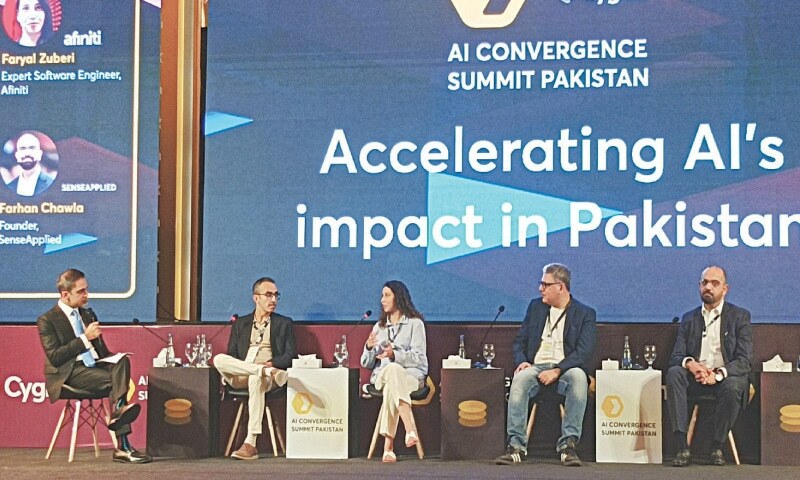
The rebrand arrived as generative AI was turning every software conversation into a referendum on the future. Hashim's public account of the shift has been notably practical. At the AI Convergence Summit Pakistan in November 2024, he said, “Today, AI is having a moment because computing has become cost-effective.” It is a less mystical explanation than the industry usually supplies, and more useful for it.
His example was New Jersey Transit. Sensors on trains could feed data into AI systems that helped engineers accelerate repairs, keep more trains in service and improve the passenger experience. The point was not that a machine had become sentient. The point was that fewer trains had to sit broken. Technology earned its place by reducing a stubborn operational failure.
Hashim's recurring filter
An editorial model of the sequence in Cygnis's stated method, not a measurement of time or revenue.
That same practicality connects the apparently distant chapters of Hashim's career. In 2010, he argued for digital media by pointing to observable behavior and calculable returns. In 2024, he argued for AI with maintenance data and trains kept on track. The vocabulary changed from clicks to sensors. The instinct remained: find the signal, connect it to a decision, and make the system work better.
Cygnis now builds AI-native products, agents, copilots and intelligent workflows, while also integrating AI into software that already exists. Its own description includes an important restraint: modern tools can increase speed, but engineering judgment cannot be outsourced to them. After sixteen years, this is less a slogan than a scar-tissue observation. Code that works in a demonstration can fail under real users, real permissions, bad data, unstable connections and regulatory constraints.
A new tool is useful when it survives the old world's mess.The operating lesson behind the Cygnis evolution
The founders who stayed for the whole song
Hashim's story is also a partnership story. He and Akhtar started Cygnis together and remained at its head through its changes. On the company's fifteenth anniversary, Hashim thanked the more than 100 people who had contributed to its journey, describing them as part of Cygnis's DNA. Akhtar wrote about challenges, learning and personal growth, and about entering an AI-enabled future with the excitement they had at the beginning.
Former colleagues responded with their own memories. They credited both founders with teaching them and helping establish their careers. Such comments are not an audited culture report, but they add texture to the number 100. A software services firm does not ship hundreds of products through founder willpower alone. It needs an ensemble that can absorb knowledge, recover from missed notes and hand the melody from one specialist to another.
Here the drummer metaphor earns one last measure. Drumming is conspicuous but not solitary. It supplies a shared clock. It listens as much as it strikes. It can lead without occupying every frequency. Hashim's public career offers no grand theory of management, but its durable facts suggest a preference for this kind of work: technically alert, commercially measurable and sustained with other people.
Build for the next beat
The easy version of a technology career is a procession of fashionable nouns. Social. Mobile. Cloud. SaaS. AI. Hashim's version is more instructive because the nouns sit on top of a steady verb: build. Cygnis began when Facebook pages could be a business frontier and endured long enough to see artificial intelligence move from a specialized capability to a default pitch.
Durability did not mean refusing to change. It meant changing without discarding the accumulated discipline of production. The company that once researched social trends now emphasizes edge cases, system design, data models, integrations and what happens after launch. The boy absorbed by video games, the musician wiring a home studio, the founder measuring clicks and the executive discussing train maintenance all share an appetite for systems that respond.
Sixteen years is not a neat ending, and Hashim has said the company still feels as if it is getting started. That may be the most founder-like sentence in the record. Still, it lands differently after hundreds of projects. Optimism at the beginning is temperament. Optimism after the bugs, scope changes, migrations and platform funerals is a practiced choice.
There will be another platform after AI's current moment, and another after that. Hashim's career makes a modest wager on what carries across them: curiosity formed early, measurement over theatre, a partner for the long run, and enough rhythm to hear when the next change is real.