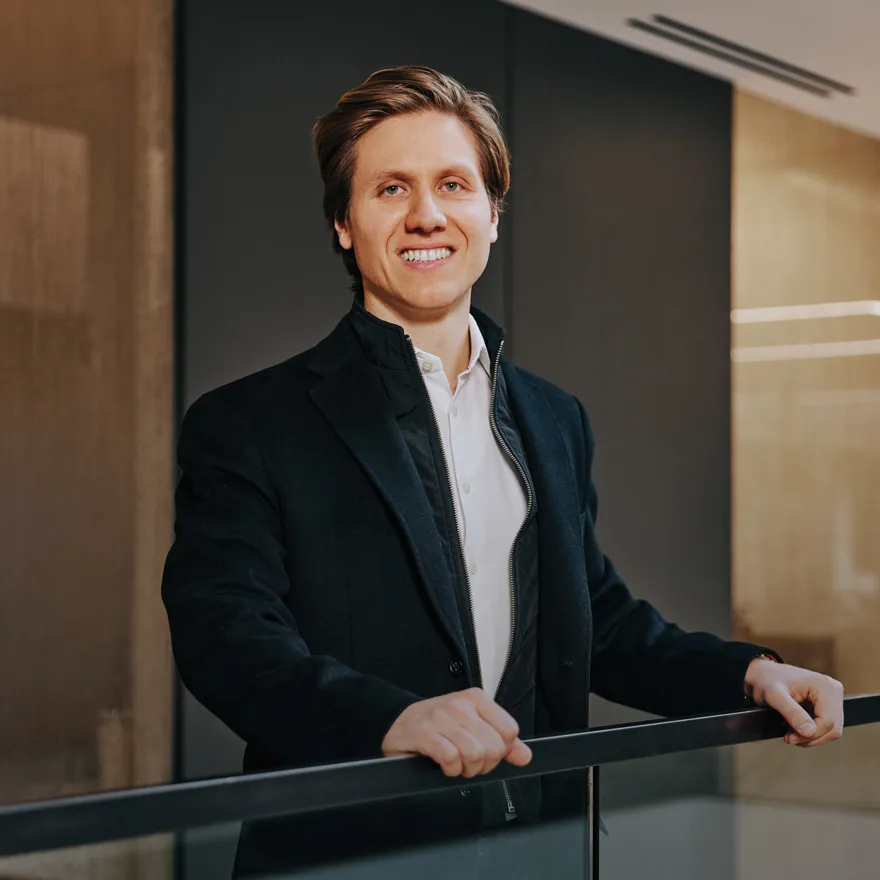
The Agent Economy Architect
Konstantine Buhler sees a future most people can't even imagine yet. Not because it's distant - because it's already arriving in fragments, scattered across seed-stage pitch decks and research labs. His job is connecting those fragments into a coherent vision: the agent economy, where autonomous AI systems don't just process information but make decisions, transfer resources, and build reputation systems of their own.
The math is staggering. Sequoia's internal research projects a multi-trillion-dollar addressable market - ten times larger than cloud computing. But Buhler isn't interested in hype cycles. "The best AI investments don't have 'AI' in their pitch deck title," he says. They have outcomes. Faster underwriting. Better security. AI as engine, not product.
This isn't abstract theorizing. Buhler holds board seats at four companies building the infrastructure: CaptivateIQ (revenue operations), EDX (financial services), Ethos Life (insurance tech), Kumo (relational AI). In 2024, he led Sequoia's seed investment in XBOW, an AI-powered offensive security company founded by the creator of GitHub Copilot. Pattern recognition matters here - the person who built the AI that writes code is now building AI that finds vulnerabilities.
From Deterministic to Stochastic
Buhler's background explains his unusual vantage point. He's an AI engineer who can actually read the research papers, a Stanford CS grad with a concentration in artificial intelligence. But he also minored in Byzantine art history and studied art theory at Oxford. The combination matters. "A lot of us fell in love with computer science because it was so deterministic," he notes. "Now we're entering an era of computing that's going to be stochastic."
That mental shift - from certainty to probability, from control to managed uncertainty - separates the investors who get AI from those still waiting for it to behave like software. Traditional venture capital looks for predictable scaling. The agent economy requires comfort with emergence, with systems that learn and adapt in ways their creators can't fully specify in advance.
Virtuous Data Cycles
Buhler's investment thesis centers on what he calls "virtuous data cycles" - businesses that accumulate customers and data to become more valuable over time. The concept sounds simple until you examine its implications. Traditional software scales through distribution. AI-native companies scale through data accumulation and model improvement. Each customer makes the product better for the next customer. Network effects, but for intelligence.
This explains his portfolio composition: enterprise software, enterprise fintech, vertical AI applications. These aren't consumer apps chasing viral growth. They're infrastructure plays in sectors where data compounds and switching costs increase as models improve. Insurance underwriting gets faster with more policies processed. Security systems recognize threats better with more attacks analyzed. Revenue operations software understands business patterns through exposure to more revenue teams.
The Immigrant Calculus
Ask Buhler about his investment philosophy and he'll tell you about his grandfathers. One sold watermelon and yogurt as a kid in Greece. After Nazis burned his village during WWII, he worked a Chicago factory line, sent wages home, eventually saved enough for a diner. The other grew up on a Wisconsin dairy farm, fought in the Pacific, became a milkman, turned one gas station into a chain of ninety.
These aren't motivational anecdotes. They're the foundation of how Buhler thinks about risk, compound growth, and the relationship between labor and ownership. His grandparents understood something venture capital sometimes forgets: building value requires both immediate survival and long-term compounding. You need the factory wages to fund the diner. You need the milkman route to buy the first gas station.
2026: The Specialization Thesis
"2026 is going to be about the specialization of AI," Buhler recently told Bloomberg. "We will see it in specialized models and specialized use cases." The prediction reflects lessons from previous platform shifts. General-purpose technology enables specific applications. The internet created Amazon and Google. Cloud computing created Salesforce and Snowflake. General AI models will create specialized agents for underwriting, security, operations, compliance.
This is where Sequoia's seed and Series A focus becomes strategic. The companies building specialized agents need capital before the use cases are obvious to later-stage investors. By the time specialized AI looks like an obvious bet, the winners will already have accumulated the domain expertise and proprietary data that create defensibility.
Managing Uncertainty
Buhler joined Sequoia in December 2019, arriving from Meritech Capital Partners where he'd progressed from MBA associate to principal. The timing matters. He became a partner before the current AI boom, which means his conviction wasn't formed by ChatGPT demos or OpenAI headlines. He was building these views when AI still meant narrow applications and incremental improvements.
That early positioning shows in his portfolio construction. He didn't pivot to AI - he was already there. CaptivateIQ, EDX, Ethos, Kumo, XBOW. These aren't companies adding AI features. They're building products where AI enables fundamentally new capabilities. The difference is crucial. Feature addition creates temporary advantages. Foundational architecture creates markets.
His Stanford training provides technical depth, but the Arjay Miller Scholar distinction (top 10% at Stanford GSB) suggests something else: the ability to translate between technical and business contexts. You can read the research papers and model the unit economics. You can explain graph neural networks to founders and explain cap tables to engineers. Bridge building as competitive advantage.
The Training Data Podcast
Buhler hosts Sequoia's Training Data podcast, interviewing AI founders and researchers. The format reveals his operating style - technical fluency without technical intimidation. He'll discuss enterprise AI deployment and graph neural networks, but always in service of understanding business models and market timing. The podcast isn't academic. It's reconnaissance.
Listen to a few episodes and patterns emerge. Questions about customer acquisition cost in the context of model training costs. Discussions of when specialized models become more valuable than general ones. Explorations of trust and reliability in agent-to-agent transactions. These aren't theoretical exercises. They're due diligence questions packaged as podcast content.
The Long Game
Buhler's career trajectory follows the patient-capital playbook. Stanford undergrad in management science and engineering, winning the Terman Engineering Award. Master's in computer science with AI concentration. MBA at the business school. Three years climbing from associate to principal at Meritech before joining Sequoia. No shortcuts. No pivots. Just steady progression through complementary skill domains.
That path created unusual combinatorial value. He can evaluate AI research, model business economics, understand regulatory implications, and assess founding teams. Venture capital loves specialists who've been forced to become generalists. The engineer who learned finance. The operator who learned investing. Buhler built that versatility deliberately, not reactively.
The agent economy thesis crystallizes all these threads. It requires technical understanding of how AI systems actually work. Economic modeling of multi-agent interactions. Historical perspective on platform shifts and market timing. And comfort with uncertainty - the ability to make large bets when the path isn't yet clear but the direction is inevitable.
Buhler carries his grandfather's name every day. The Greek kid selling watermelon. The factory worker who became a diner owner. That legacy shapes more than motivation. It shapes risk assessment, time horizons, and the belief that ownership compounds across generations. The agent economy isn't just a market opportunity. It's a continuation of the same pattern: labor creates value, ownership captures it, time compounds both.