Alex Kronman found his company idea in a place entrepreneurs are routinely advised to flee: a struggling newspaper. At Colorado College, he spent three years as editor-in-chief of The Catalyst. The work gave him a close view of a peculiar little economy. Students paid attention to campus journalism. Publishers needed money. National advertisers wanted young customers. Yet connecting one side to the other could require a thicket of calls, media kits, invoices, and local negotiations. The audience was present. The plumbing was missing.
After graduating in 2012 with a political science major and journalism minor, Kronman stepped across the table. At Crispin Porter + Bogusky in Boulder, he worked as a media planner and helped brands, including Domino's, think about reaching young consumers. The agency world confirmed what the newsroom had suggested. Marketers liked the college demographic, but campus media was scattered across independent papers, radio stations, posters, and local operators. A campaign spanning dozens of schools could become an administrative scavenger hunt.
The valuable part of Kronman's education was the overlap. He did not merely know publishers, and he did not merely understand buyers. He had felt the same market failure from both chairs. Shortly after college he and classmate Ben Quam started College Press Club, an online platform connecting advertisers with student newspapers. The venture would evolve, change partners, enter accelerators, and take the name flytedesk. Its premise remained agreeably stubborn: make a thousand small media relationships behave like one coherent network.
The unglamorous bridge
In 2014, the young company joined BoomTown's first accelerator class. Six companies were chosen from 170 applicants, and each received $20,000 plus the sort of practical help a first-time founder rapidly learns to value: fundraising, product, user experience, and a room full of people willing to notice the hole in the plan. Kronman described startup life at the time as a roller coaster containing both awesome and painful moments. The metaphor was conventional. The market was not.
College media looked small because its supply was distributed. Each outlet sold a finite patch of attention. In aggregate, the system held millions of students and a rich variety of formats. The business opportunity was to standardize the transaction without flattening the local institutions. Flytedesk would supply the tools, aggregate national demand, manage campaigns, process payments, and verify placements. Student publishers could remain student publishers.
one campaign brief
buy, schedule, verify
local outlets and students
The design also aligned a social aim with a commercial one. National ad spending could become revenue for organizations teaching young reporters how to cover a meeting, question an institution, sell an ad, and put an issue to bed. Kronman has repeatedly described student journalists as the company's true north. His stated ambition was broad: if media lived on a college campus, he wanted it owned there and connected to the wider market through flytedesk.
A flight, a desk, and a wall of checks
The company's new name condensed its job into two bits of trade language. A media campaign runs in a flight. A trading desk buys inventory. A newsroom has a desk, too. Flytedesk sounded technical while keeping a faint smear of printer's ink on its fingers.
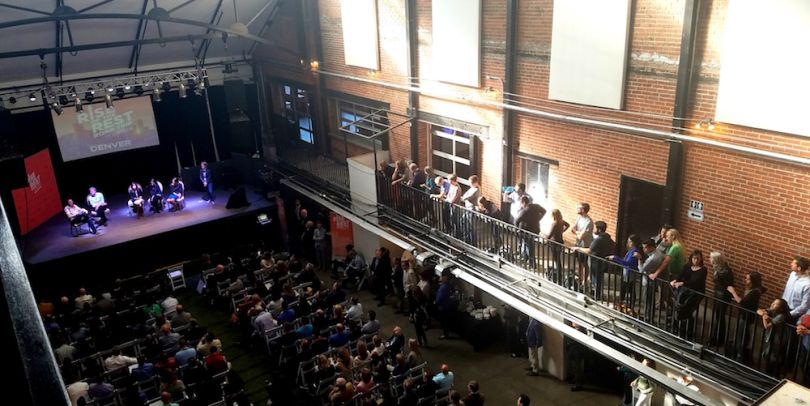
The company moved through Techstars Boulder and, in 2016, won the Colorado stop of Steve Case's Rise of the Rest pitch competition. The prize was a $100,000 investment and an enormous ceremonial check. Piper Jackson-Sevy, then flytedesk's vice president of growth and now identified by the company as a co-founder, joked that it would join a wall of checks from clients such as Trojan and Nintendo. For an enterprise built to modernize advertising operations, the persistence of checks and snail mail provided a tidy comic refrain. A startup may disrupt one thing at a time.
By 2018, flytedesk said it worked with 2,300 student media organizations. Its inventory had spread from print into digital editions, college radio, flyers, billboards, and other campus placements. Buyers could see inventory, send creative, pay, and receive verification after publication. An early local-buying product called Ad Shop let a business purchase media on one campus through an interactive media kit. It was built with the Daily Tar Heel and piloted with publishers including the Daily Emerald and the State Press.
Kronman understood the sales problem as a question of legibility. A hundred campus outlets could be valuable and still remain invisible to a buyer who had time for one transaction. Chuck Porter, the CP+B co-founder who became an investor, put it plainly: a marketer seeking colleges across a region once had to speak with a hundred people; Kronman made it one. Porter also remembered Kronman for his high-fashion glasses, a detail that makes the founder sound like the rare adtech operator who could debug a media plan and improve its eyewear.
Autonomy with a pulse
Kronman's management language had a similar affection for independence. His hiring rule was, “do you, just do it good,” followed by the cheerful caveat that he believed it was an Afroman lyric. The line sounds loose until he explains it. He wanted characters who could create the script, carve out a role, and take ownership. One designer grew into product work. An intern learned how to earn the trust of college publishers and expanded her remit. Freedom came paired with an expectation of commitment.
He tried to keep that freedom connected. Managers held weekly one-on-ones, while Kronman held monthly conversations with everyone in the small company. It is a useful operating pattern: independence at the edge, regular contact at the center. The company office made the philosophy visible. An early profile found champagne bottles labeled with future and completed milestones. Each newly reached mark earned the team some bubbly. The place also contained college newspapers, business sketches, leftover investment-firm furniture, and a few newer unicorns. Serious infrastructure can live among silly objects without suffering.
The harder strategic choice was building rather than borrowing. Kronman said flytedesk developed its buy-side, publisher-side, and data tools itself because suitable partners did not exist. That created more work and more control. The firm could manage the relationships, transactions, and verification without waiting for a dominant platform to adjust an algorithm. In a market defined by fragmentation, owning the connective tissue became the durable asset.
The campus after the feed
The advertising argument aged in an interesting direction. Students became more digitally saturated, while ad blocking and rapid video skipping made online attention less dependable. In 2025, when the operation was publicly presented under the College Inc. name, Kronman argued that physical campus presence could produce a 40 percent conversion lift when brands shifted a third of a college-targeted budget into physical media. He favored consistency over a brief burst of omnipresence that “evaporat[es] into the wind.”
That view does not reject digital media. It treats campus as a context capable of joining physical and digital channels. A poster can lead to an event. An event can produce social content. A student newsletter can reinforce an outdoor placement. A creator can make the campaign native to a particular school. The current flytedesk description covers software colleges use to manage media and a system brands use to reach students nationwide. Its listed channels now span out-of-home placements, newsletters, transit, creators, newspapers, screens, and posters.
Graduates from Colorado College, works in agency media buying, and starts the venture that becomes flytedesk.
College Press Club enters BoomTown's inaugural accelerator cohort.
flytedesk joins Techstars Boulder.
The company wins Colorado's $100,000 Rise of the Rest competition.
Kronman continues making the case for measurable, multichannel campus media at national scale.
The founder's original insight survives all those formats. College is a recurring population, a concentrated place, and a period when people form habits. It is also an ecosystem of locally run institutions whose small scale makes them easy to underestimate. Kronman's career has been an extended act of aggregation, turning those small surfaces into a national canvas while arguing that the value should flow back to the people maintaining them.
There is a broader lesson in the path from The Catalyst to flytedesk. A market can be large in total and still feel tiny at every point of contact. It can have eager buyers and willing sellers while failing to function because nobody has built the boring middle. Founders like to talk about finding white space. Kronman found paperwork, phone calls, and a stack of student newspapers. It was enough.