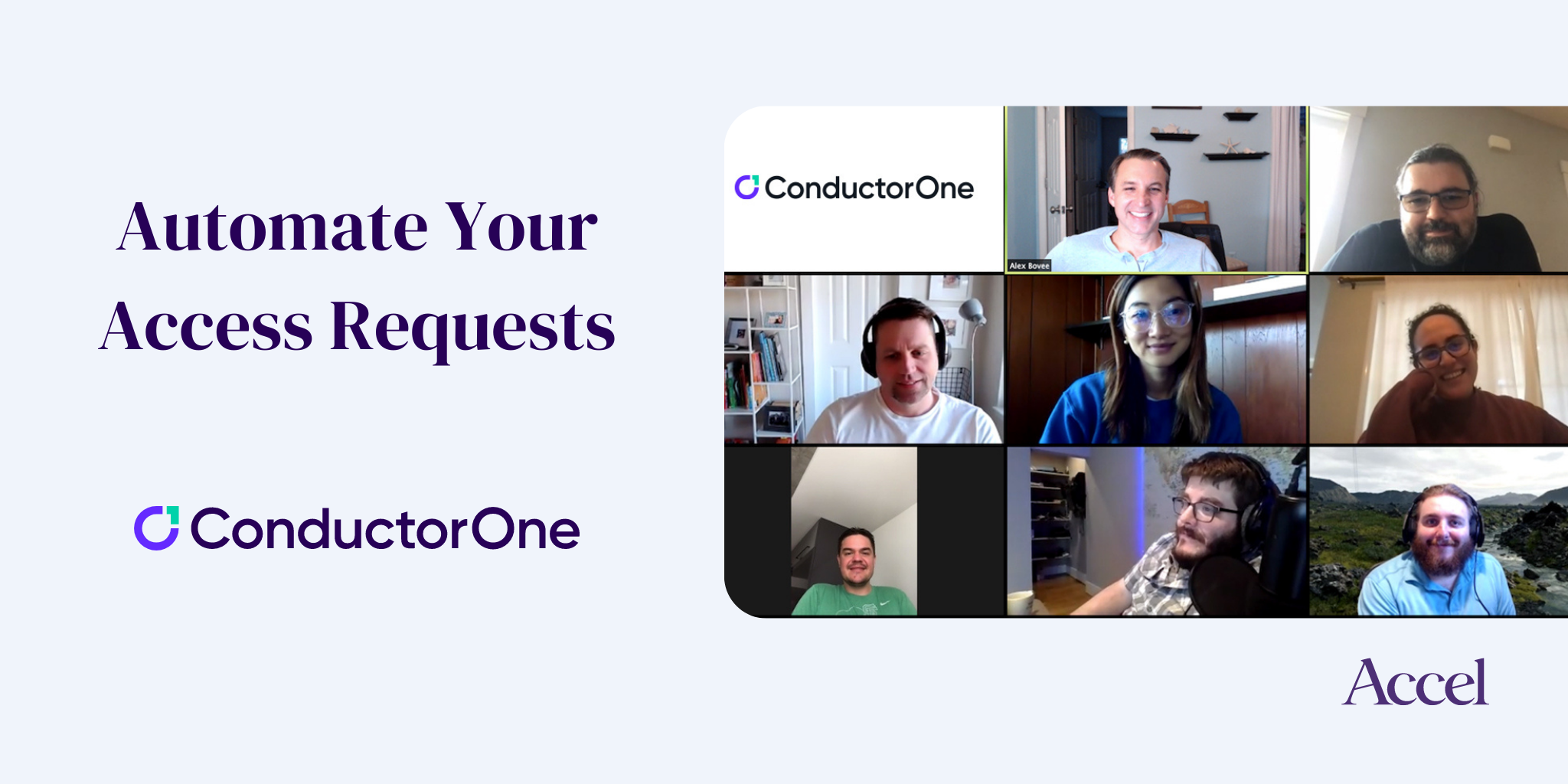
Alex Bovee took an identity-security conversation to a railway museum and added hot wings. In 2024, he and David Lee, known in the industry as the Identity Jedi, recorded an episode of All Aboard at Portland’s Oregon Rail Heritage Center. The format borrowed from Hot Ones: increasingly fiery food, increasingly candid conversation. Enterprise access governance had acquired a condiment budget.
The setting was a cheerful departure from the usual software discussion. The subject was familiar territory for Bovee: why getting people into the right systems remains so difficult, and why the tools meant to help can become another piece of work. Behind the sauces sat a question he had already spent years pursuing. How do you make security useful to the person trying to get something done?
That question led him from product roles at Lookout and Okta to founding ConductorOne with Paul Querna in 2020. The company is now C1. On October 13, 2026, it announced an agreement to be acquired by Workday. Between those two dates, the population needing permissions expanded beyond employees. Software agents wanted keys, too.

The colleague before the company
Bovee’s route into founding ran through other people’s security products. At Lookout, he worked on enterprise device security. At Okta, his responsibilities included authentication, security, privileged access management, and the company’s Zero Trust product strategy. His education combined an engineering bachelor’s degree from Cornell with an MBA from the University of Chicago Booth School of Business.
Those jobs placed him near a stubborn operational problem. Companies were adopting cloud applications and infrastructure, while the business of assigning and reviewing access remained cumbersome. Getting a tool into the company did not settle who should be allowed to use which parts of it. Every additional system brought another set of permissions to understand.
He also met Querna. Okta had acquired ScaleFT, the access-management company Querna co-founded, in 2018. Their overlap became consequential. When Bovee joined Accel as an entrepreneur in residence in August 2020, the details of his future company were still unsettled. His preferred co-founder was already clear.
There is something revealing about that order. Before the product had its finished shape, Bovee had chosen the person with whom he wanted to work it out. Querna brought experience building identity infrastructure and starting a company. Bovee brought years of product decisions in security. They had encountered the territory from adjacent directions.
The residency itself had a small historical distinction: Bovee was Accel’s first virtual EIR. By late 2020, the partnership had become ConductorOne. In April 2021, the company announced a $5 million seed round led by Accel. Its early public description was practical: help IT teams automate employee access requests for cloud applications and infrastructure.
A permission with an expiry date
Access management has an unusually efficient way of making itself noticed. A person needs to do a job, opens an application, and discovers that someone else must first approve their existence. At the other end of the process, an old permission can remain long after the task has ended. Waiting and excess accumulate in the same organization.
Bovee’s opportunity sat inside that awkward combination. ConductorOne set out to automate access and make it easier to govern. The aim connected two constituencies that often experience the same process differently: employees who need to move, and security teams responsible for where they can go.
Consider a simple illustration. A worker needs a sensitive system for one assignment. A useful access process establishes the need, applies the appropriate approval, grants the permission, and removes it when the work ends. Making the first step pleasant while forgetting the last would leave half the job unfinished.
- 01RequestA job needs access
- 02CheckPolicy and approval
- 03GrantOnly what is needed
- 04ExpirePermission ends
Illustrative workflow. The permission should have a life shorter than the filing cabinet.
For a product leader, this is a demanding brief. The employee’s experience matters, but so do the controls and records behind it. Bovee’s company biography gives an unusually plain account of what interests him: effortless product experiences and making customers smile. In this business, a smile might mean simply getting back to work.
The service survives the code
Bovee has another job that makes him a regular listener. He hosts All Aboard, talking with people who build and operate security products. His guests have included 1Password CEO Jeff Shiner, Tailscale co-founder Avery Pennarun, and Snyk founder Guy Podjarny. The conversations range from passwords to company building and the everyday relationship between security and productivity.
Hosting puts the founder among other people wrestling with similar trade-offs. A product must control something complicated while remaining usable by someone who has other concerns. The hot wings episode was one entertaining variation on that continuing discussion.
His own writing shows where he draws a line in the debate about AI-generated software. In April 2025, he argued that generating code does not dispose of the work of maintaining, securing, supporting, and improving a service. Customers still need a product they can operate and a company that understands their problems.
He also recalled being advised to concentrate on a single product area when starting the company. He preferred a broader platform approach, connecting related capabilities around a shared domain. He wrote that they had “stuck with our intuition.”
“stuck with our intuition”
Alex Bovee, on early advice to focus on one product area · 2025
That is a founder’s judgment rather than a universal recipe. A larger product ambition brings more work with it. Bovee’s argument was that the connected knowledge and service around the software would matter as code became easier to produce. The value would depend on understanding a customer’s world well enough to make the pieces work together.
The workforce acquires a new kind of colleague
By October 2025, the company had announced a $79 million Series B led by Greycroft, with participation from CrowdStrike’s Falcon Fund and existing investors including Accel and Felicis. Its stated remit included human identities, non-human identities, and AI. The employee-access problem was becoming part of a broader argument about who, or what, could act inside a company.
- 2020
- Bovee and Querna found ConductorOne
- $79m
- Series B announced in October 2025
- 2026
- C1 signs an acquisition agreement with Workday
In February 2026, Bovee described a workplace in which people oversee fleets of agents. He used an air traffic controller analogy: a person establishes goals and constraints, watches outcomes, and intervenes when needed. His emphasis was on governing execution. A system that can perform more work also needs a credible way to limit its actions.
In April, ConductorOne became C1.ai. Bovee presented the change as recognition that the company’s scope had grown. The platform would govern people and agents, with policies and authorization operating as work happened. The name shortened as the job description lengthened.
His August writing sharpened the proposal further. Permission should be evaluated at the moment of an action, with attention to the resource and task involved. An agent retrieving one customer record and an agent exporting an entire collection may be using similar access while doing very different things. His proposed controls included scoped, short-lived credentials and the ability to constrain work during a session.
There was a commercial consequence, too. In June, Bovee explained why C1 offered both Platform pricing for a defined scope and Flex pricing tied to measured work. A human seat and an agent’s activity do not describe the same unit of use. The changes reached beyond the product diagram into the invoice.
The next door opens at Workday
The October 13 Workday agreement gave the original access question another setting. Workday records events such as someone joining a company, changing jobs, or leaving. C1 governs access across the systems where the work happens. The proposed combination brings the workforce record closer to the permissions that follow from it.
Workday said it expected the transaction to close in its fiscal fourth quarter ending January 31, 2027, subject to customary closing conditions. As of this profile’s publication, the milestone was a signed agreement. The promised integration lay ahead.
Bovee framed the move in terms of reach: “Joining Workday will get our mission to far more organizations, far faster.” It was a continuation of the 2020 bet, now attached to a company whose software already sits near the beginning and end of an employee’s working life.
Backup vocals
Outside work, his public biography supplies a different arrangement of responsibilities. Bovee plays guitar and sings backup in his family band. In a 2023 conversation, he described teaching himself guitar with YouTube and receiving a Taylor acoustic from his family. He also spoke about taking his children to soccer and dance activities.
These are modest details, and useful ones. The CEO role is only one part of the calendar. At home, he can supply the accompaniment. At work, he has spent years trying to make an essential piece of enterprise software less laborious for the people using it.
The museum conversation, the guitar, and the product career belong to the same person without requiring a grand theory to connect them. Bovee’s business began with a familiar frustration: people need permission to do their jobs. Six years later, the cast includes agents and a proposed Workday combination. The question still earns its place on the page: what should be allowed to happen next?