Airplanes have a stubborn relationship with visual habit. For more than half a century, the commercial fleet has settled into a familiar grammar: a long tube, two wings, a tail, and a row of windows that reassures everyone before the safety card appears. Aleksey Matyushev has spent enough time with aerodynamics to see that shape less as an icon than as a compromise.
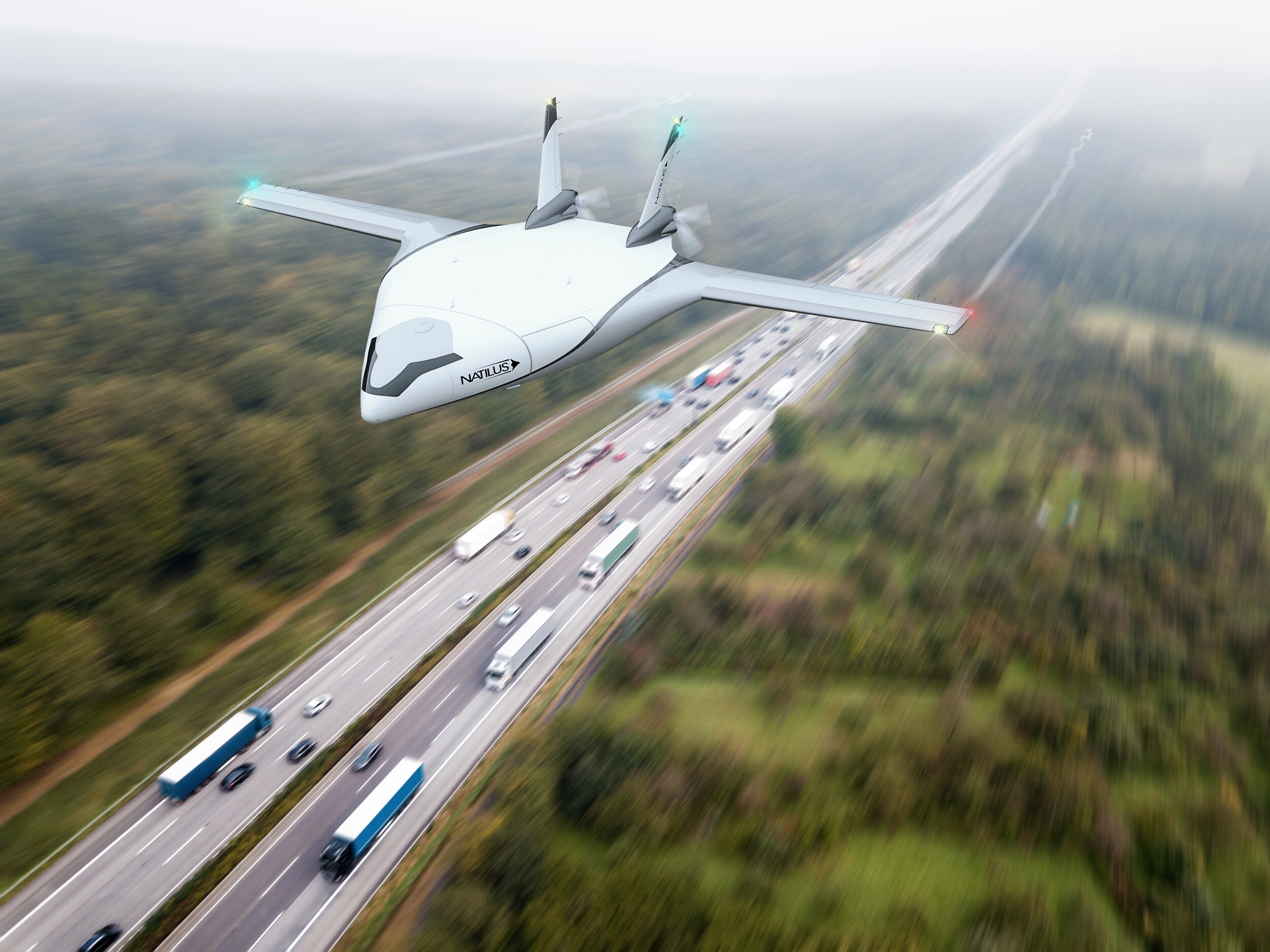
His company, Natilus, is developing aircraft in which fuselage and wing blend into a single lifting form. The KONA regional freighter comes first. HORIZON, a larger passenger aircraft, is meant to follow. Their silhouettes look unfamiliar, but Matyushev’s pitch is unusually practical. A lifting body can create more useful internal volume while burning less fuel. For cargo operators, more boxes per flight and lower operating expense are not aesthetic claims. They are arithmetic.
The interesting part is not merely that an aerospace founder wants to redraw an airplane. Aerospace founders are professionally required to own ambitious drawings. Matyushev’s story is about the order in which he intends to turn a drawing into an institution: freight before passengers, existing engines around a new airframe, test data before bravado, and a factory plan before the prototype is ready for applause.
A shipping complaint grows wings
Natilus began with a frustration far below cruising altitude. Before the aircraft company, Matyushev and his collaborators ran an industrial design business. Its first product found quick success on Kickstarter. Design happened in the United States, manufacturing in Asia, and then came the unglamorous question that can ruin a perfectly good product: how does the thing get here?
Sea freight was affordable and slow. Air freight was fast and painfully expensive. Clients encountered the same choice. One evening, over drinks, the recurring complaint turned into a company idea. Could a large cargo aircraft land between those two economics?
The original Natilus concept was a large autonomous seaplane. A prototype reached low-speed taxi tests in early 2018, revealed problems, and went back for modification. This is a useful detail because it removes the varnish from the founder mythology. The early machine did not glide out of a napkin sketch. It taxied, complained, and demanded another round of work.
“I want there to be change in the industry - and that’s what gets me up every morning.”Aleksey Matyushev
The apprenticeship of an aerodynamicist
Matyushev studied aerospace engineering at Embry-Riddle Aeronautical University. He then worked on unmanned aircraft systems at Composite Engineering, part of Kratos Defense, and moved into aerodynamic work at Piper Aircraft. His experience there included the PiperJet Altaire and the M600, as well as consulting in applied aerodynamics and advanced design.
That path matters because Natilus is not a software metaphor wearing an aviation costume. Matyushev’s working vocabulary includes performance, stability and control, computational fluid dynamics, structural loads, flight testing and certification. The company’s public case for a blended wing rests on those disciplines, and on research that predates it.
He has credited NASA’s X-48 program with producing test data that helped Natilus move through early technical questions faster. Previous blended-wing experiments had already wrestled with stability and passenger comfort. Natilus could study the record instead of beginning with an empty notebook. Three wind-tunnel campaigns followed. Matyushev described the second and third as “phenomenal,” saying the design showed stability in each axis without requiring a costly, complex fly-by-wire solution.
His patent history offers an odd little bookend to that career. Long before the KONA program, Matyushev was named on an invention for a distributed electronic phonebook. In 2025, he and Natilus co-founder Anatoly Starikov received a U.S. patent for a cargo-bay layout tailored to a blended-wing-body aircraft. The distance between those two inventions is amusing, but the common thread is systems thinking: information or freight has to be arranged so the whole network works better. In KONA, the cabin is not leftover space inside an aerodynamic shell. Cargo volume is one of the reasons for choosing the shell in the first place. The plane begins with what it needs to carry, then asks the airframe to make room without paying the usual penalty in drag.
Flight path / from equations to an OEM
Unmanned-aircraft systems engineering at Kratos Defense.
Lead aerodynamics and advanced design work at Piper Aircraft.
Natilus is founded around a stubborn freight-cost gap.
A subscale blended-wing prototype completes flight testing.
A $28 million Series A funds the next manufacturing phase.
Freight is the proving ground
The current KONA is an optionally piloted regional freighter designed for a payload of about 3.8 tonnes and a range near 1,000 miles. Natilus says its blended-wing family can use 30 percent less fuel and provide 40 percent more cargo volume than comparable conventional aircraft, with carbon emissions and operating costs reduced by as much as half. Those are company targets, not a verdict already rendered by airline service. The hard part is turning them into repeatable operating data.
Cargo is a shrewd opening customer for an unfamiliar shape. Parcels do not require windows, aisle preferences or an explanation of why the cabin wall curves differently. A freighter can accumulate the evidence a future passenger aircraft needs: certified structures, predictable maintenance, reliable dispatch, trained crews and suppliers who know how to produce the parts twice.
Matyushev has been direct about that sequence. A startup asking passengers and airlines to trust a new configuration faces a higher bar. KONA can normalize the shape and its supply chain first. HORIZON can then inherit more than design features; it can inherit credibility.
One new thing at a time
There is restraint inside the radical silhouette. Natilus is not trying to invent a new engine, a new avionics stack and a new airframe simultaneously. Matyushev describes the approach plainly: existing engine technology, new airframe, freight first, passenger jet later. Flight-proven components narrow the field of uncertainty.
This is the company’s most portable lesson. Every hard-tech startup has an innovation budget. Spend it across every subsystem and the risks begin to multiply each other. Spend it on the feature that creates the customer advantage, then make the surrounding choices as legible as possible.
The novelty budget
Concentrate the experiment. Familiarize the edges.
Airport compatibility is part of the same discipline. A beautiful aircraft that requires every gate to be rebuilt is an expensive piece of sculpture. KONA and HORIZON are being designed to work with existing infrastructure. HORIZON’s passenger plan has evolved from a single deck to two decks after feedback from regulators and airline customers. Even the future must fit through today’s doors.
Building the company that builds the plane
In February 2026, Natilus announced a $28 million Series A led by Draper Associates, with participation from Type One Ventures, The Veterans Fund, Flexport and several other investors. The company said it had more than 570 aircraft orders worth roughly $24 billion. The capital is intended to advance a full-scale KONA prototype, certification work and manufacturing plans.
The factory appears early in Matyushev’s thinking. Natilus began selecting a site for a 250,000-square-foot KONA plant before the full-scale prototype flew, because getting such a facility ready is itself a multi-year project. The stated goal is capacity for up to 60 aircraft a year and more than 300 jobs. HORIZON would eventually require a much larger operation.
“We are not just building the product, we are building the company.”Aleksey Matyushev
That sentence contains the institutional weight of aviation. A prototype can demonstrate that equations and composites agree. An aircraft manufacturer must demonstrate that thousands of people, parts, documents and inspections agree, repeatedly, for years.
KONA’s FAA project number, announced in 2026, formally opened its Part 23 certification program. The milestone is bureaucratic in the best sense. It converts a broad intention to certify into a defined relationship with the regulator. Structural load tests on the vertical tail, instrumented with strain gauges and compared with analytical predictions, show the daily grammar beneath the sweeping renderings: load, measure, release, compare, repeat.
The shape after the slogan
Matyushev’s public manner is more engineer than oracle. He talks about supplier leverage, speed to market, balanced founding teams and the danger of waiting for perfection. His family’s early entrepreneurial hustle in Ukraine shaped that outlook. So did earlier startup work, where physical products, Asian manufacturing and impatient customers offered a blunt education in the difference between an invention and a delivery.
The aspiration now is larger: create a modern American aircraft manufacturer, put KONA into service, and carry its manufacturing knowledge into a passenger aircraft for the early 2030s. Matyushev argues that the industry’s slow pace is not a natural law. Yet he has chosen a field where optimism gets audited by physics, regulators and buyers with long memories.
That tension gives Natilus its character. The silhouette says revolution. The program says sequence. Start with the boxes. Reuse what already works. Let data make the unfamiliar ordinary. Build the factory while building the machine. If the bet succeeds, the most surprising thing about a blended-wing airliner may eventually be how quickly its once-strange outline begins to look inevitable.