$11B+ in signed letters of intent$26M Series A closed Oct 2025Laila full-scale flight testing underway14 US Department of Defense contractsOman AAM program launching Q1 2026One platform, two aircraft, infinite missions$11B+ in signed letters of intent$26M Series A closed Oct 2025Laila full-scale flight testing underway14 US Department of Defense contractsOman AAM program launching Q1 2026One platform, two aircraft, infinite missions
Deep-Tech Aerospace / Long Beach, CA
Odys Aviation flies without the airport.
A hybrid-electric VTOL company building aircraft that take off straight up, then cruise like a plane. The promise: vertical lift without the short-range penalty.
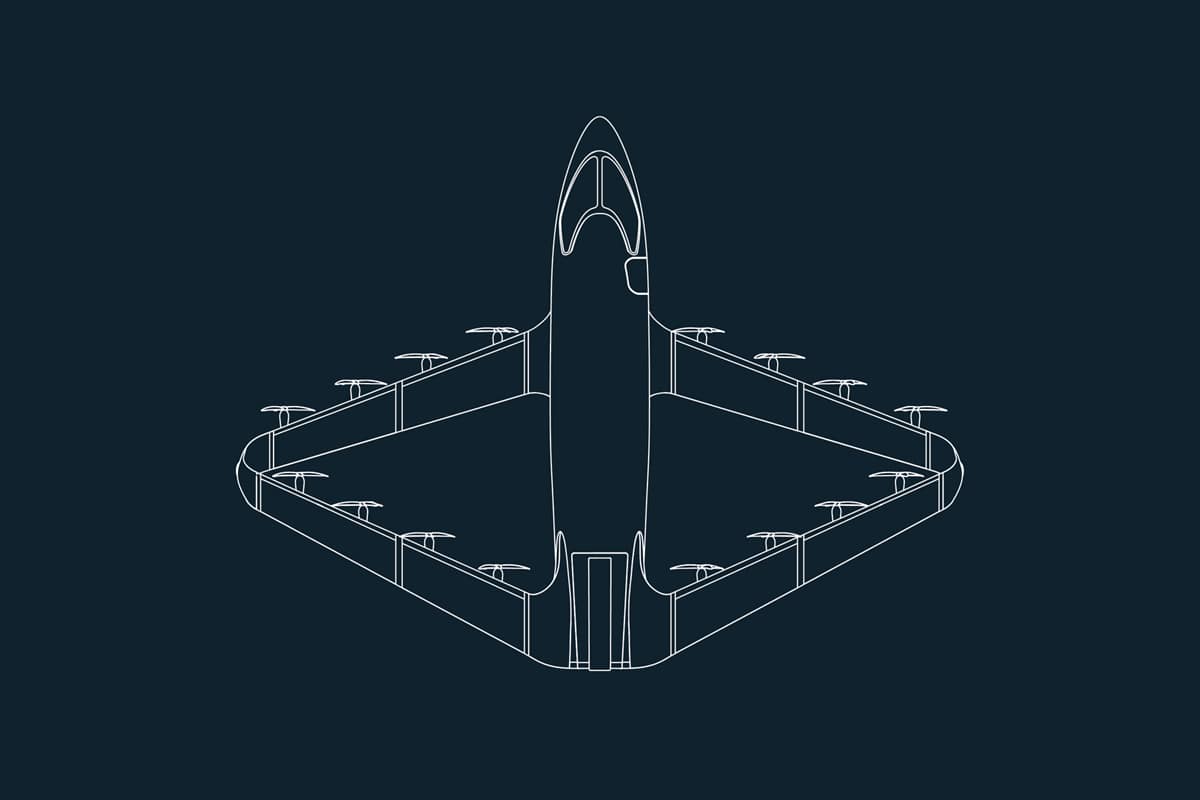
ODYS AVIATION. Wings that blow their own air to lift off vertically, then fold back for the long haul. The part where physics usually says "pick one" - they declined to pick.
// The State of Play, 2026
A demonstrator is hovering somewhere over Southern California right now.
It lifts off with no runway, tilts forward, and settles into level flight. Then it does the genuinely hard thing - the transition between hover and cruise that has grounded more eVTOL programs than any spreadsheet ever will. Odys Aviation calls this aircraft Laila, and the company has spent years proving it can survive that handoff.
Odys is a roughly 49-person deep-tech aerospace company in Long Beach, California. It does not build a flying taxi for your commute downtown. It builds long-range, hybrid-electric VTOL aircraft for the routes the airlines quietly abandoned - regional cargo, defense logistics, the 200-mile hops that are too far to drive and too short to justify a jet and a terminal.
"This funding marks a critical inflection point for Odys. We've already proven the technology and performance."
Vertical flight is easy. Vertical flight that also goes far is the trap.
Here is the inconvenient arithmetic of electric aviation. Lifting straight up burns enormous energy. Batteries are heavy and store little. So most eVTOL aircraft can hover beautifully and then fly about as far as a generous bike ride. The industry's open secret is that the demos are gorgeous and the range is disappointing.
Odys looked at that wall and refused to accept the usual trade. Their answer is a blown-wing design: air is blown over a high-lift flap system to generate enough lift for vertical takeoff, then the wing folds back to cruise efficiently like a normal airplane. Pair that with a hybrid-electric powertrain - electric where it helps, a turbine generator where range demands it - and the math changes.
"What sets Odys apart is our ability to execute beyond a single aircraft or flight."
- Andy Apple, VP of Strategy
// The Founders' Bet
A plasma researcher, a hyperloop, and a roster of people who have done this before.
CEO James Dorris spent 15 years in advanced transportation - GoogleX, Hyperloop One, Arrivo - with a background in MIT plasma research. Co-founder Axel Radermacher rounds out a founding story that started life under a different name, Craft Aerospace, before becoming Odys. The bet was simple to state and brutal to execute: hybrid-electric, not battery-only, is the path to VTOL that actually travels.
They stacked the bench accordingly. The chief engineer, Uwe Kiesewetter, previously led a VTOL program at Airbus. Operations leadership carries 30 years across Sikorsky, Bell and Archer. Certification expertise comes straight from Airbus civilian and military programs. The pedigree reads like the credits of every serious aircraft you have ever boarded - which, for a company asking regulators to certify something new, is rather the point.
"Connect people and goods in ways that truly solve real-world challenges and open new possibilities for the future of flight."
- Odys Aviation, company mission
// The Flight Log
How a YC startup became an $11B order book.
AUG 2021
Out of Y Combinator with $12.4M
Completes Y Combinator and raises a $12.4M seed from a wide group of early backers including Soma Capital and Giant Ventures.
SEP 2022
$9B in letters of intent
Pre-orders and LOIs pile up before a full-scale aircraft has flown - a vote of confidence in the blown-wing approach.
NOV 2023
Laila unveiled
The company reveals Laila, a hybrid-electric VTOL cargo drone, as the prelude to its larger regional aircraft.
DEC 2024
Transition flight, validated
Full transition flight - vertical, transition and cruise - is achieved, and the Alta 1MW hybrid-electric generator is tested.
OCT 2025
$26M Series A
Nova Threshold leads a $26M round, with Tuchen Ventures and insiders, to fund full-scale flight testing and global launch.
Q1 2026
Oman & first international operations
A landmark Oman agreement launches one of the world's most comprehensive Advanced Air Mobility programs.
// The Product
One platform. Two aircraft. The range nobody else is promising.
Odys runs a two-aircraft strategy off shared technology. The smaller one earns revenue and trust today; the larger one is the prize.
Aircraft 01 / Flying now
Laila
A tactical hybrid-electric VTOL cargo drone - and the full-scale flight-test demonstrator.
~450-mile range
130 lb payload
Multi-hour endurance
Billed as the most capable hybrid-electric cargo drone in its class
Aircraft 02 / The prize
Alta
A regional VTOL for cargo, defense and up to nine passengers.
Up to 1,200-mile range
3,500 lb cargo capacity
Powered by the Alta 1MW generator
Lands anywhere - vertiport, field, ship deck
The range argument, in one chart
APPROXIMATE STATED RANGE BY AIRCRAFT TYPE (MILES)
Typical eVTOL
~100
Odys Laila
~450
Odys target
~750
Odys Alta
~1,200
Figures are approximate company-stated ranges and typical industry references; bars are scaled for comparison, not to a precise axis. The point of the picture: hybrid-electric buys distance that battery-only VTOL gives away.
// The Proof
Order books are easy. Contracts and flight data are not.
Skeptics are right to discount letters of intent - they are promises, not purchase orders. So look past the headline $11B+ in LOIs to the parts that are harder to fake. Odys has 14 awarded contracts across three U.S. Department of Defense branches, worth over $11 million. It has validated the transition flight that strands its competitors. And it has a national government partner in Oman ready to stand up an Advanced Air Mobility ecosystem in 2026.
That mix - defense revenue today, a giant commercial order book for tomorrow, and a real demonstrator in between - is what a $26M Series A led by Nova Threshold is buying. Less a moonshot, more a company methodically retiring risk.
"Odys is positioned to meet strong customer demand for longer-range, high-efficiency aircraft."
- Justin Hamilton, Managing Director, Nova Threshold
// Why It Matters Tomorrow
The map is full of places planes can't reach. Odys is redrawing it.
Roughly half the world's population lives more than an hour from a commercial airport. Most cargo still crawls the last hundred miles by truck. Regional air travel is the slice of aviation that decarbonization keeps forgetting, because the aircraft to serve it cleanly did not exist. A long-range hybrid-electric VTOL that lands anywhere is a different kind of infrastructure - one that does not require pouring a single runway.
That is the bet underneath the order book: that the next era of flight is not bigger jets between bigger hubs, but small, efficient aircraft connecting the dots in between. Defense wants it. Logistics needs it. Passengers, eventually, will simply expect it.
Back to that demonstrator over Long Beach. It is not a concept render or a press-day flyby. It is the slow, expensive, unglamorous work of proving that an aircraft can take off straight up and still go the distance - and if Odys is right, the airport stops being the thing you build flight around.