Decisions at sea can't wait. So Valtec sends a drone up off the deck of a moving boat - and an AI that reads the water for fish, vessels and trouble.
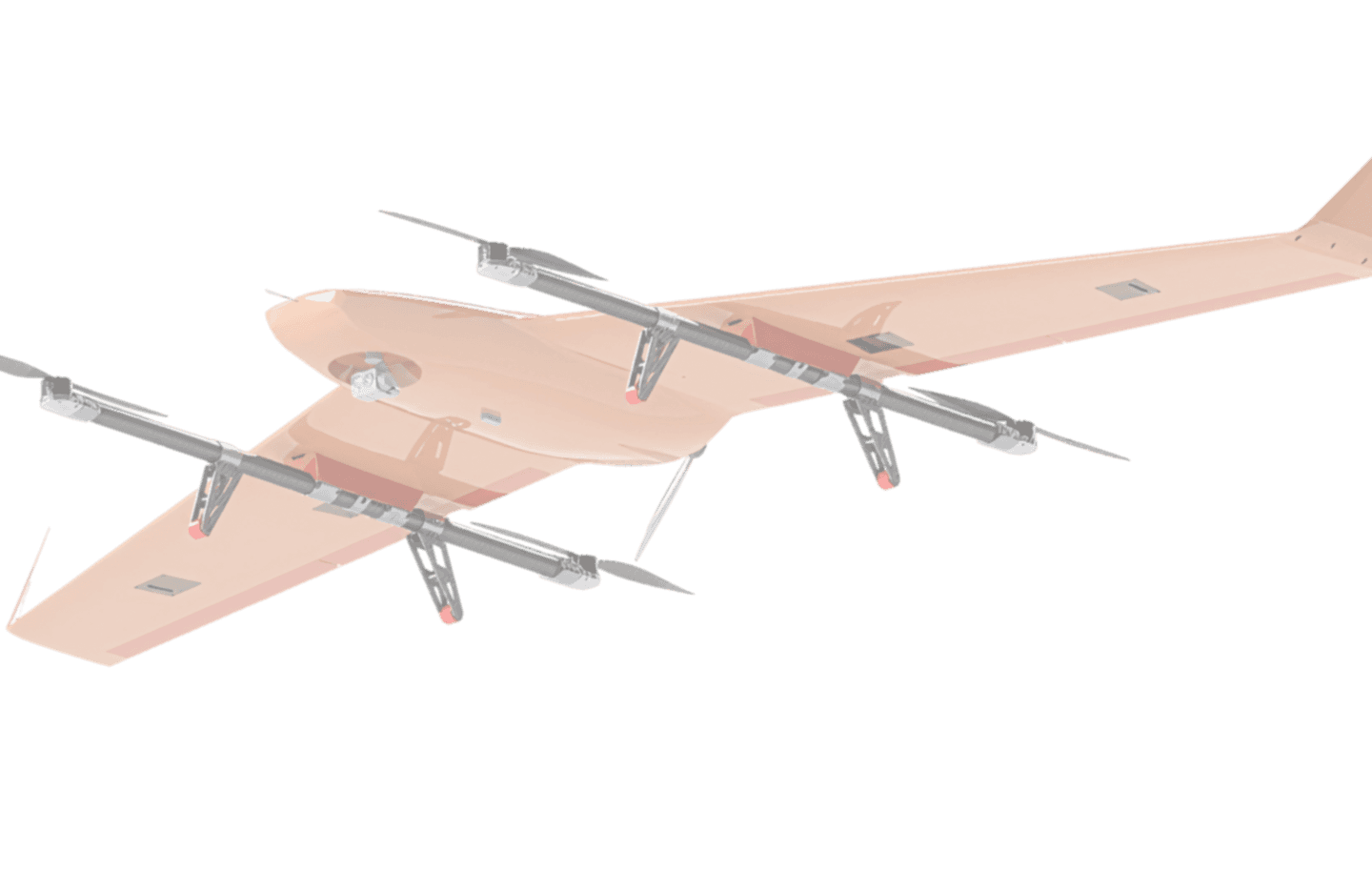
LARUS, ON APPROACH. A fixed-wing body with four lift rotors - the trick that lets it leap straight up from a pitching deck and then fly like a plane for two hours. Image: Valtec.
Picture a tuna vessel three hundred miles from anywhere. The crew has burned a week of fuel chasing a hunch about where the fish are. The radar sees the surface. The sonar sees straight down. Everything in between - the next ten kilometers of empty, expensive water - is a guess. This is the moment Valtec was built for.
At that moment a drone lifts off the deck. Not a quadcopter that wobbles to a hundred meters and comes home, but Larus - a fixed-wing aircraft that rises vertically on four rotors, tips forward, and then flies like a glider for two hours over an 80-kilometer arc of sea. Below it, Valtec's AI is doing the part humans can't: watching everything, all at once, and turning the churn of the ocean into a single useful sentence. The fish are that way.
It is a deceptively simple promise for a deceptively hard problem. The ocean is the largest data source on Earth and the least observed. Valtec's bet is that the gap between those two facts is a business.
Maritime Intelligence, from the Sky.
Valtec splits its work cleanly. There's the thing that flies, and there's the intelligence that makes the flight worth taking. Neither is much use without the other.
A VTOL fixed-wing hybrid drone engineered for autonomous maritime work. It launches and lands vertically from a moving vessel - no shore station, no infrastructure - then cruises with fixed-wing efficiency. Modular, AI-enabled payloads swap in for fishery intelligence, environmental monitoring or maritime security. (The name is the genus for gulls. Subtle.)
The brain. An integrated stack of AI-powered vision, modular hardware and scalable software that handles real-time detection, monitoring and decision support. It fuses bird radar, sonar, satellite data and live drone footage into one read of the water - and is built to grow into command-and-control for whole fleets of aircraft.
John Keh has an unusually literal qualification for this job: he flew drones for the US Air Force. Then he took a hard turn into startups - he helped grow Caviar, the food-delivery service, and led business intelligence teams at Uber Eats across the US and Canada. Call it a career spent moving things people want from where they are to where they aren't, and measuring it obsessively along the way.
Valtec is where the two threads meet. The military taught him what unmanned aircraft can do. The startup years taught him that data is only valuable when someone acts on it before lunch. Maritime fishing - slow to digitize, brutal on margins, played out across waters no one can see - turned out to be the perfect place to put both lessons to work.
Decisions at sea can't wait.
Valtec's first customers are commercial fishing fleets, and the pitch is refreshingly unromantic: cut a month at sea down to roughly two weeks, burn less fuel finding fish, and stop guessing. The company has partnered with a Taiwanese fishery group and a Philippine fishing corporation, and plans to push into Japan and South Korea. In 2025 it opened an office in Kaohsiung to sit close to the boats.
But the same drone that finds a school of tuna can find a vessel that shouldn't be there. Valtec's roadmap reaches into illegal-fishing detection, exclusive-economic-zone enforcement, environmental monitoring, remote-island watch and coastal defense. One airframe, many payloads. The fishing business pays the bills while the harder, higher-stakes markets come into focus.
Valtec raised $2M with SparkLabs Taiwan leading the support, alongside Wavemaker VC and Japan's DRONE FUND. The cap table has a few names that don't usually share a page with tuna boats - and the company has signaled a larger seed round to follow.