Breaking
EL9 takes off in ~150 ft - roughly a soccer field 2,200 pre-orders, ~$9B backlog from 60+ operators $115M Series B closed April 2025, led by Prysm Capital FAA type-cert application filed December 2025 Bristow grabs first EL9 delivery slot, Jan 2026 Goldfinch lands at 25 knots, 75 dB at 300 ft Backers: Lockheed Martin, Safran, Honeywell, US Air Force, NASA EL9 takes off in ~150 ft - roughly a soccer field 2,200 pre-orders, ~$9B backlog from 60+ operators $115M Series B closed April 2025, led by Prysm Capital FAA type-cert application filed December 2025 Bristow grabs first EL9 delivery slot, Jan 2026 Goldfinch lands at 25 knots, 75 dB at 300 ft Backers: Lockheed Martin, Safran, Honeywell, US Air Force, NASA
Company Profile / Advanced Air Mobility

Electra.aero

The plane that fits in a parking lot, lands at a jog, and recharges itself in the sky.

~150 ftTakeoff distance
9Passengers
1,100 nmRange
75 dBat 300 ft
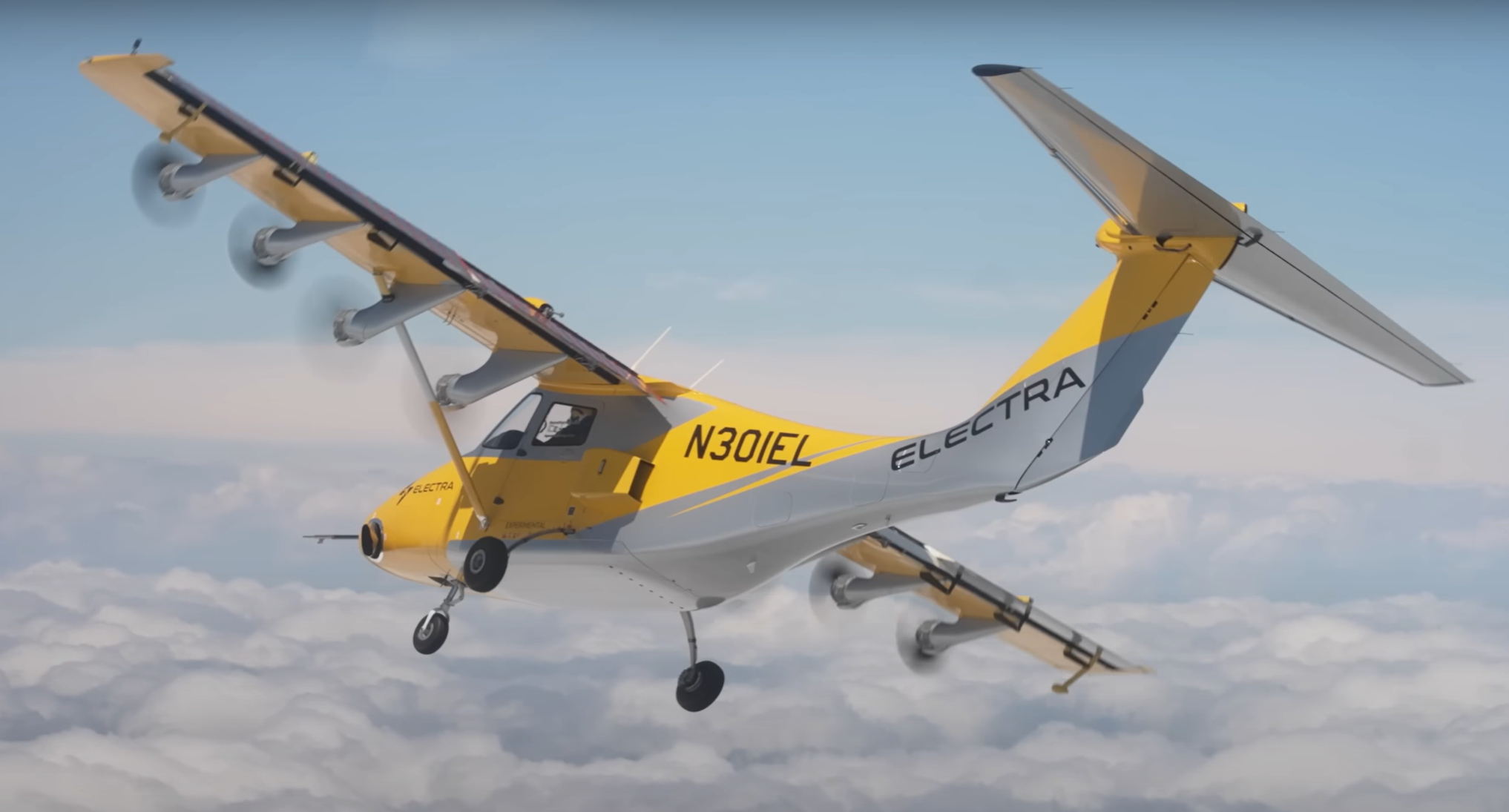
Electra EL-2 Goldfinch hybrid-electric aircraft in flight
The EL-2 Goldfinch banking over Virginia - a two-seat demonstrator that lands shorter than the average suburban driveway. Most aircraft photos brag about altitude. This one brags about how little ground it needs.
Who they are now

A flight test team in Manassas is making the runway optional.

On a strip of grass outside Washington, a small airplane lifts off in less ground than a tennis court is long. No screaming turbine. No mile of pavement. Eight electric motors hum across the wing, the air bends, and the thing is airborne before a normal plane would have finished its safety briefing. That is Electra.aero on a Tuesday.

Electra is an aerospace company in Manassas, Virginia, building the EL9 - a nine-passenger hybrid-electric "Ultra Short" aircraft designed to take off and land in roughly 150 feet. Not from an airport. From a field, a clearing, a short patch of pavement near where people actually want to go. The company has about 96 employees, a flying demonstrator, and a pre-order book north of 2,200 aircraft.

The pitch is almost rude in its simplicity: affordable air travel without airports, emissions, or noise. The aviation industry has spent a century insisting all three are non-negotiable.
"Affordable air travel without airports, emissions, or noise."

Electra.aero - the company mission, stated without hedging
The problem they saw

There are thousands of airports. Almost nobody can use most of them.

The United States has roughly 5,000 public airports. Scheduled airlines serve a few hundred. The rest sit mostly idle - short runways, small towns, no jet bridge, no reason for a regional carrier to bother. The economics of conventional aircraft demand long runways and big loads, so the small airfield became a parking lot for weekend Cessnas.

Meanwhile the obvious fix - electric flight - kept running into the same wall. Batteries are heavy. Pure-electric range stays stubbornly short. And the vertical-takeoff air-taxi crowd has been promising flying cars for so long that "eVTOL" now reads like a punchline at investor dinners.

Electra's read was contrarian: the bottleneck was never the engine. It was the runway. Solve the runway, and a small electric airplane suddenly has thousands of places to land and a business that closes.

Everyone tried to make electric planes fly farther. Electra asked why they needed so much room to leave the ground.

The bet beneath the bet
The founders' bet

A man who sold his last aerospace company to Boeing bet on lift, not levitation.

Electra was founded in 2020 by Dr. John Langford, who is not new to this. He built Aurora Flight Sciences, ran it for nearly three decades, and sold it to Boeing in 2017. His technical advisors read like an MIT aeronautics faculty meeting: Professors John Hansman and Mark Drela. The bet they made was on an old, unglamorous idea called blown lift - blowing air from propellers directly over the wing so it generates enormous lift at low speed.

Blown lift lets the EL9 fly slowly enough to stop in a soccer field, but cruise like a normal airplane. A small turbogenerator charges the batteries in flight, which means no ground charging stations and far more range than a pure-electric design. It is, in a sense, a refusal to choose between electric and practical.

In August 2024 the company brought in B. Marc Allen, formerly Boeing's Chief Strategy Officer, as CEO - a signal that Electra intends to be a manufacturer, not a science project.

The hard part of flying was never going up. It was coming down somewhere useful.

On why blown lift, not vertical takeoff
Founder

Dr. John Langford

Founder & Chairman. Built and sold Aurora Flight Sciences to Boeing; MIT-trained aeronautical engineer.

Chief Executive

B. Marc Allen

CEO since August 2024. Former Chief Strategy Officer at Boeing. Hired to take Electra from demonstrator to production.

Advisors

Hansman & Drela

MIT aeronautics professors guiding the aerodynamics behind Electra's blown-lift system.

Home Base

Manassas, Virginia

Headquarters and flight operations beside Manassas Regional Airport, ~96 employees.

The product

The EL9: nine seats, eight motors, one very short ground roll.

The EL9 carries nine passengers and two pilots, hauls up to about 3,000 pounds, and ranges over 1,100 nautical miles. Eight electric motors line the wing, feeding the blown-lift system. A hybrid turbogenerator keeps the batteries topped up mid-flight. The result is an aircraft that needs roughly 150 feet to take off and land - about a tenth of the footprint a comparable conventional plane requires.

It is also quiet. About 75 decibels at 300 feet, which is closer to a conversation than to a helicopter. That number matters more than it sounds: noise, not technology, is what usually keeps aircraft away from the places people live.

Before the EL9 there was the EL-2 Goldfinch - the two-seat demonstrator that first flew in November 2023 and proved the system was real, taking off from as little as 170 feet of runway and landing in under 115, at approach speeds as low as 25 knots.

9 passengers ~3,000 lb payload 1,100 nm range 8 electric motors in-flight recharge 25 kt landing FAA Part 23

A plane that lands at 25 knots is barely flying. That is exactly the point.

On the Goldfinch demonstrator
The flight log so far

From a 2020 idea to a $9 billion order book.

2020

Electra is founded

John Langford starts the company to chase ultra-short hybrid-electric flight, advised by MIT's Hansman and Drela.

November 2023

Goldfinch flies

The two-seat EL-2 demonstrator makes its first piloted flight from Manassas Regional Airport.

2023

U.S. Air Force partnership

A STRATFI strategic funding partnership valued up to $85M to develop a full-scale pre-production eSTOL.

August 2024

A Boeing veteran takes the controls

B. Marc Allen, former Boeing Chief Strategy Officer, is named CEO.

November 2024

EL9 design revealed

The nine-passenger production aircraft is unveiled at the Manassas headquarters.

March 2025

2,200 pre-orders

Backlog from 60+ operators reaches roughly $9 billion in value.

April 2025

$115M Series B

Round led by Prysm Capital to push the EL9 into pre-production and certification.

December 2025

FAA type-cert application filed

Electra formally enters the certification process under FAA Part 23.

January 2026

Bristow takes slot #1

The Bristow Group secures the first EL9 delivery slot as operational launch partner.

The proof

The skeptic's question: is anyone actually buying this?

Renderings are cheap. Order books are not. Electra reports more than 2,200 pre-orders from over 60 operators across five continents, a backlog valued near $9 billion. The customer list spans air-taxi outfits and helicopter operators - JSX, Surf Air, JetSetGo, and operators in Turkey, Senegal, Nigeria, Denmark, India and Brazil. In January 2026 the Bristow Group, a serious commercial helicopter operator, claimed the first delivery slot.

The money is just as telling. Lockheed Martin, Safran, and Honeywell are not just investors - Honeywell is supplying the safety-critical flight control computers for the production aircraft. The U.S. Air Force put up to $85 million on the table. NASA selected Electra for its AACES 2050 program, and the Goldfinch became the first piloted electric aircraft to fly at NASA's Langley Research Center.

Why the runway math changes the business

Ground distance to operate, relative scale
EL9 Ultra Short
~150 ft
Typical 9-seat aircraft
~1,500 ft
The EL9 needs roughly 10% of the takeoff/landing footprint of a comparable conventional aircraft - which is why thousands of small airfields suddenly become viable. Figures are company-stated, approximate.

Demonstrated short-field performance

EL-2 Goldfinch test results, feet of ground roll
Takeoff
170 ft
Landing
115 ft
Recorded during 2024-2025 flight tests at Virginia airfields. Bars scaled against a 260 ft reference. Approximate, company-reported.
Strategic Investor

Lockheed Martin

Backs Electra and collaborates on advanced air mobility and defense applications.

Systems Partner

Honeywell

Strategic investor supplying safety-critical flight control computers and actuation.

Propulsion

Safran

Strategic investor on the propulsion and systems side of the production aircraft.

Launch Partner

Bristow Group

Operational launch partner; holder of the first EL9 delivery slot.

The mission

Decarbonize the flights nobody talks about.

The headlines go to transatlantic jets and rocket launches. The carbon hides in the boring middle - short regional hops, cargo runs, the connections that knit small communities to the rest of the country. Electra is aiming squarely at that middle: clean, quiet aircraft that can serve places a 737 will never touch, without building new infrastructure to do it.

It is a less cinematic mission than flying cars over Manhattan. It is also a more believable one. The EL9 is a fixed-wing airplane that takes off and lands - just shorter, quieter, and cleaner. The engineering is ambitious; the concept is not science fiction.

The future of flight might not look futuristic at all. It might just be an airplane that needs a smaller field.

Why Electra's bet feels different
Why it matters tomorrow

Back to that strip of grass outside Washington.

Picture it again in 2029, the year Electra is targeting for certification and service. The same field. But now the airplane lifting off in 150 feet carries nine paying passengers, costs a fraction of a charter, and barely registers over the sound of the wind. The pilot did not drive an hour to a regional airport. The passengers did not either.

That is the whole bet, compressed into a single takeoff. If Electra is right, the small airfield stops being a relic and becomes a node - and a country of 5,000 mostly-empty airports gets a reason to use them. The runway was never the point. Getting somewhere was.

There is still a certification gauntlet, a manufacturing ramp, and a long history of aviation startups that never delivered. Electra has a flying demonstrator, real customers, and serious money on its side. The next few years decide whether the soccer-field takeoff becomes a timetable.

Watch & explore

See it leave the ground.

Spread the word

Share Electra.aero