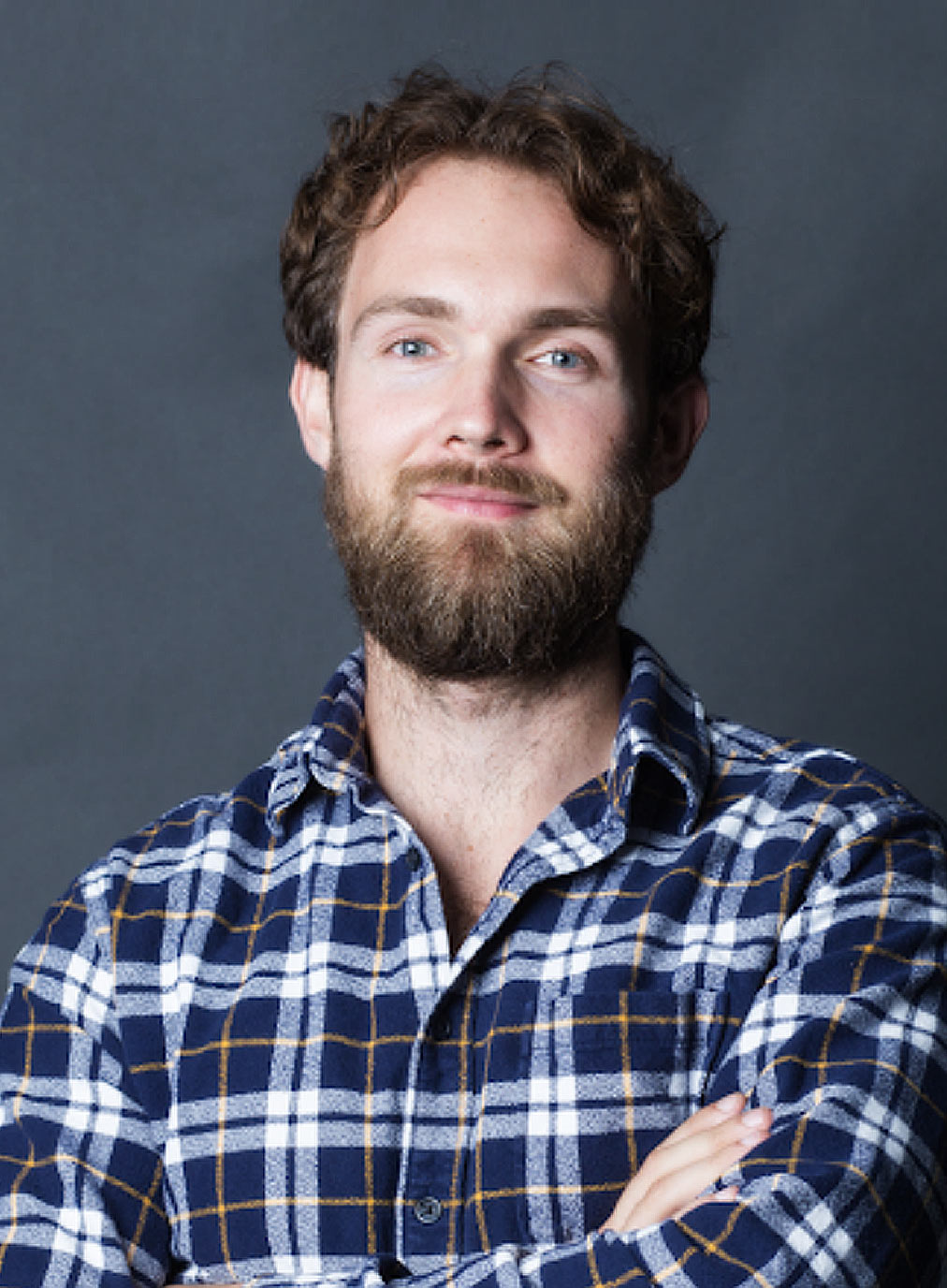
He opens a laptop, types a few lines of logic, and a cell does what he asked. The co-founder and CEO of Asimov is making the genome something you can write.
Picture a laptop on a bench near the MIT campus. Nielsen types in what he wants: feed this cell arabinose and lactose, have it make a fluorescent jellyfish protein, make it glow yellow.
About sixty seconds later, the software hands back roughly 11,000 letters of DNA and a circuit diagram to match. No pipetting yet, no trial and error at the bench. Just a specification compiled into the chemical language a living thing can run. The tool is called Cello, and it works the way the software that lays out billions of transistors on a microprocessor works, except the output is genetic code instead of silicon.
That demonstration is the whole thesis of Nielsen's career in one gesture. For most of history, engineering biology meant guessing, then checking, then guessing again. He thinks it should look more like writing a program: state the logic, let the compiler handle the messy chemistry, run it, and expect it to behave. Asimov, the company he leads, exists to make that the default rather than the miracle.
Cloud software plus engineered biology that designs and manufactures biologics, cell therapies, gene therapies, and RNA. The product lines carry blunt, hardware-sounding names: CHO Edge, LV Edge, AAV Edge, RNA Edge.
The most interesting applications will be things we cannot predict.- Alec Nielsen on the next century of gene circuits
The handle gives it away. On X he is @alectricity, a relic of where he started. Nielsen took a B.S. in electrical engineering and bioengineering at the University of Washington, then carried the circuit-designer's habits into a place most people would not expect them: a wet lab.
At MIT he joined Chris Voigt's group during a long-running collaboration with Doug Densmore of Boston University on genetic logic circuits. His PhD, finished in 2016, was not a side quest. It produced Cello, released that year with collaborators at NIST, a platform that compiles plain logic into DNA. The metaphor he kept reaching for was the semiconductor. A cell, looked at the right way, is a place where signals get processed, gates open and close, outputs follow inputs. If chips could be designed in software, why not circuits made of genes?
In 2017 the academic work grew a company. Nielsen co-founded Asimov with Voigt, Densmore, and Raja Srinivas. The name is a tip of the hat to Isaac Asimov, the writer who imagined laws for engineered minds. Andreessen Horowitz led the seed round and DARPA signed on early, two backers rarely found in the same sentence. The bet was that the tooling Nielsen built in a university lab could become infrastructure for an entire industry.
Describe the behavior you want in plain terms: sense these inputs, produce this output.
Cello maps the logic onto engineered genetic gates, standardized host cells, and a circuit diagram.
Out comes thousands of letters of sequence, ready to synthesize, in about a minute.
The construct goes into a living organism, which executes the program you wrote.
The shift is subtle and total. The biologist stops being a craftsperson coaxing a result and starts being a programmer who expects one. Asimov turned that idea from a lab demo into commercial Edge Systems aimed at the hardest part of modern medicine: actually manufacturing the cell and gene therapies that designers dream up.
Here is the uncomfortable truth that shapes everything Asimov does. Designing a clever therapy on a screen is one thing. Getting a living cell to make it, reliably, at scale, batch after batch, is another problem entirely, and it is the one that quietly kills good medicine. A construct that performs in a flask can stall in a bioreactor. The biology that looked obedient on the bench turns temperamental at volume.
This is the gap Nielsen pointed the company at. The Edge Systems, CHO for protein therapeutics, LV and AAV for the viral vectors behind gene therapy, RNA for the newer wave, are not abstract design playgrounds. They are aimed at the production floor, at the moment where a sequence has to become a manufacturable product. Asimov pairs the cloud software with engineered host cells, so the thing you design and the thing that builds it are tuned to each other rather than stitched together from incompatible parts.
It is a less glamorous story than glowing yeast, and a more important one. The frontier in cell and gene therapy is no longer mostly about whether a treatment can work. It is about whether it can be made. Putting design and manufacturing in the same toolchain is Nielsen's answer to that, and it is the reason institutional money, not just venture money, started showing up on the cap table.
CHO Edge for biologics. LV Edge and AAV Edge for the viral vectors that carry gene therapies. RNA Edge for the newest modality. Each pairs design software with engineered cells built to actually produce at scale.
Five moments that take you from a PhD bench to a nine-figure round.
The PhD and CelloFinishes at MIT in the Voigt Lab and, with NIST collaborators, releases Cello, the platform that compiles logic into genetic circuits.
Asimov is foundedCo-founds the company with Chris Voigt, Doug Densmore, and Raja Srinivas. Andreessen Horowitz leads the seed; DARPA backs it early.
Out on the circuitSpeaks at SynBioBeta; MIT Technology Review profiles the glowing-yeast demo and the vision behind it.
The big-stage pitchPresents at the a16z Summit on a future that is, in his framing, genetically engineered.
$200M arrivesAsimov announces a $175M Series B led by CPP Investments, with Fidelity, Casdin, Pillar, Horizons Ventures, and a16z alongside.
Nielsen's collaborators from the academic years. Chris Voigt ran the MIT lab; Doug Densmore brought the design-automation discipline from Boston University.
A venture firm and a defense research agency funding the same seed, a rare pairing that signals both the commercial and strategic weight of programmable biology.
Canada's pension fund led the $175M round, a sign that synthetic biology had crossed from frontier science into institutional-grade infrastructure.
It was impossible to imagine mobile phones or Instagram at the start of the semiconductor era. Gene circuits are at that start.- Nielsen, paraphrasing the long view
His social handle is a pun on the electrical engineering degree he started with. The wiring never really left.
Asimov honors Isaac Asimov, who imagined rules for engineered intelligence. The company wants to write foundational rules for engineered life.
Cello is modeled on the electronic-design-automation software used to plan processors with billions of transistors. Same idea, wetter substrate.
Beyond running Asimov, Nielsen serves as a Venture Partner at Pillar VC, one of the firm's voices on the science.
Asimov has operated the MIT-Broad Foundry for synthetic biology R&D, blending academic muscle with a company's focus.
Undergrad on the Pacific at the University of Washington, doctorate on the Atlantic at MIT. Engineering both ends.
Asimov states the goal plainly: radically advance humanity's ability to design living systems, and enable biological technologies with outsized benefit.
Strip away the mission-statement gloss and it comes down to predictability. The reason a phone works is that the people who designed its chip could trust their tools. Type a design, and the silicon behaves. Biology has never had that. Cells are noisy, contingent, alive. Nielsen's wager is that the right software layer can make engineering them feel less like alchemy and more like writing code that compiles.
If that sounds modest, look at what rides on it. Cell and gene therapies are among the most promising and most maddening products in medicine, brilliant in the lab and brutal to manufacture. Asimov aims its tools squarely at that gap, the unglamorous middle where a good idea either becomes a treatment or dies in a bioreactor.
He is careful not to oversell the destination. His own framing is that the best uses are unforeseeable, the way no one at the dawn of transistors could have sketched a smartphone. The work is to build the foundation and let the surprises arrive.
Engineer cells the way engineers design chips: state the logic, trust the compiler, expect the result. Everything else, the therapies, the materials, the foods, follows from that.
The clearest way to understand the pitch is to watch Nielsen make it. The Pillar VC "Founder Stories" conversation walks through how a PhD project became a venture-backed company.
▶ Founder Stories: Alec Nielsen, Co-Founder & CEO of Asimov