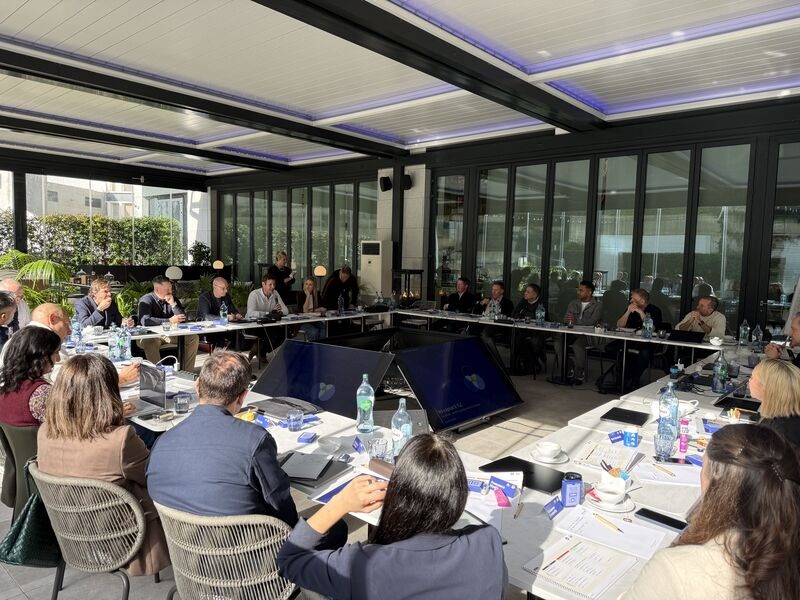
In Lisbon, Alec Johnson found something worth announcing about a leadership retreat: the seating plan. Everyone would sit in a square, facing everyone else, for three days. No retreating behind email. No convenient seat at the edge of proceedings. For a gathering about growth, it was an unusually concrete place to begin. The chairs had become part of the strategy.
Johnson, TLC Worldwide’s co-founder and Group CEO, described the arrangement with the pleased mischief of someone who had removed a familiar escape route. “No hiding or naughty corner,” he wrote. The retreat brought TLC’s leaders together with bd-capital, the investor backing its expansion. His point was attention: people looking at the same problem, and at one another, long enough to work on it.
It is a useful opening scene for Johnson’s working life. A rewards business promises its clients a change in behaviour. A leadership meeting asks something similar of the people around the table. Both can fail if the invitation is attractive and the practical arrangements are poor. Johnson’s square offered a modest answer to a large management problem: first, make participation difficult to avoid.
A partnership measured in decades
TLC began in 1991 with Nick True. Johnson joined a few years later, and the two concentrated on expanding its rewards marketing business. The distinction matters. Johnson’s story is tied to a partnership developed over time, with True as the original founder and Johnson becoming the chief executive who helped carry the idea across markets.
By TLC’s thirtieth anniversary in 2021, the business described 14 offices, 300 team members and more than 400 campaigns a year. Johnson’s account of those decades emphasised a steady underlying appetite: customers still wanted brands to reward their loyalty. Digital delivery, the range of rewards and the ability to run international campaigns had changed around that appetite.
There is something refreshingly unromantic about this version of entrepreneurship. The customer’s basic desire does not need to be reinvented at every anniversary dinner. The work lies in making the promise usable, in another country, through another channel, for another client. Johnson’s long tenure gives his career the shape of an extended operating assignment: take an appealing idea and keep making it function at greater scale.
- 1991Nick True establishes TLC
- Early yearsJohnson joins a few years later
- 2024bd-capital invests; Johnson continues as CEO
- 2026Growth planning together in Lisbon
The people who make a reward arrive
In February 2019, Johnson welcomed Preneshen Munian’s promotion from managing director to CEO of TLC’s African business. His praise followed the route of Munian’s career, from business development through management to chief executive. It was a small piece of corporate news with a longer story inside it: someone had been given room to grow, and the person running the group had watched that growth happen.
That interest appears again further down the organisation. During a 2024 visit to the African team, Johnson caught up with Zondi Tshabalala and Fiata Adelina Ramphekwa. Both had entered TLC through sponsored training programmes and subsequently joined the business. Their routes were different: Tshabalala completed a basic office skills internship; Ramphekwa undertook an end-user computing learnership. Each had found an opening into employment.
Those meetings put faces to a subject that companies often reduce to a recruitment slide. A global campaign needs people who can handle details, work with colleagues and learn a client’s requirements. An entry-level opportunity belongs in the same commercial picture as a senior appointment. The distance between them may be considerable; Johnson’s public attention reaches both ends.
In Johannesburg, he also singled out Cecilia, a community executive who had been part of the office for 12 years. He described her contribution to the culture as equal in importance to the CEO’s. Coming from a chief executive, that is a useful reallocation of prestige. The organisational chart can tell you who approves a decision. It is less reliable at telling you who makes a workplace hold together.
“We run a flat ship here in our global community”Alec Johnson, on recognising Cecilia’s contribution in Johannesburg
A Welsh accent in the boardroom
Johnson’s public voice allows a little air into the language of leadership. When TLC shared a Best Companies studio appearance featuring him, Nick True and People Director Dipti Shah, he joked about the absence of subtitles for his Welsh accent. He was proud of the team, but apparently felt the occasion could survive a joke at his own expense.
That combination is more revealing than a polished list of executive attributes. He can celebrate an achievement without treating the chief executive as a ceremonial object. In a business dependent on people across countries and functions, an approachable tone has a practical use. Colleagues still have to bring the awkward question into the room.
There is a more deliberate side to the approach. In 2023, TLC described Johnson taking its teams through a leadership playbook, including listening and showing passion in daily work. He called the half-hour exercise a worthwhile investment. The scale was small enough to repeat: a short session, a common set of expectations, and leaders reminded that their behaviour is visible to other people.
The investor gets a seat
In February 2024, bd-capital announced its investment in TLC. True stayed on the board; Johnson continued to run the business. David Johnston, previously chief executive of Nectar owner Aimia, became chairman, while former Nectar CEO Jan-Pieter Lips joined the board. The new relationship brought people with experience of loyalty programmes into the company’s decisions about expansion.
At the time, TLC’s network offered more than 45,000 experiences across 40 countries. Its offices spanned 14 countries and it employed more than 350 people. Those figures describe the business at the investment announcement, rather than a permanent scoreboard. They also explain the appeal of experienced partners: a network of that size presents questions about coordination as well as growth.
A year into the relationship, Johnson addressed bd-capital’s investor AGM. He acknowledged that entering private equity had felt daunting. Cultural fit, he explained, had been central to the board’s choice of partner. This is a more human account of a transaction than the usual language of effortless alignment. Even a long-serving chief executive can find a new audience uncomfortable. He went and presented the plans anyway.
The continuity gives this chapter its tension. Johnson remained responsible for TLC, but the company now had additional experience around its boardroom table and a shared ambition to expand. His task included carrying the habits of an established business into that relationship. The Lisbon square, with bd-capital participating, makes more sense against this background: the partners needed time together, looking at the work.
Network figures at the February 2024 investment announcement.
The software behind the invitation
A reward has two lives. First comes the pleasant possibility: dinner, a trip, an outing. Then comes the process of claiming it. Johnson’s technology agenda sits in that second life, where a customer encounters instructions, choices and a website. This is where an imaginative marketing promise acquires a sequence of things that must actually work.
TLC introduced COSMOS in its African market in June 2023 as a platform for building campaigns, selecting rewards and collecting consumer insights. It could create configurable branded websites and support redemption and distribution. That description places software close to the customer experience, rather than somewhere behind the finance department’s door. The platform carries part of the promise made by the campaign.
By the end of 2025, Johnson was reporting wider deployment across continents and six types of programme mechanic. He put the team at 408 and said TLC had launched 400 programmes that year. These were his year-end figures, offered as evidence of progress against the business plan. His account connected the technology work with the teams delivering programmes for clients.
He also used the compact instruction “solve” rather than “sell”. It is an appealing standard because it can be tested. A proposed reward either suits a customer’s circumstances or asks that customer to do too much work. Software either helps someone claim the benefit or adds another obstacle. The slogan earns its place only when the choices underneath it are useful.
Growth has a local address
Consider TLC’s £1 Coffee Network for Three UK, which won Best Supplier/Vendor Innovation at the European Loyalty Awards in 2025. Johnson publicly congratulated the people involved. A coffee reward is wonderfully resistant to abstraction: someone eventually wants a cup of coffee. The participating network, the offer and the act of redeeming it have to meet in the same place.
For a group chief executive, that is the peculiar arithmetic of international scale. A programme can have an international business behind it while depending on a very local exchange. More territories create more versions of that exchange. Success asks the company to preserve an ordinary customer’s sense that the reward is convenient, even as the organisation delivering it becomes more complicated.
In December 2025, TLC announced Jay Cary as North American CEO, Georgia Graham-Leigh as chief operating officer and Paul De Bonis as chief commercial officer. Cary thanked Johnson for trusting him with the business. The appointments gave Johnson’s expansion plans a recognisable operational form: named people with responsibility for a region, rather than growth left floating as an ambition.
Johnson has since celebrated the US business’s performance from TLC’s Tribeca office, describing it as the group’s fastest-growing operation. He has also written about spending 48 hours reviewing every region’s first quarter, including difficult conversations where needed. The celebratory visit and the performance review belong together. A company can enjoy its results and still require someone to examine the parts that are moving less smoothly.
Back to the square
Across these episodes, Johnson’s career comes into focus through repeated acts of attention: noticing a colleague’s progression, crediting an office’s community executive, learning how to work with investors, checking the performance of individual regions. His stated ambitions include developing TLC’s technology and data capabilities, investing in its people and expanding the business with bd-capital. Each ambition depends on decisions made by people other than the CEO.
That returns us to Lisbon. Three days facing one another is a fairly demanding interpretation of a retreat. The furniture offers little assistance to anyone hoping to disappear. Yet the arrangement suits the business Johnson has spent decades helping to build: many people, different responsibilities, a common promise that needs delivering. Before the next reward reaches a customer, someone around that square has work to do.