Aidan Dewar's first enterprise with Sam Perkins did not involve a clinic, an algorithm or a term sheet. It involved whatever two schoolboys could sell. Concert tickets. Textbooks. A miscellany of adolescent arbitrage. They had known each other since they were eight, which is an enviable length of due diligence for a future co-founder and a terrible basis for Dewar to offer anyone dating advice. He has joked that choosing a founder this way is like marrying your high-school sweetheart, then being asked how to play the field.
There was an earlier ambition. Dewar wanted to play in the NBA. The dream survived until he noticed that other players could do everything he could do while also being 6-foot-9 and considerably more athletic. School suddenly looked attractive. It is a neat little Dewar story: appetite meets evidence; evidence wins; appetite finds another outlet.
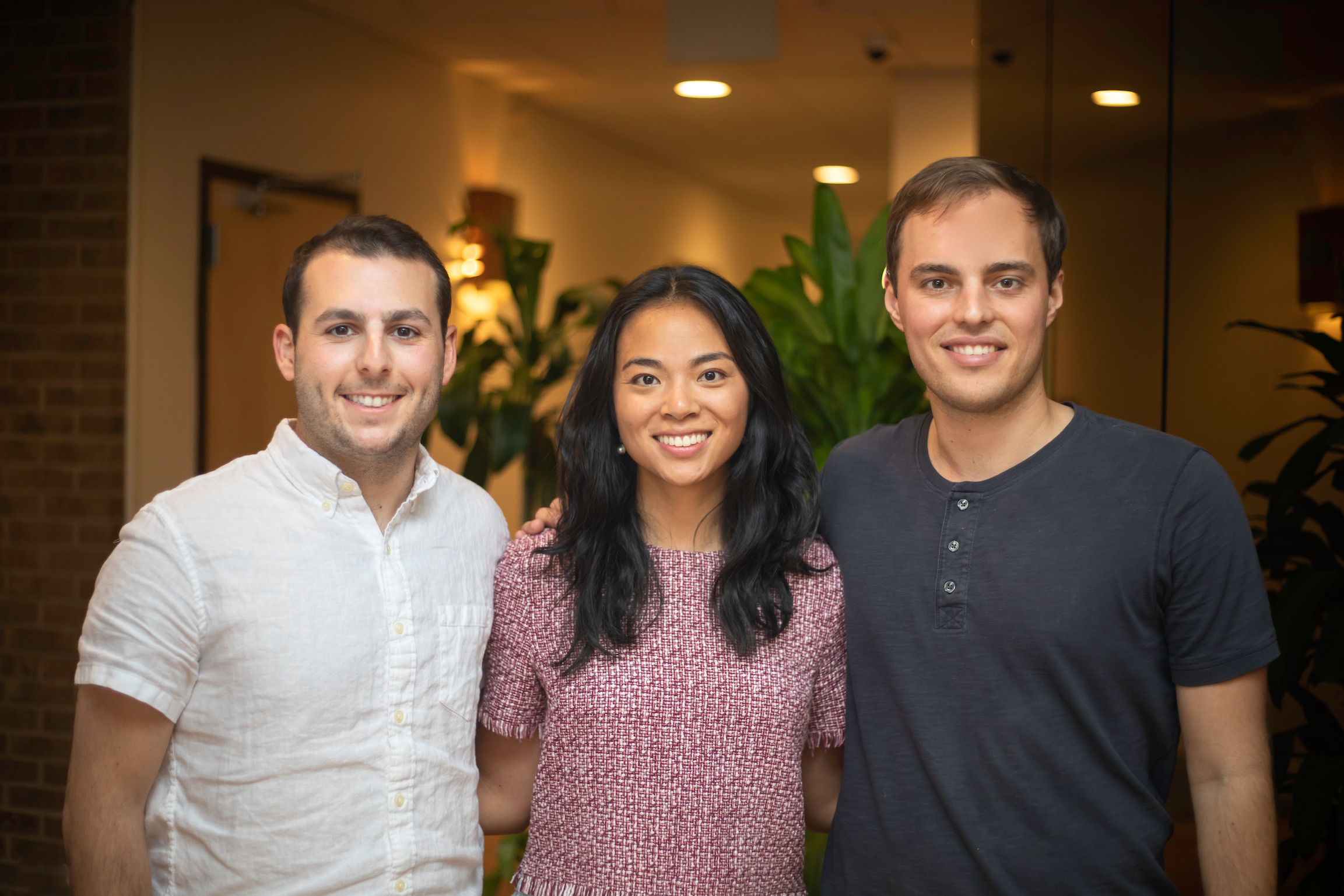
The outlet became entrepreneurship. Perkins remained in the picture. Stephanie Liu, whom the pair met around college age, completed the trio. Long before they agreed on a company, they had the rarer asset: a working history. Nourish would be founded in 2021, but the partnership beneath it was already old.
The unfashionable middle
Before Nourish, Dewar studied economics at Harvard and graduated cum laude in 2018. The résumé that followed reads like a careful tour of American capital: internships at AT&T, Goldman Sachs and L Catterton, then two years as an associate consultant at Bain & Company. In 2020 he helped start Feed the Front Line SF, which used restaurant meals to support frontline workers. The following winter, Nourish entered Y Combinator.
The company began with a proposition that sounded almost suspiciously untechnical: connect people with registered dietitians through video appointments and get insurance to cover the bill. The ambition sat in the machinery. Insurance eligibility, clinician supply, matching, scheduling, billing and ongoing engagement all had to cooperate. Healthcare is full of excellent ideas waiting to be mugged by a fax machine.
Dewar's instinct was to treat the relationship as infrastructure. A match could not stop at specialty. Language mattered. Culture mattered. So did temperament: some people want firm direction; others do better with a gentler coach. The software could improve the odds, but a human being would still deliver the care. Nourish hired dietitians as employees rather than treating them as an interchangeable contractor pool, offered benefits, and made longer-serving clinicians eligible for equity.
That choice explains more about Dewar than the usual founder adjectives. He is plainly comfortable with technology, but reluctant to confuse the instrument with the music. Meal logging, messaging, progress tracking and administrative automation make the encounter work. Accountability comes from somebody noticing whether you returned.
“Lifestyle change is a 24-7 thing.”Aidan Dewar, on why virtual care can fit daily life
A friendship learns to scale
Nourish's timing helped. The company began amid the great, compulsory experiment in telehealth. Patients, clinicians and insurers had all learned that serious care could pass through a screen. Yet convenience alone would not build a national service. Nourish needed to persuade health plans, attract dietitians, earn referrals and create a product that two very different customers would use.
Dewar describes the channels with consultant-like neatness: insurers, digital marketing, clinician referrals, influencers and, best of all, word of mouth. His preferred channel is revealing. Advertising can introduce a service. A recommendation from a patient says the service survived contact with reality.
The early booking platform widened into a clinic. The company added lab work, virtual medical care and prescription management, while its app gained increasingly capable AI features. A photograph can become a meal log. A clinical note can be drafted with less clerical labor. The patient can ask questions between appointments. Dewar's formulation for these systems is not replacement but assistance. The aim, he has said, is to make care “smarter, more human and more engaging.” The order of those words is doing some work.
Growth brought a less glamorous problem: yesterday's process breaks tomorrow. Dewar has put it bluntly in conversations about hiring: what works when onboarding two people does not work when onboarding 20. The point applies beyond recruiting. A company can keep its purpose while replacing nearly every method it used to express that purpose. Nostalgia is pleasant; it is not an operating system.
The $100 million sentence
In May 2026, Nourish announced a $100 million Series C led by Menlo Ventures, taking its stated total funding to $215 million. It said the money would expand its clinical network, partnerships and AI systems. The number was large enough to invite spectacle. Dewar joined one interview remotely from a company off-site, where a lightly rocking phone and wood-paneled conference room convinced the hosts that he was secretly aboard a boat.
He denied it. They persisted. The room was boring, he protested. The boat allegations survived. Moments earlier, the group had celebrated the round with a gong, and Dewar decided Nourish's office needed one. It was an unusually human few minutes in the funding-news genre, where adults generally discuss enormous sums with the emotional range of a parking receipt.
The humor did not soften his argument. Medications and AI, in Dewar's telling, are tools inside a larger system. He is interested in the unheroic connective tissue: whether care is covered, whether advice can be acted upon, whether a patient stays engaged and whether the economics reward a lasting result. He has even sketched a possible future in which food recommendations become as easy to fulfill as a prescription, perhaps through covered delivery partnerships. Nourish has not made that its immediate priority. Dewar is comfortable naming the horizon without pretending to have arrived.
“We measure Nourish success as Scale × Outcomes - how many people we help and how much we help them.”Aidan Dewar, 2026
The operator's tell
Ask Dewar how Nourish competes and he does not produce one precious secret. He talks about scale, product, distribution and execution. The last word matters most. A clinic with thousands of professionals cannot run on founder charisma, however generous the supply. It needs repeatable hiring, clear standards and software that can carry a good decision farther than the room in which it was made.
His career before Nourish makes that emphasis unsurprising. Economics supplied the model-making; consulting supplied the habit of breaking a large problem into tractable pieces. But Dewar is livelier than the spreadsheet caricature. He likes quick shipping, celebrates product releases in public and speaks about the team with uncomplicated enthusiasm. When Nourish introduced a meal-logging feature that could read a photo, barcode or nutrition label, his entire public commentary was three rocket ships. There are occasions when a strategy memo can safely be shortened.
The discipline appears in the boundaries as much as the launches. Nourish has discussed meal-delivery partnerships but has not rushed into the operational weight of preparing and moving food. It uses name-brand medicines and works through insurance rather than pursuing compounded alternatives. It builds technology where Dewar believes the product needs direct control and waits where the next layer would be premature. Ambition is often mistaken for the number of things a founder is willing to start. In Dewar's case, it is also visible in the things he is willing to sequence.
That sequencing now includes AI in two directions. Provider tools reduce documentation and surface useful information; patient tools answer questions and make daily tracking less tedious. Dewar has said the company cut charting time by as much as 90 percent with its scribe. The interesting use of the saved minutes is not more screen time. It is attention. Every administrative task removed from an appointment returns a small piece of the encounter to the two people having it.
The old-fashioned advantage
By 2026, Nourish said it had more than 10,000 registered dietitians and could reach more than 200 million covered lives. Inc. placed the company at No. 39 on its annual list after reporting 6,794 percent three-year growth. Those figures are the public evidence of velocity. They are also abstractions. Dewar's more interesting measurement is the multiplication sign: scale times outcomes. Reach without effect is distribution. Effect without reach is a boutique. The company he wants must do both.
This is where the childhood-friend origin story stops being charming decoration. Companies change shape quickly under pressure. Founders do too. Dewar, Perkins and Liu brought years of familiarity into a business that would repeatedly force them to rebuild the way it worked. Familiarity does not guarantee agreement. It does make candor cheaper, and candor is a useful commodity when the old process has just broken.
Dewar now speaks the language of a chief executive responsible for a large, regulated operation: cost, access, execution, incentives, quality. Then a trace of the boy selling concert tickets slips through - a fondness for the deal, the joke, the next thing to build. He is self-aware enough to mock the NBA fantasy and ambitious enough to retain its scale.
The paradox at the center of Nourish is that its future-facing machinery protects an old-fashioned encounter. One person pays attention to another. The algorithm improves the introduction. The app remembers the details. The insurer pays. The clinician listens. Dewar has built a growing company by refusing to treat that last verb as inefficient.