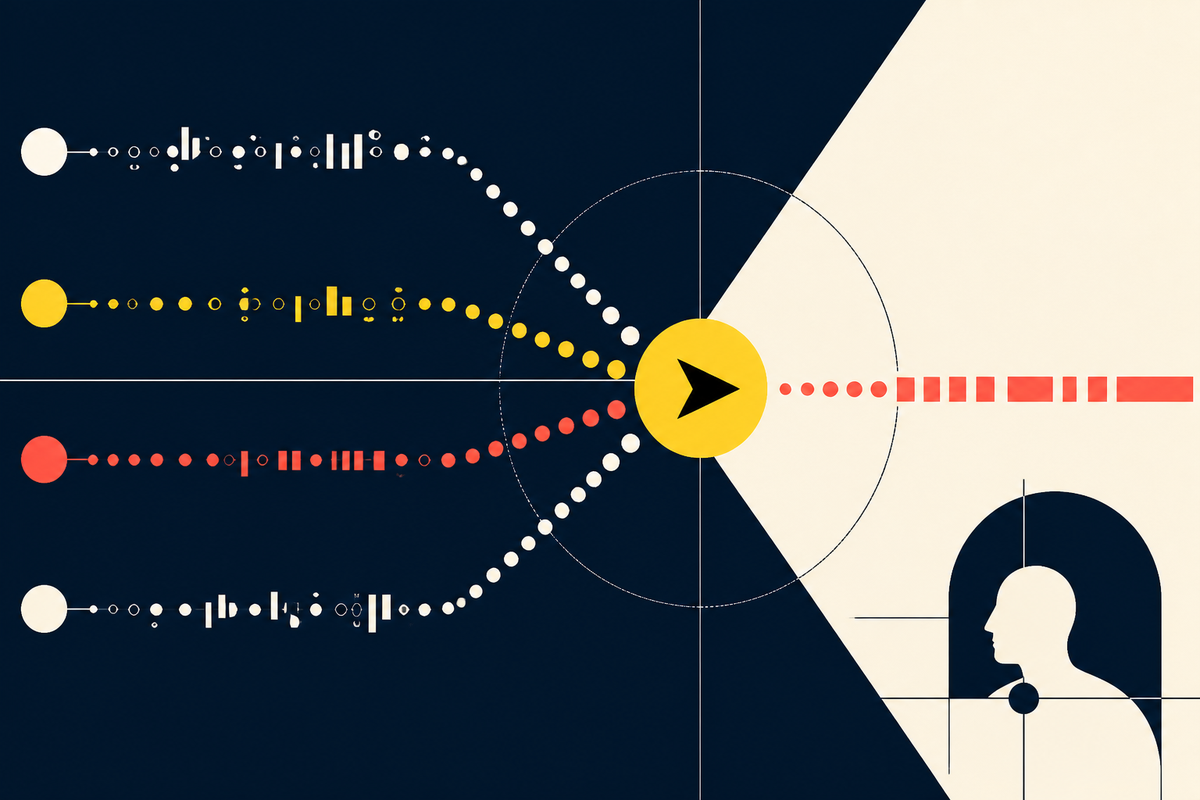
The customer rarely leaves on renewal day. The exit begins earlier, in smaller motions: a weekly user becomes monthly, a project champion skips two calls, a support thread gets reopened, an invoice ages, a sentence loses its usual warmth. Each clue lives somewhere different. By the time they are assembled into a red square on a quarterly slide, the relationship may already be running on administrative momentum.
Customer-success software is being rebuilt around that delay. The pitch is no longer simply to store the account plan or remind a manager to send an email. The new systems want to observe the relationship continuously, turn scattered activity into an interpretable health signal, and recommend what should happen next. Kaizan, Skalin and Churned approach the problem from different angles. SAP shows what the same idea looks like when it meets enterprise data, process controls and thousands of customers.
Together they make a useful map of an emerging category. They also expose its central tension. A machine can read more traces than a person. A person still has to decide whether a quiet customer is drifting, busy, disappointed or simply on holiday.
The CRM remembers what somebody bothered to type
For years, the customer record has been a negotiated version of reality. The meeting happened; notes arrived later, perhaps. Sentiment became green, amber or red. A renewal date sat in a field. The record was valuable, but its quality depended on human attention at the precise moment when humans were juggling calls, escalations and internal work.
Kaizan starts with the unstructured layer. Its public materials describe a platform that draws on meetings, email, messages, documents and system updates to score client relationships, surface risks and draft follow-ups. Co-founder Glen Calvert argues that the useful signal was already present in conversations but inaccessible to software. That framing matters. It treats customer success as a listening problem before it treats it as an automation problem.
“The signal was always there, trapped in conversations no software could read.”Glen Calvert, co-founder and CEO of Kaizan
Skalin begins closer to the portfolio view. The company says it combines CRM, usage, support, email and billing data, then uses a self-calibrating health score to learn from observed churn patterns. Its sales argument is pointed: a team should not have to know every causal threshold before the tool becomes useful. Churned pushes further toward action. It describes a three-part loop: connect customer data, predict behavior, then use automation to deliver a recommended retention, reactivation or upsell move through existing tools.
The practical AI customer-success loop
These products overlap, but they are not interchangeable. A services firm may care most about language, stakeholder engagement and delivery promises. A SaaS company may lean heavily on depth and breadth of product use. A subscription business may need segment-level predictions and high-volume campaigns. The category label hides these differences, so the buyer's first job is to define what a healthy customer actually does in its own business.
The long tail finally gets a signal
The economic pressure behind this shift is straightforward. A customer-success manager can hold only so many relationships in working memory. A company can reserve frequent human attention for its largest accounts, but the rest still onboard, struggle, adopt and reconsider. At SAP, Carsten Schütz, vice president and global head of scaled customer success, described the role for agents in serving the large share of customers who receive little or no direct human contact. Hiring indefinitely is not a scaling strategy.
AI can widen the field of view. It can summarize a call, identify a falling usage pattern, draft a recap, update a system and route an alert while the account manager is speaking to another customer. SAP Service Cloud publicly lists generative-AI features for case and email summaries and contextual draft responses. SAP has also described AI in support as a way to analyze process metrics, find bottlenecks and improve business processes. At enterprise scale, the attraction is not merely a clever message. It is an intervention connected to governed operational data.
That last distinction is where many demos become slippery. Coverage is not care. A personalized email assembled from current data may be useful, but it can also reveal a category mistake at remarkable speed. A usage drop caused by a completed project is different from a usage drop caused by abandonment. A frustrated message from a new administrator is different from an executive sponsor losing faith. The machine's confidence does not reduce the company's responsibility to understand the situation.
Automate the archaeology. Keep the apology human.
A sensible operating line is easy to state and harder to enforce. Automate collection, summarization, routine follow-through and low-risk reminders. Require a person for concessions, promises, escalations, contract discussions and any communication where a missing piece of context could change the relationship. The point is not to preserve busywork. It is to preserve accountability.
A health score should survive its own renewal meeting
The worst way to evaluate an AI customer-success platform is to admire a clean demonstration built on clean data. A live customer base contains duplicate accounts, missing notes, seasonal usage, departed champions, unusual contracts and teams that disagree about what churn means. The product has to be tested against that mess.
Start with a backtest. Select past renewals, expansions, contractions and losses. Hide the outcomes, give the platform only the information that would have existed at a chosen point in time, and ask what it would have surfaced. Measure warning time, false alarms and missed risks. Then inspect the explanation. A score without evidence creates a new chore: the CSM must investigate the machine before investigating the customer.
- Define the event. Decide whether churn means cancellation, contraction, non-renewal, inactivity or a combination.
- Test on old outcomes. Compare warnings with accounts that renewed, expanded or left.
- Demand a reason. Every material score change should point to the signals that moved it.
- Assign the boundary. Write down which actions can run automatically and which require approval.
- Measure the intervention. Track whether the recommended move changed behavior, not whether somebody clicked send.
Data governance belongs in the buying conversation, too. Meetings, email and support records can contain personal, confidential or commercially sensitive material. Teams need to know what is ingested, where it is stored, how access is controlled, how long it is retained and whether it is used to train models. SAP's emphasis on governed business data is a reminder that intelligence and permission are separate design problems.
There is also an organizational risk. If a health score becomes a target, people learn to manage the score. If it becomes a verdict, they stop contributing contradictory evidence. The better use is as a prompt for inquiry: what changed, how do we know, who should look, and what would improve the customer's outcome? A red account is a hypothesis with a clock attached.
Less note-taking, more interpretation
The customer-success manager's work does not disappear in this model. It moves. Less time is spent reconstructing the last month from five tabs. More time is spent judging evidence, designing interventions, coordinating product and support, and having conversations that cannot be reduced to a playbook. That is a better job when the system is reliable. It is a more exhausting job when every alert is noisy.
The near-term winners will probably look boring in practice. They will produce complete recaps, cite the sentence behind a risk, keep the CRM current, notice a missing stakeholder and send the right owner a useful prompt before Friday. Reliability compounds in customer relationships because follow-through is itself a signal. The dramatic agent can wait.
Kaizan, Skalin, Churned and SAP each point toward a customer-success layer that observes more of the relationship and acts earlier. The durable opportunity is not a machine that conducts a flawless renewal meeting. It is a system that helps the people in that meeting arrive with the right evidence, enough time to respond, and a clear memory of what they promised last time.
AI customer success, briefly
What is AI customer success?
It is the use of machine learning and generative AI to combine customer signals, estimate account health, prioritize risks, draft routine work and support retention or expansion decisions.
How do these platforms predict churn?
They analyze combinations of product usage, support history, CRM records, billing events, engagement and conversation patterns. Inputs and modeling approaches vary by vendor.
Can AI replace a customer success manager?
The reviewed products are strongest at monitoring, summarization, prioritization and routine action. High-stakes promises, negotiations and relationship repair still require accountable human judgment.
How should a team evaluate an AI health score?
Backtest it against past renewals and losses, inspect the evidence behind each score, measure warning time and check whether its recommended actions are useful and safe.
What data does the system need?
Common inputs include CRM records, product usage, support tickets, billing data, emails, meeting transcripts and customer messages. Connect only data the team can govern and use responsibly.