The launch campaign fitted inside a WhatsApp message. In May 2016, Ahmed Al Rawi and his co-founder introduced Malaeb, an app for booking football pitches, at seven locations in Bahrain. They sent a broadcast. Players forwarded it to their football groups. By Al Rawi’s account, more than a thousand downloads arrived overnight. Someone had finally given the group chat something useful to do.
Four months later, the founders reported more than 5,000 registered players and enthusiasts. Malaeb was approaching its thousandth booking. The inconvenience was ordinary: people wanted to organise a match, and finding an available pitch involved too much chasing. An app that reduced the chasing gave its customers a reason to recruit the next customers.
Al Rawi is now the co-founder and CEO of Calo Inc., the meal subscription business he started with Moayed Almoayed in Bahrain in 2019. The orders have changed considerably. So have the sums of money involved. But that early broadcast offers a useful introduction to his career: build something that earns a place in somebody else’s conversation.
Malaeb’s launch broadcast was forwarded through football groups. The downloads arrived overnight, Al Rawi recalled.
A successful app, and an empty calendar
Leaving Malaeb required walking away from visible progress. In his departure announcement, Al Rawi said more than 200,000 people had used the app, placing bookings worth over $5 million. He separately reported more than $50 million in bookings managed through its software. Those were different measures, and neither suggested an idea that had simply failed to find an audience.
He stepped down as CEO after roughly three years, leaving his co-founder and team to continue. His next stated plan was to take time off and explore. It is an unusually awkward move to explain at a dinner party: the business works, therefore you are leaving. Yet a working business and the right business for its founder can be separate questions.
The idea had to earn its five years
He later described the period after his previous startup as an investment in exploration. His savings could cover roughly six to twelve months. Consulting extended the runway while he tested different ventures. Some experiments revealed that customers were indifferent. Another revealed that he disliked the field. These were useful findings, though useful findings have a regrettable habit of declining to pay rent.
The experiment nearly ended in a job search. Al Rawi wrote that he came close to exhausting his money and borrowed to keep going. He credited both experimentation and luck when one venture worked and attracted funding. His account contains an escape hatch that tidy founder stories often remove: the outcome could have been different.
By December 2023, he had turned that experience into a question about five years of someone’s life. Imagine having a million dollars and only one investment opportunity to choose. You would investigate carefully. Why, he asked, commit years of earning potential to a business idea after giving the alternatives so little attention?
His criticism included himself. He had rushed into work too. The point was to compare possibilities before becoming devoted to one, and to let experiments supply reasons for that devotion. It is a demanding standard for an idea that has so far survived mainly by sounding splendid in its owner’s head.
“The most important thing is: build something people want. Everything else is secondary.”
Ahmed Al Rawi · December 2023
Two thousand dollars, then a kitchen
Calo’s first proof of concept cost $2,000. The founding proposition was a recurring service: customers could order meals through an app and have them delivered. For Al Rawi and Almoayed, the early question was whether people would keep using it. A subscription makes the answer visible each time a customer decides to stay.
Bahrain gave them a manageable place to learn. Al Rawi has described its simpler logistics and the strength of word of mouth as advantages for an initial launch. There is a pleasing continuity with Malaeb: customers who tell other customers remain more useful than a founder congratulating himself on his own marketing.
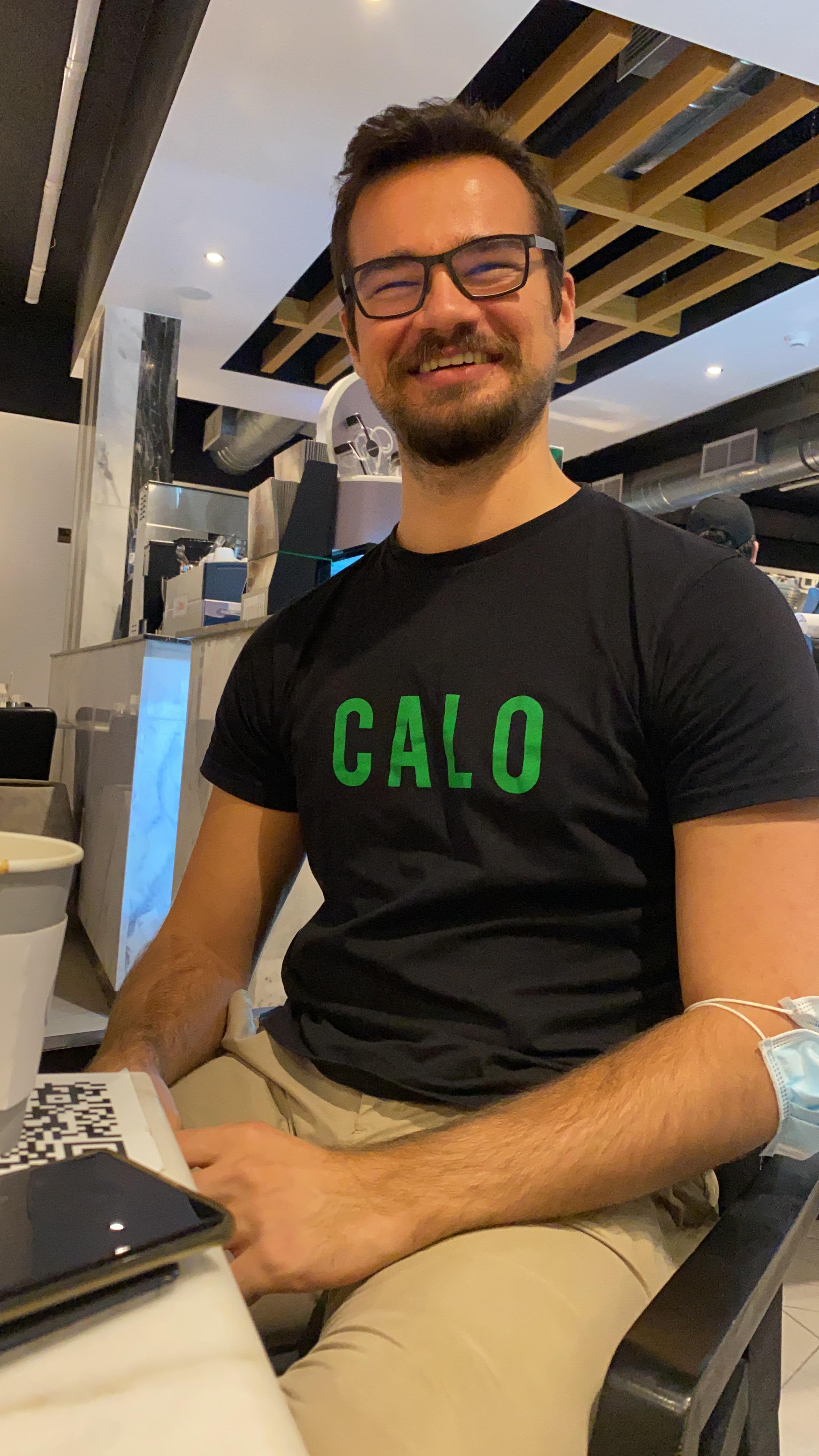
Saudi Arabia required a larger physical undertaking. Khwarizmi Ventures helped arrange a kitchen acquisition in Riyadh and supported preparations for launch. A photograph from June 2021 shows Al Rawi in a Calo T-shirt during the first Saudi delivery period. The company could appear on a phone; the order still required a kitchen, suppliers and a route to the customer.
By December 2024, Calo had raised a $25 million Series B led by Nuwa Capital. A $39 million extension led by AlJazira Capital followed in July 2025, bringing that Series B to $64 million. Repeat investors joined the extension, alongside new backer Oraseya Capital. The initial test had become an organisation that investors were willing to finance again.
Two funding tranches. Bar segments show their relative size.
He keeps score in customer problems
Al Rawi’s writing supplies his own metaphor for this work: business as a team sport. In an October 2024 essay, he compared employees to players and revenues and profits to the score. The underlying action was solving a customer’s problem well enough for that customer to pay. The language is competitive, but the referee is carrying a wallet.
The analogy also puts limits on the solitary founder portrait. A team has different jobs, supporting roles and people whose abilities have to develop as the competition changes. A CEO can set expectations. He cannot personally prepare, pack and deliver every order. The business has to produce a result through other people.
His 2018 decision-making exercise is rather quieter than the sporting language. Write down the problem. List the choices. Examine their strengths, weaknesses, opportunities and threats. Then declare which option already appeals to you before inviting other people to challenge it.
That declaration is the interesting bit. Advice can become a decorative ceremony in which a person collects permission to do what they already intended. Al Rawi’s written method gives the adviser a different job: find the weaknesses in the preferred answer. Ambition gets to make its case, and then somebody gets to cross-examine it.
Put the favourite answer on trial.
- Set out the choices. Write the problem and possible answers.
- Declare the bias. Admit which option already appeals.
- Invite a challenge. Ask others to test the reasoning.
A founder sits on the other side of the table
By March 2025, Al Rawi was also writing about advising and investing in early-stage founders. One meeting began with a familiar list of concerns: marketing, product and hiring. He thought the execution had deteriorated. Before delivering his feedback, he asked whether everything was all right for the person running the company. The conversation changed.
He distinguished problems inside a business from problems that prevent its founder from acting. His practical advice included setting a milestone, giving it a deadline, and making the commitment visible to people whose opinion mattered. He also challenged the idea that an imperfect product must wait indefinitely before meeting its first customer.
There is a family resemblance to the Malaeb broadcast. An actual customer can tell you something that another round of private polishing cannot. That leaves room for both his habits: investigate the opportunity carefully, then put an initial version into the world where someone can respond. The difficult part is knowing which kind of work the moment requires.
The appointment he would rather cancel
Then there is the camping trip. In December 2024, Al Rawi wrote about spending two weeks away with friends, repeatedly answering questions about the following day with the same phrase: “the plan is no plan”. They chose what to do when the day arrived, allowing yesterday’s suggestions to expire without a committee meeting.
Back in his ordinary routine, he noticed how much of it had already been promised away. Even arranging coffee could claim a piece of the future. He wrote about wanting one to three unscheduled days each week, while acknowledging that he was not ready to accept every compromise of a completely unscheduled life.
It is a revealing preference from someone building a subscription company. Customers buy predictability; the founder would like occasional permission to wake up without an appointment. There is nothing especially mysterious about that. Providing a reliable service and wanting some personal freedom can coexist. The calendar, however, is unlikely to surrender without negotiations.
The episode also makes his ambitions less abstract. A company can absorb an unlimited quantity of a founder’s attention. Al Rawi had found a small, concrete thing he wanted back: a day whose contents had not been settled in advance.
Britain asked a different question
Calo’s British expansion in 2025 introduced another kind of test. Through Fresh Fitness Food and Detox Kitchen, the company gained existing teams, supplier relationships and customers. Al Rawi described the appeal of learning from established local operators while bringing in Calo’s technology and operating methods.
Some differences appeared in the buying process. He said British customers required a stronger web experience from the beginning, whereas the Gulf business had concentrated on mobile. Building trust and advocacy also took longer. The product crossed the border with a history; the new customers were entitled to make up their own minds.
His advice to other founders included hiring local expertise, respecting cultural and operational differences, and allowing time for integration. These are sober tasks to put beside an expansion announcement. An acquisition supplies a beginning, along with a substantial list of things that still need to work.
In May 2026, Calo announced that its UK operations would close. UK general manager Caspar Rose set out the timetable: new orders and renewals would stop after May 31, existing deliveries would continue through June 30, and outstanding credits would be refunded. The stated focus shifted to six GCC markets: Bahrain, Saudi Arabia, the UAE, Kuwait, Qatar and Oman.
The closure adds a consequential decision to Al Rawi’s record. The earlier intention to expand and the later decision to withdraw belong together. His career has included leaving an established app, spending scarce savings on experiments, and building a meal business across borders. Each move creates something that can subsequently be reconsidered.
UK expansion through Fresh Fitness Food and Detox Kitchen.
UK closure announced in May. Focus returns to six GCC markets.
Tomorrow still needs a reason
In August 2025, Al Rawi proposed a small exercise for decisions that keep slipping into the future. Ask why an action cannot happen tomorrow. List the obstacles. Convert each one into a task and estimate how long it will take. A vague postponement becomes work with a timescale.
The young Malaeb founder had discovered that people would forward a useful answer to their friends. The Calo CEO has since had to choose which questions deserve years of his life, whose help to seek, and when to change direction. His public writing keeps returning to those decisions. Somewhere beyond the next plan, a customer is deciding whether to come back.
“Speed and urgency are not excuses for not doing something well.”
Ahmed Al Rawi · August 2025