The easiest way to misunderstand Ag Management Solutions is to call it a public-relations company. Public relations is there, certainly. So are designers, editors and people who know what to do when a soybean booth needs a putting green. But down the hall are accountants closing ledgers, administrators assembling board books, technical specialists thinking about trade barriers, and executives answering to farmer directors. The curiosity is not any single service. It is the fact that all of them share an address.
That address is 1020 Innovation Lane in Mankato, Minnesota, where AMS employs more than 30 people. The company was created in 2017 by Tom Slunecka and farmer leaders and is owned by the Minnesota Soybean Research & Promotion Council and the Minnesota Soybean Growers Association. Its premise is less romantic than a sunrise over a cornfield and considerably more useful: a small association may not have enough work for a full-time CFO, editor, event producer, policy specialist and executive director. It still needs CFO-grade books, an edited magazine, a functioning conference, sound policy advice and someone in charge.
“By sharing talented staff, small associations can get the most out of their organizations.”Ag Management Solutions
The expensive fraction
Every small organization eventually discovers the expensive fraction. It needs perhaps two-fifths of an accountant, one-third of a membership manager and six very intense weeks of an event team. Hiring whole people for fractional problems is ruinous. Asking one generalist to do all three is how databases decay, audits become adventures and the annual meeting acquires the emotional tone of an airport cancellation.
AMS sells the fraction. A client can contract for full management or for a department. The menu runs from accounts payable, balance-sheet reconciliation and grant compliance to bylaws, board governance, media relations, websites, member recruitment, sponsorship sales and technical work in agronomy, trade agreements and environmental regulation. The company is broad because its customers are narrow: small and midsize agricultural groups whose missions are specific but whose operating chores look remarkably alike.
This is where AMS differs from a general marketing agency. The campaign is not floating above the organization. The people making the magazine can sit beside the people managing its membership and books. The technical staff understand why an identity-preserved soybean mark matters overseas; the event staff know which members must be in the room. The work continues after the poster comes down.
The campaign that needed more beans
Consider a yield contest in Wisconsin. The contest had a plain problem: participation needed to rise after the previous year. AMS did not merely freshen the logo and hope farmers felt moved. It recast the competition as “Big Bean Energy,” then joined direct mail, print advertising, paid social, email and digital partnerships into one campaign. AMS reports that contest participation doubled in 2024.
The reusable lesson is not “give your project a caffeinated name,” although that probably did not hurt. It is to define the failed behavior precisely. People were not entering. So AMS built a connected route to the entry form across the places those people already encountered the association. An isolated advertisement would have made a prettier artifact. The integrated system made a result.
Two boards enter, one organization leaves
The more revealing case involved two boards with nearly identical memberships. Duplication had become a clue. AMS helped develop a strategy to dissolve the two structures and form the Specialty Soya and Grains Alliance, creating financial efficiencies and one set of goals. It then secured more than $2 million in federal grants to launch the U.S. Identity Preserved brand assurance mark. The mark debuted in December 2021; AMS later reported 13 companies using it to promote products abroad, with more applications waiting.
This is not the typical sequence for a communications contractor. It begins with governance, moves through finance, and ends in international market development. That sequence also reveals the condition on which the model depends: the client must be willing to share operational machinery and let specialists see the whole problem. An organization seeking a single disconnected deliverable can hire any competent vendor. An organization guarding every function as a private kingdom will struggle to gain much from a shared one.
A newsroom hiding in an operations company
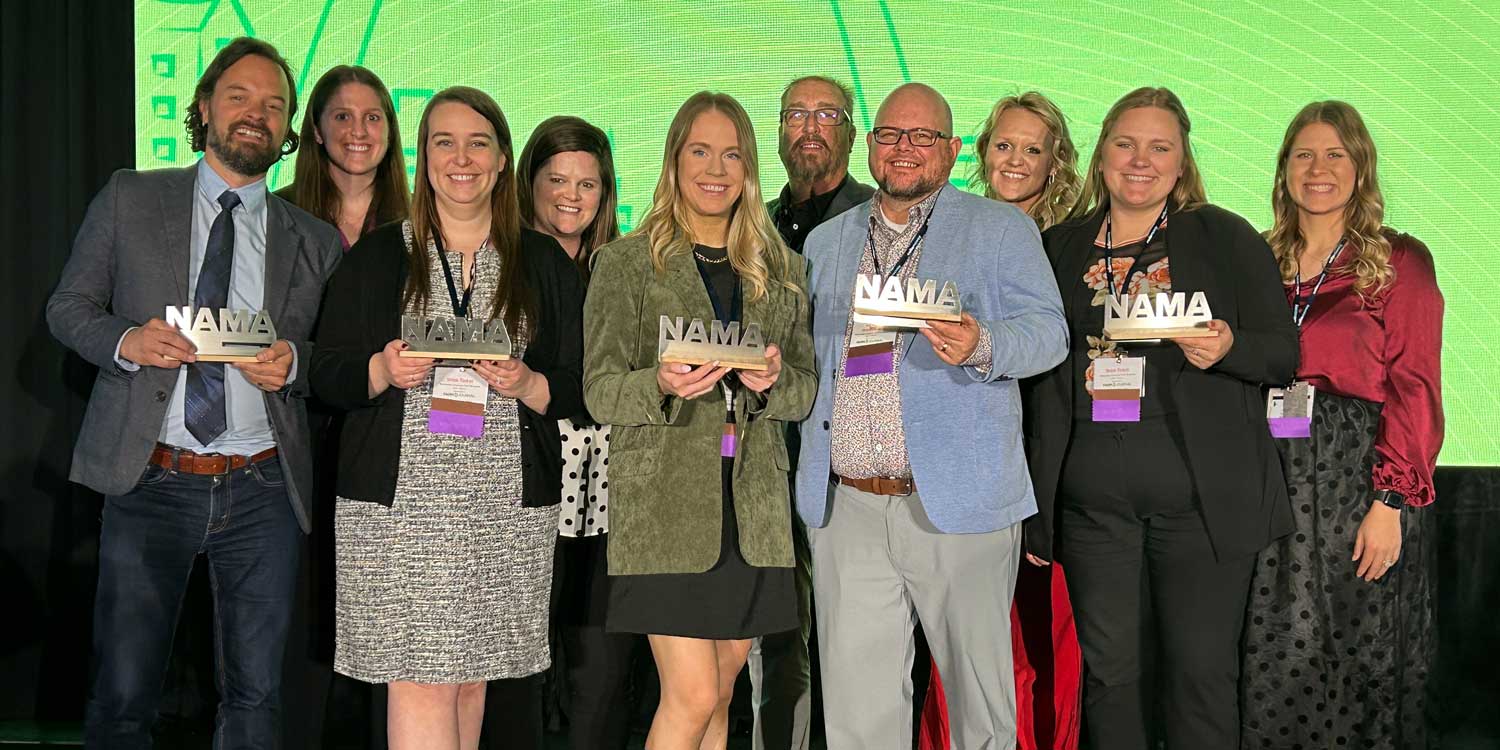
AMS also contains a small agricultural newsroom. Its team produces the bimonthly Soybean Business, whose reported audience is 23,000 farmers, industry professionals and legislators, and Prairie Grains, which covers wheat communities across four states. Soybean Business spent years entering the National Agri-Marketing Association awards, earned a merit in 2024 and finally took first place nationally in 2025. This was persistence with a production schedule.
The creative work can be wonderfully literal. For the 2024 Farmfest, AMS helped build the Mini-Soyta Golf Course, a playable exhibit laid with soy-based turf. It won a national award. Another campaign donated soy-based Skechers to rural health-care workers. Another put soy-based Goodyear tires on law-enforcement vehicles. Each turns an abstract claim - soy has uses beyond food - into an object somebody can putt on, wear or drive.
The useful trick is to make the organization’s invisible value visible - sometimes as a balance sheet, sometimes as a magazine, and occasionally as a golf hole made of soy.
Four things worth stealing
Buy the missing department
List recurring specialist work before adding full-time roles. Several clean fractions can be cheaper and better than one heroic generalist.
Treat duplication as evidence
When boards, lists or programs substantially overlap, ask whether the structure serves the mission or merely remembers its history.
Join the channels
The Big Bean Energy result came from direct mail, print, social, email and partners pointing toward the same behavior.
Give the idea a body
A shoe, tire or putting green makes an agricultural innovation easier to grasp and easier to repeat to somebody else.
There are limits. AMS is built for agriculture and for organizations comfortable with a farmer-owned provider. A large enterprise with deep in-house departments may find little advantage in sharing. A board that needs fully independent advice on a matter involving AMS’s owners would need especially clear conflict safeguards. And a group that changes priorities daily will still create confusion - access to thirty specialists does not produce a thirty-first person whose job is mind reading.
But for the right association, the appeal is almost embarrassingly practical. Leaders can spend more time choosing direction while somebody else reconciles the account, retains the member, edits the story and books the room. In a sector fond of grand technologies, Ag Management Solutions has made a business from a modest innovation: no one said every organization had to own the whole back office by itself.