For six years, Lorri Rishar and Angela Witwer went shopping for the same thing. They worked together at a Lansing-area health care organization, and whenever a communications problem arrived, they looked outside for help. The ideal firm would understand research, strategy, media, design and the peculiar diplomacy of organizations with many stakeholders. The search kept producing fragments. One agency could think. Another could make. A third could place the ads. Nobody quite resembled the thing in their heads.
Then Witwer walked into Rishar's office with the sort of question that sounds obvious only after someone else asks it: Why don't we open the agency we're always looking for?
That was 2007, an awkward moment to leave corporate work and begin a service business in Michigan. But the first failure had already happened. It was not a failed product or a lost account. It was the market's repeated failure to supply a vendor that could carry a communications job from the first awkward question to the last measurable result. Edge Partnerships was built to close that gap.
“Why don't we open the one agency that we're always looking for?”Angela Witwer, as recalled by co-founder Lorri Rishar Jandron
The product is the handoff that never happens
Today Edge is a full-service agency with headquarters on East Kalamazoo Street in Lansing. Its menu covers strategic research, public relations, social management, branding, design, traditional and digital media planning, events, fundraising and association management. The list is broad enough to resemble six small companies sharing a reception desk. The better way to understand it is as a single promise: the client should not have to translate the same problem for six vendors.
That matters because Edge's typical assignment is not a fashionable consumer launch. Its public portfolio includes counties, health departments, schools, trade associations, food banks and nonprofits. These clients have residents, boards, members, funders, reporters, employees and elected officials to consider. They often need a landing page, a press strategy, an annual report, a media buy and an event plan at once. A beautiful campaign that cannot survive procurement, translation, a board meeting or a bus wrap is merely a beautiful campaign.
The working sequence
- Research the audience
- Claim a position
- Choose the channels
- Implement and measure
Edge describes its process in similarly plain terms. Gather baseline intelligence through existing data, surveys and focus groups. Assess the environment. Define the audiences. Decide which messages and channels fit their behavior. Build a schedule and allocate resources. The method is hardly mystical. Its commercial value comes from disciplined completion.
The proof in public
Three months, 3.5 million people
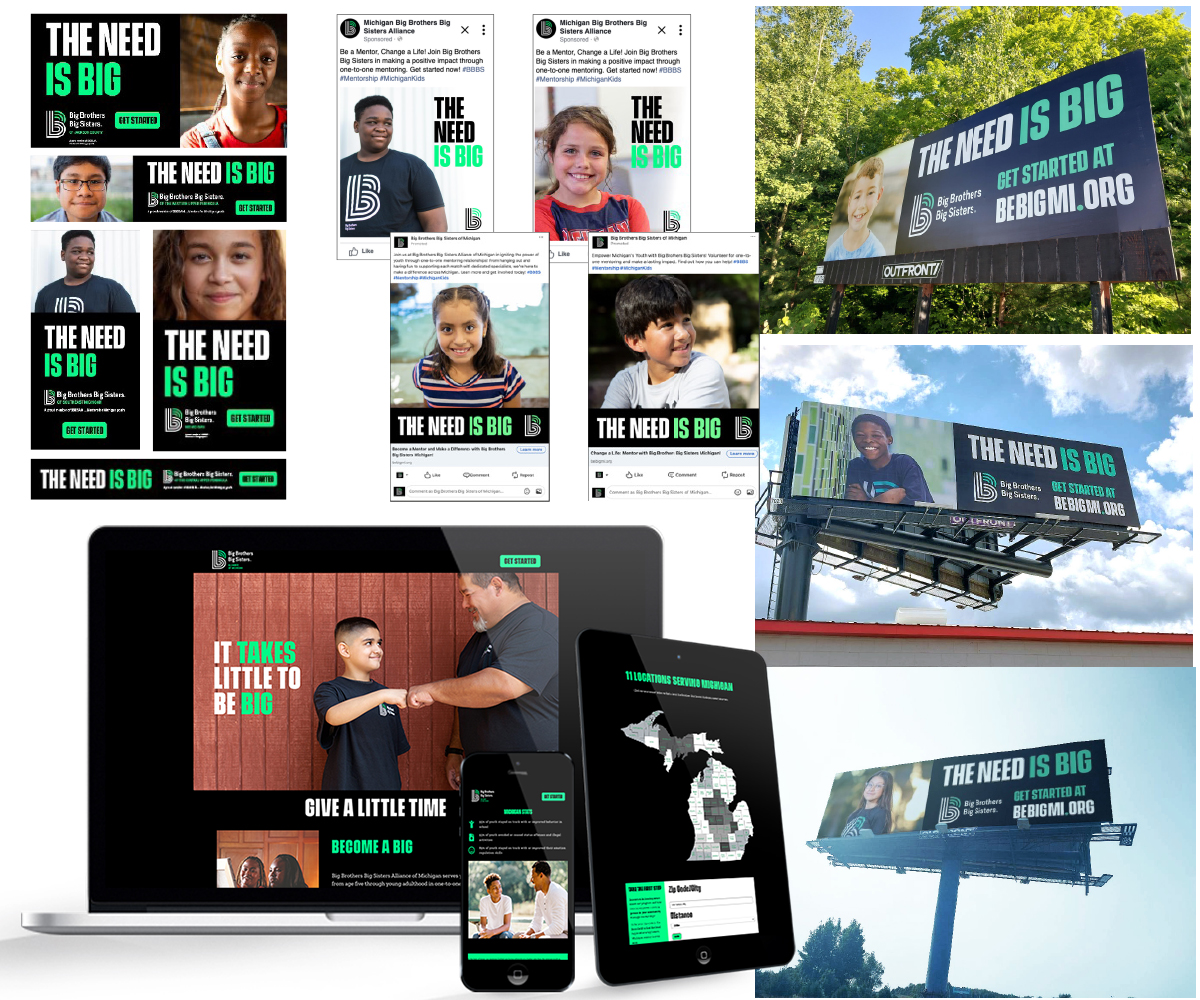
Consider The Need Is Big, a 2023-24 campaign for the Big Brothers Big Sisters Alliance of Michigan. The pandemic had thinned the supply of adult mentors. The alliance, representing 11 regional agencies, wanted statewide awareness and more volunteers, particularly Black professional men. This was not a general request to “raise awareness.” It was a recruiting problem with a specific shortage.
Edge built a campaign landing page, then combined Facebook, LinkedIn, streaming television and broadcaster inventory. Over three months, the work reached more than 3.5 million Michiganders. Facebook generated 12,748 link clicks and LinkedIn produced 12,123. Streaming placements delivered more than 650,000 impressions. The landing page received 25,993 visitors and nearly 37,000 sessions, with a reported average visit of seven minutes and 30 seconds.
The clever detail was economic. Through a relationship with the Michigan Association of Broadcasters, Edge says the campaign delivered more than three dollars in media value for each dollar spent. In other words, the agency's advantage was not just what it said. It was knowing the pipes through which the message could travel.
A bandage can be a public-health verb
The Your Shot vaccination campaign began with a different shortage. Countywide vaccination rates had fallen after the pandemic. Edge and the Ingham County Health Department turned a familiar phrase into an invitation: take your shot to protect loved ones, keep the community healthy, lead and protect the future. Bright bandage icons made the instruction visible from a passing car. The campaign appeared on billboards, buses, television, social media, display ads and multilingual print material. Two neighboring health departments adopted it too.
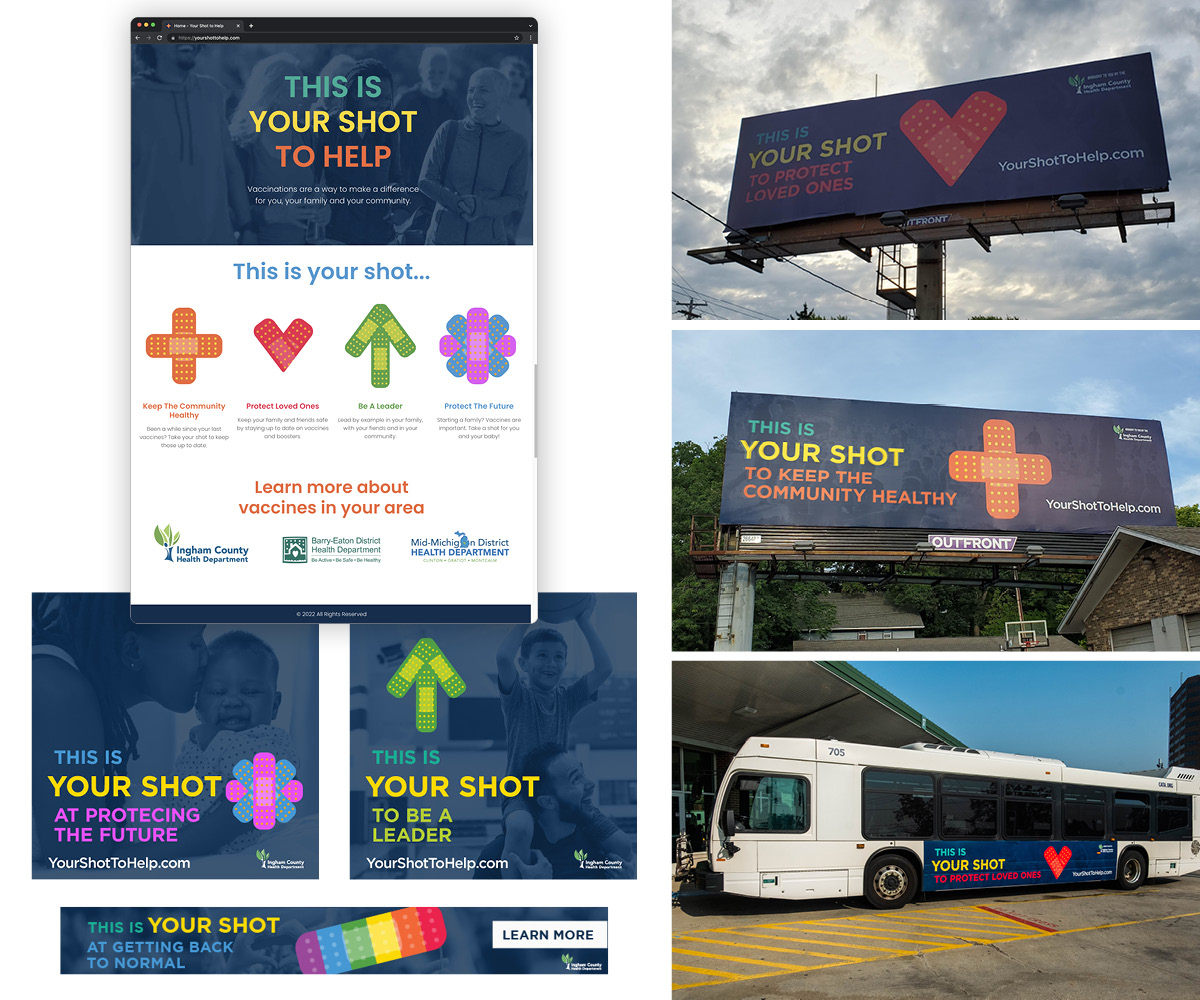
The work won a local silver ADDY and a national Gold Aster Award. Awards are pleasant, but adoption is the more revealing signal. A campaign conceived for one county proved portable enough for three health departments because the idea was simple, the design system could flex and the delivery plan was already attached.
What did it cost?
Edge does not publish a rate card, and the visible prices belong to particular public contracts rather than a standard package. That caveat matters. Still, government records provide a rare peek behind agency language. In 2025, Edge proposed a $38,000 all-inclusive annual public-relations retainer to Ingham County. In 2026, the county authorized a separate Discover Greater Lansing promotional plan for no more than $34,999.
A public ceiling, not a universal price
The year-long Discover Greater Lansing package specified monthly promoted posts, 57,870 display impressions per month, broadcast spots on WLNS and WLAJ, interviews, web pages and streaming content.
That specificity explains where Edge sits in the market. It competes with Michigan integrated agencies such as GUD Marketing, Piper & Gold, InVerve, 8THIRTYFOUR and Burch Partners. It also competes with a client's temptation to split the job among a freelance designer, a media buyer, an event producer and an internal communications manager. Edge's pitch is coordination, priced and measured as a package.
A county is not a sneaker
For Eaton County, selected through a competitive bid in 2023, Edge created an internal and external communications strategy, key messages and earned-media work within 30 days. It completed a county logo and brand system within 60 days. Over the following year, county milestones, sheriff's reports and resident news generated more than 50 media reports. The deliverables included newsletters and a landing page for a tax limitation proposal.
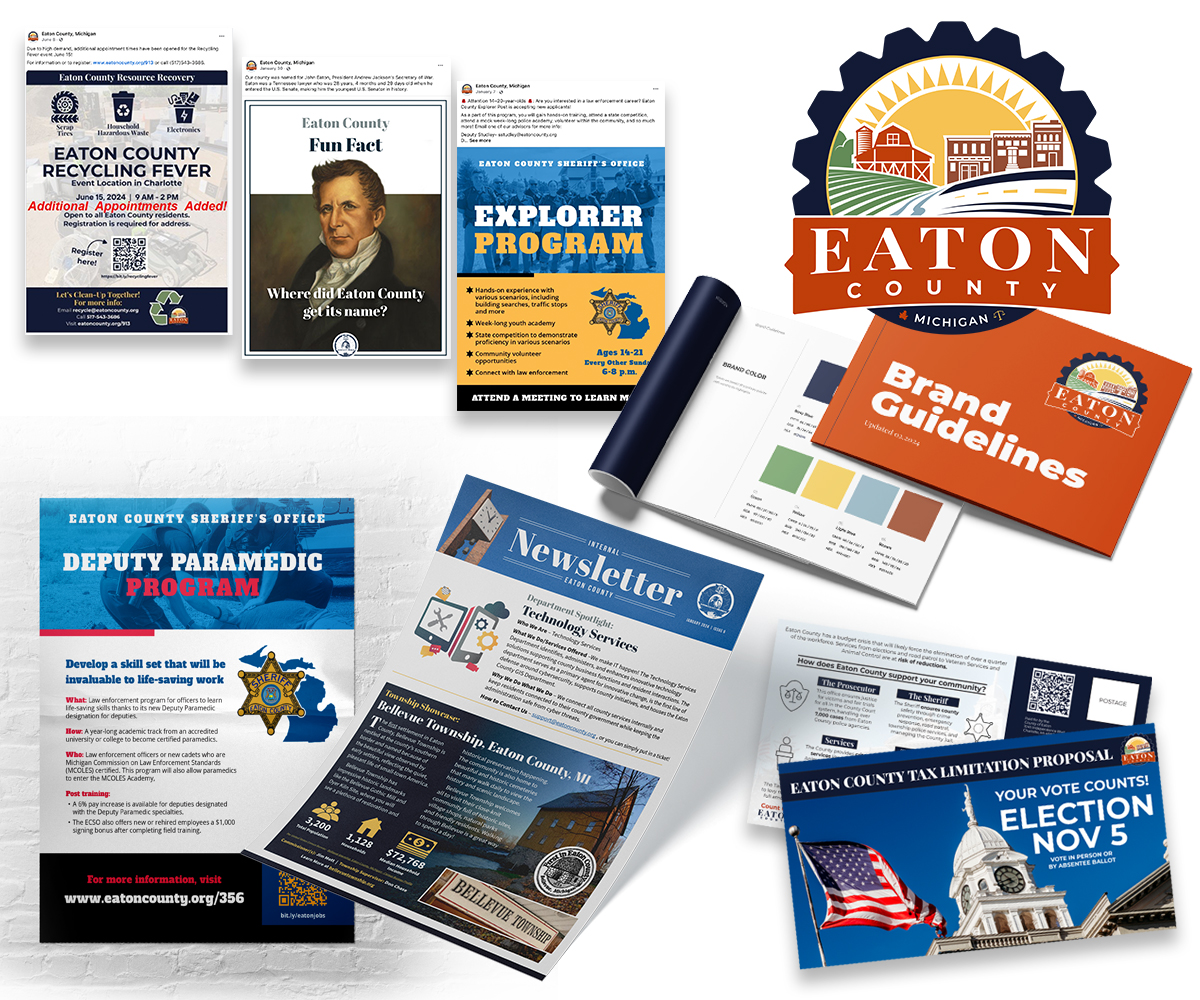
Branding a county is not like branding a sneaker. People can decline to buy a sneaker. They cannot decline to be residents. The design must hold farm fields, small towns, law enforcement, taxes, recycling and job openings without turning any one of them into the whole story. Edge's work is strongest under precisely these conditions: the audience is broad, the stakeholders are numerous, the subject is consequential and implementation has many moving parts.
The inverse is also useful. A founder seeking one viral launch, an app chasing rapid global acquisition or a luxury label built on exclusivity may prefer a specialist with a narrower cultural lane. Edge's public record is deepest in Michigan institutions, public-interest behavior and organizations that reward consensus. Its method also requires access to data, stakeholders and decision-makers. Without those, “research first” becomes decoration.
The people who remember why
Service firms often lose their memory when their people leave. Edge's chief creative officer, Aaron Pumfrey, marked his 18th year at the company in 2026. He began as a freelancer after a pro-bono event, became the young agency's lone employee and stayed. Rishar says the firm supports mental and physical health, career growth, family needs and flexible hybrid schedules. Pumfrey describes being trusted to experiment and develop his own creative approach.
This is culture with an operational consequence. Long tenure preserves the reason behind a brand choice, the temperament of a board and the lesson from a past campaign. Edge says some clients have remained since the beginning. In a business of repeated briefings, memory is a form of margin.
What another team can copy on Monday
- Write the audience shortage in one sentence before choosing a format.
- Collect baseline data before promising reach, clicks or behavior change.
- Design one visual idea that survives a phone, a billboard, a bus and a board packet.
- Put owners, dates and measurement inside the strategy instead of attaching them later.
- Use partnerships to stretch distribution, not to decorate a press release.
The lesson of Edge Partnerships is not that every frustrated buyer should start a company. Most complaints are merely complaints. The useful ones recur, cost time and remain unsolved after reasonable effort. Rishar and Witwer saw the same gap for six years: thinking over here, making over there, accountability somewhere in between. They stopped searching when they realized the missing agency was a design brief.