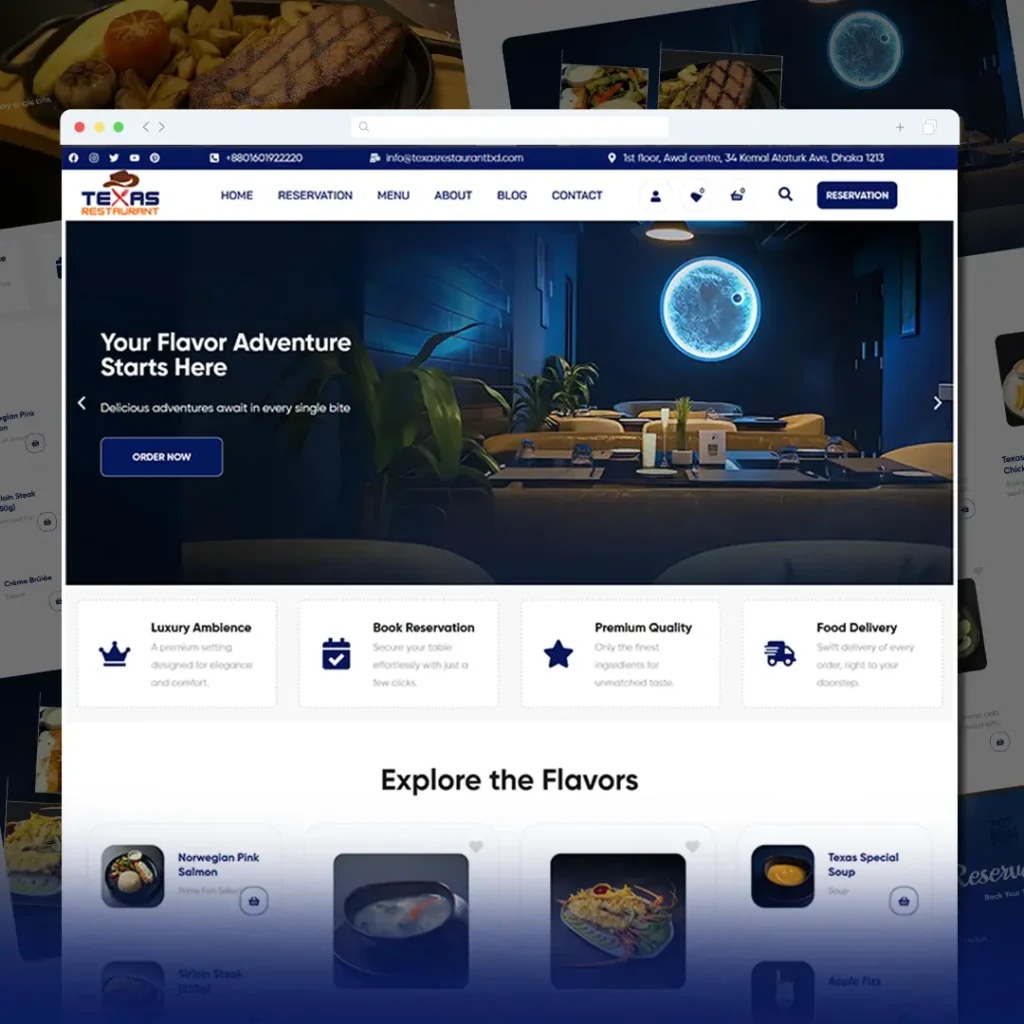
A restaurant website contains a small promise. Choose a dish, book a table, place an order: somewhere behind the photographs, a real business must make good on every click. In Samrat ICT’s portfolio, the Texas restaurant website puts reservations and food delivery beside images of dinner. The interesting part begins when the customer stops browsing. Someone still has to handle the table, the payment, the ingredients and the next shift.
- Builds websites and custom software, then offers content and marketing to support them.
- Serves businesses across sectors, with a Dhaka base and an international client mix.
- Its practical pitch: fewer handoffs between the people attracting customers and the people building business systems.
Samrat ICT Ltd. has assembled its services around those adjacent jobs. It sells web development, business applications, creative work and digital marketing. That breadth can look untidy on a services menu. Read through the lens of a restaurant owner, however, and the menu becomes more coherent. A visitor, an order and an inventory record belong to the same business, even when three different specialists usually handle them.
The website is only the front door
The company’s restaurant management offering describes order and table management, billing, stock control, menu changes, customer records and staff scheduling. Its restaurant website offering occupies the public side of that operation. The two are related, but they are separate pieces of work. A good-looking reservation button does not, by itself, establish that a booking reaches the person managing the dining room.
This distinction matters when assessing Samrat ICT. Its catalog describes capabilities a buyer can commission, rather than proving that every listed module comes connected in every installation. The useful proposition is access to several disciplines within one supplier. The useful question is how those disciplines meet on a particular project. Ask where an order goes after checkout. Then ask who fixes it when it goes nowhere.
One customer, several kinds of work
The same pattern appears in its e-commerce services. Samrat ICT lists product catalogs, inventory, payment gateways, checkout, shipping and returns. It also offers search optimization and marketing integration. A shop’s problem can therefore be approached from either end: making it easier to buy, or getting the right visitor to arrive. Those jobs require different skills, but the result depends on both.
Its business management software goes further inside the organization. The advertised functions span accounting, invoices, customer relationships, stock, human resources, tasks and reporting. Education management has its own vocabulary: attendance, examinations, parent portals and fees. The common thread is administrative work. Each offering proposes a way to turn recurring records and decisions into software that staff can use.
The portfolio makes the audience more tangible than an industry label would. It includes Monowara Hospital, Health Aid Hospital, Sunshine Maritime BD, Texas and Akhi Mart. These are company-listed examples, not a census of deployments. Together they show the range Samrat ICT chooses to present: healthcare, maritime businesses, restaurants and retail. Accounting sits within that range of operational needs, rather than defining the entire company.
The handoff is the product
A buyer has several plausible alternatives. A website builder can handle a straightforward online presence. A specialist agency can concentrate on advertising. A packaged business application can supply established workflows. Samrat ICT occupies the space where a customer wants implementation across several of these jobs, including custom development. Its distinction is the combination it offers; the public material does not establish an exclusive technology advantage.
Look at the team page and the combination becomes visible. It separates web developers, software engineers, quality assurance staff, designers, audio and video specialists, market researchers and advertising specialists. Those are different crafts. Their presence on one roster helps explain the business model: commissioned services around building, promoting and maintaining digital systems, with customization and continuing support included in the advertised scope.
The handoff deserves as much attention as the homepage.
An observation on the service model
For a customer, the potential saving is coordination. That is an interpretation of the service mix, not a measured financial result. One brief can establish what the website promises, what the software must record and what a campaign should attract. The economics still need to be worked out project by project: development scope, integration work, support obligations and advertising spend are different budget decisions. A tidy proposal should make those boundaries explicit.
From outsourcing to its own experiments
Samrat ICT dates its establishment to 2012. Its published history places a training division in 2013, entry into the US market in 2014 and Canada in 2015. Later entries describe digital marketing expansion in 2018 and an ERP project in 2022. These are the company’s account of its development. They describe a widening remit, from technical delivery toward a broader collection of business services.
The newer experiments extend that habit. Its sister-concern page describes Spiderman AI as a content creation toolkit, Purbachal City as a local directory and Akhi Mart as an online retailer. The company’s 2025 timeline entry discusses AI and SaaS development. These projects give the profile a distinctive twist: an agency offering to build other people’s digital businesses also presents digital ventures of its own.
Copy the brief before the feature list
The transferable idea is modest and useful. Start with one complete customer journey, then follow the work into the business. For a restaurant, that might mean discovering the menu, booking a table and recording the payment. For a school, it might mean sending a fee notice and reconciling the result. Name the handoffs, decide who owns them and make the acceptance criteria observable.
This approach fits a buyer whose needs cross disciplines and who can commit time to defining workflows. A simple brochure site may call for a much smaller engagement. An organization needing specialized regulatory controls or deep integration should establish those requirements before selecting any generalist supplier. Breadth becomes valuable when responsibility stays clear. Samrat ICT’s menu makes that conversation possible; the buyer’s job is to turn the menu into a precise order.
See the work up close
Explore Samrat ICT, its project portfolio and company blog. Follow the company on LinkedIn, X, Facebook, Instagram and YouTube.