In January 1967, Ron Martin and Marty Sixt visited agricultural researchers in Columbus, Ohio, with questions about plastic drainage tubing. The researchers offered a wonderfully unglamorous piece of advice: keep the diameter at four inches. Farmers were already being asked to abandon clay and concrete. Asking them to accept a different pipe size, too, would make the sale harder.
That encounter, recorded by USDA engineer James Fouss, offers a useful entry into Advanced Drainage Systems. A material can be new while the customer's habits remain familiar. Almost six decades later, ADS still operates at that intersection: changing what goes underground while making construction above it easier.
- ADS sells pipe, underground storage, drainage components, and onsite wastewater systems.
- Its customers buy usable land, manageable runoff, and equipment that fits the job.
- Recycling, engineering support, and delivery help turn plastic products into a repeatable business.
A parking space with a second job
Consider a parking lot. It earns its keep by accommodating cars. Rain creates another obligation: collect the runoff and control where it goes. A surface pond can occupy land the developer would otherwise use. Underground storage lets the same footprint perform two jobs.
ADS's StormTech chambers form buried rows of arched storage space. Water can be held for controlled release or infiltrated into suitable ground. The SC-800, designed primarily for parking lots, needs a minimum of 15 inches of cover, compared with 18 inches for the SC-740. A difference of three inches sounds trivial until you are designing within a fixed vertical envelope.
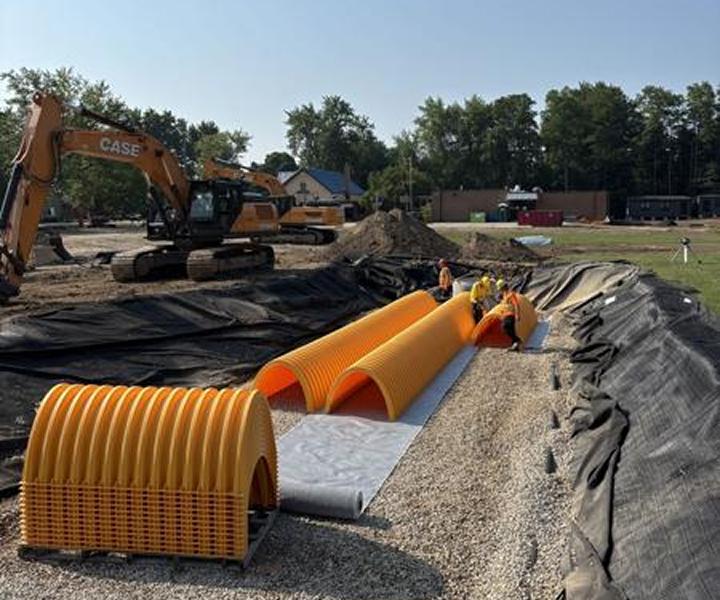
There is a particularly concrete example, despite the plastic. At the Centre Park hotel project in West Chester, Ohio, 381 StormTech MC-4500 chambers were installed beneath the parking lot in 2014. The system provided 516,254 gallons of storage. The cars and the rain could occupy the same address.
Conceptual sequence. Treatment can occur at multiple points; every site needs its own design.
The smooth part of the argument
Founded in 1966, ADS began in agricultural drainage. Its N-12 pipe later combined a corrugated exterior with a smooth interior: structural strength outside, a less obstructed path for water inside. That design helped carry the business into storm sewers and other engineered construction applications.
Today the product family includes HDPE and polypropylene pipe, fittings, Nyloplast basins, StormTech storage, and water quality equipment. Infiltrator adds septic tanks, drainfield chambers, and treatment systems. NDS extends the range around homes into drainage and irrigation. These are manufactured goods sold into commercial, residential, infrastructure, and agricultural projects.
The buying group is wider than the person placing the order. Civil engineers specify systems; contractors install them; distributors stock products; developers and public agencies need functioning sites. ADS supports that chain with technical resources and a company-owned delivery fleet. In a business tied to excavation schedules, availability is part of the product.
This explains why comparing pipe prices alone misses so much. The relevant unit is a finished installation. A lighter component may change handling requirements; a different chamber layout may change excavation. Neither advantage automatically makes a project cheaper. The engineer still has to reconcile loads, available depth, runoff volume, and the receiving environment. ADS's opportunity lies in helping those decisions fit together. Its competition comes from manufacturers offering other ways to reach the same outcome, including regional plastic suppliers and concrete or metal systems already familiar to the specifying engineer.
The relevant unit is a finished installation.
Yesterday's bottle, tomorrow's drain
ADS also buys discarded HDPE and polypropylene, including material from detergent bottles, crates, and bottle caps. It sorts, grinds, cleans, pelletizes, and blends the plastic before manufacturing. The interesting work is in the formulation: turning variable incoming material into something suitable for a specified engineering application.
Recycled material processed. The reporting period matters: older ADS pages carry different annual figures.
The company describes its purpose with four words: Our Reason is Water
. The economics belong in the picture, too. Recycling gives ADS another source of raw material. Its 2026 earnings commentary explicitly discussed shifting toward lower-cost material to help offset inflation. Environmental usefulness and procurement discipline can share a production line.
Buying the next water problem
This expansion has a price tag. ADS paid approximately $1.08 billion for Infiltrator in 2019 and approximately $1 billion for NDS, completing that deal in February 2026. The purchases extended its reach into onsite wastewater and residential water management. They also added businesses to integrate, rather than just new products to list.
Growth has exposed less flattering engineering problems inside the company. Its amended fiscal 2016 filing described restatements and weaknesses involving leases, inventory, journal entries, and other accounting controls. Management reported remediation work. That history adds a useful complication to the industrial success story: the reporting machinery needs attention alongside the factories.
For the year ended March 31, 2026, ADS reported $3.05 billion in sales, up 5%. Net income from continuing operations fell 5%, partly because of acquisition and restructuring costs. Revenue growth and the cost of achieving it deserve separate lines on the page.
Rain makes an awkward customer-acquisition strategy. In its August 2025 earnings release, ADS said wet weather had delayed installations, while elevated interest rates remained a headwind. The need to manage water does not guarantee a convenient construction schedule. Customers still need financing, crews, and a site that can be worked. Long-term demand and next quarter’s orders can tell different stories.
Even plastic has to make room for concrete
October 2026 supplied an intriguing next chapter: an agreement to acquire StormTrap for approximately $530 million. The deal, expected to close in the fourth calendar quarter subject to approvals, would add access to a precast concrete partner network for large, deep, constrained storage projects. For a company built around plastic's advantages, that is a revealing choice of expansion.
The practical lesson is to follow the site problem. Concrete, steel, PVC, and rival plastic systems remain alternatives. Soil or regulation can prevent infiltration; StormTech describes lined detention arrangements for those circumstances. Sediment also needs accessible collection and cleaning. A buried system still has a maintenance schedule.
For readers choosing drainage, the copyable habit is to compare a complete installed system: excavation, storage, treatment, access, and upkeep. For business builders, it is the four-inch lesson from 1967. Keep enough of the customer's world familiar that a useful change can actually get bought.