Before Adrianna Nowell was paid to explain software, she was paid to write it. Before she managed marketers, she helped customers make technical systems behave. The beginning matters because her later career can look, at a distance, like a series of turns: developer, applications engineer, product marketer, marketing director, vice president, chief marketing officer. Up close, it looks more like one long act of translation. She learned how machines speak, then how customers speak, then how teams speak when the work is moving faster than the org chart.
Nowell, usually called Adri, studied computer science at the University of Oklahoma. Her campus life was not confined to a terminal window. She founded and led the university's Women of the Association for Computing Machinery chapter, participated in the Society of Women Engineers and Engineers Club, held roles in Alpha Chi Omega, and joined OU Cheer. Code may reward exactness, but all those rooms require another faculty: persuading people to move together.
She worked as a software developer at the university, then joined National Instruments through an applications engineering internship. By 2008 she was an applications engineer. A year later, she moved into product marketing. There is a pleasing logic to the transition. Applications engineers live at the seam between a product and the person trying to use it. Product marketers live at almost the same seam, only the questions widen. What is the customer trying to accomplish? Why this tool? Why now? What must be true for the promise on the page to survive contact with the product?
A debugger's route into marketing
Nowell did not discard the engineering part of herself when her title changed. Her public record from those years includes an IEEE conference paper on using modern ANSI C development tools, followed by articles about instrumentation software and productivity. The subjects sound far from brand strategy. The underlying skill is familiar: reduce a complicated system to the part that matters, preserve accuracy, and leave the reader able to act.
One career, six markets
The products kept changing. At Volusion, she rose from senior product marketing manager to director of marketing for Mozu, the company's enterprise commerce platform. At Bazaarvoice, she became senior director of product marketing. Then came Rev, the speech-to-text company, where she served as vice president of marketing from late 2019 to 2022. Brightspot followed, giving her the CMO title and responsibility for brand strategy, demand generation and communications.
Instrumentation, ecommerce, customer reviews, transcription and content management do not share a neat buyer or vocabulary. They do share a problem: a useful technical product can remain obscure unless somebody understands both its internal logic and the customer's lived context. Nowell built a career in that middle territory. The engineer asks whether it works. The marketer asks whether anyone understands why it matters. She had reason to ask both.
“Trust is the foundation that leads to results.”Adrianna Nowell, on leading a remote team
Seventy thousand people, one story at a time
At Rev, Nowell's public description of the business moved easily between scale and intimacy. She spoke of roughly 70,000 transcription professionals, a workforce large enough to become a statistic in a presentation. Then she supplied the human cases that made the number mean something: caregivers earning while looking after an older parent, and mothers transcribing near a child in the hospital. For them, remote work was not office policy with a nicer chair. It was room to arrange income around responsibility.
“When I connect with the Rev-ers in our community, it brings me so much joy,” she said. The line is revealing because it does not pit analysis against empathy. Nowell's marketing philosophy, as she has described it publicly, is data-driven and customer-focused. Data helps locate the pattern; a conversation supplies its temperature. Metrics can establish that a marketplace exists. A caregiver's Tuesday afternoon explains why it deserves attention.
That instinct carried into management. Leadership required a different kind of translation, particularly when individual contributors became managers and had to surrender work they knew how to do well. Nowell borrowed a metaphor from the operator Molly Graham: imagine building a LEGO tower, then giving it away. The new owner might change it. They might extend it in a direction the original builder would not choose. The anxiety is natural because competence has become identity, and delegation can feel like watching identity walk off in somebody else's hands.
The point of scale, however, is not to place a museum rope around the tower. The builder has to become the person who creates conditions for other builders. Nowell said she found it useful to name the emotional roller coaster directly. That small choice turns a management abstraction into something a nervous new leader can hold. Everybody understands the terror of a beloved construction wobbling on the way across the room.
Her own path offered repeated rehearsals for that surrender. A product marketer cannot personally write every feature, close every sale or sit beside every customer. The job depends on influence across functions whose incentives do not arrive neatly aligned. Engineering knows what can be built. Sales knows which objections keep returning. Customers know where the workflow pinches. Marketing has to make those accounts cohere without pretending they are identical. For someone trained to debug, the temptation must be to locate the one faulty line. Organizations are less courteous. Their problems are distributed, and so is the knowledge required to solve them.
When the CMO calls without a calendar invite
At Brightspot, the lesson acquired a comic prop. Nowell liked making quick, unscheduled calls to teammates to discuss an idea, a project or the general shape of a strategy. Not everybody delights in seeing the CMO's name suddenly illuminate a phone. Her team teased her about it. On Halloween, revenue marketing leader Jessie Kennedy dressed as the incoming call itself, a costume alarming enough to qualify as affectionate organizational satire.
Nowell shared the joke, then explained the behavior beneath it. Remote work had removed the collaborative chatter of a shared office. Short calls could restore a little of its informality without manufacturing another meeting. Human connection helped establish trust; trust made useful disagreement and coordinated work possible. She also noted that the approach was not for everyone and that different boundaries and work styles deserved respect. A quirk is only charming while it notices the person on the other end.
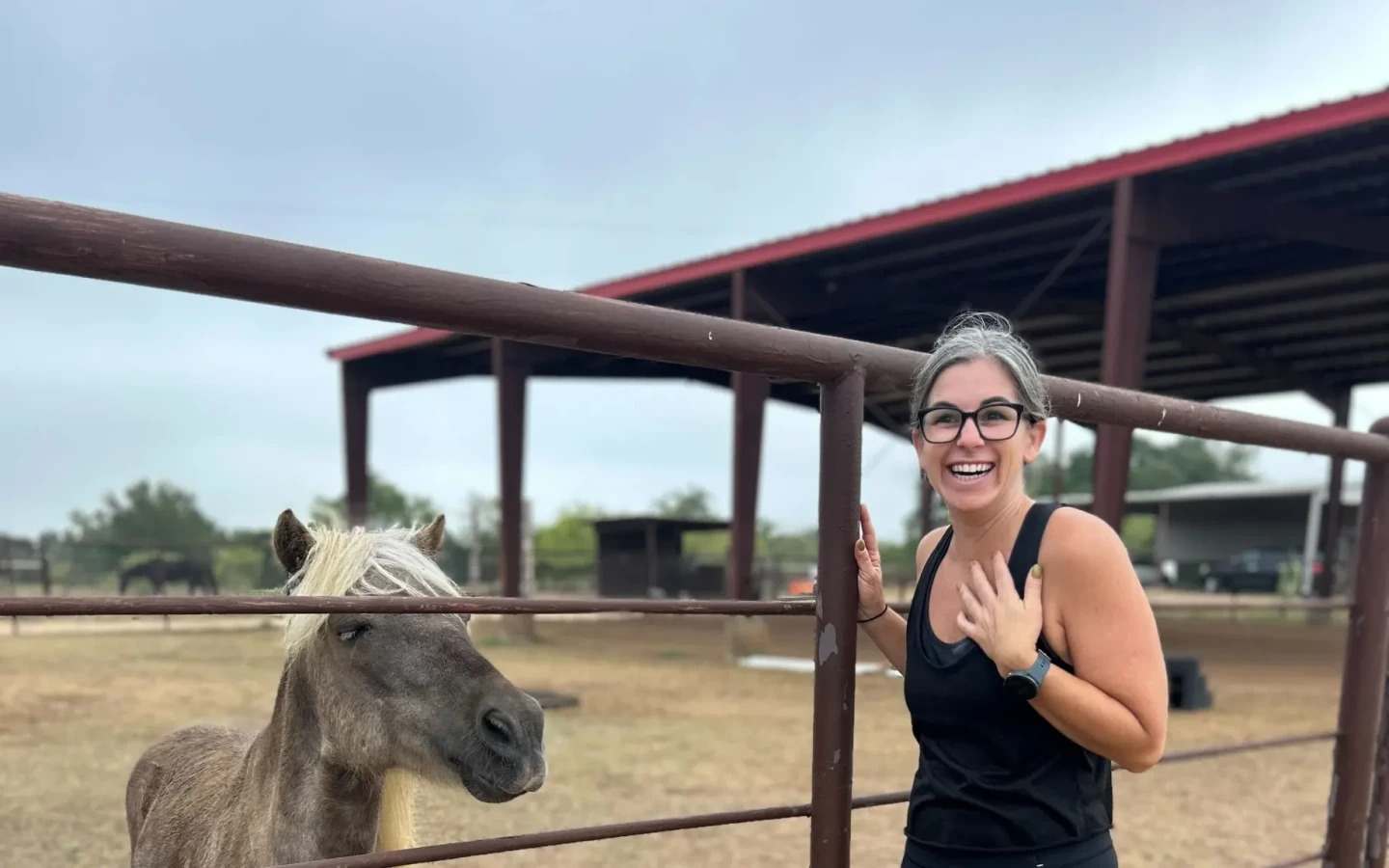
A photograph from her Brightspot years supplies an unexpectedly good visual footnote. On a 2023 volunteer day at Restoration Ranch near Austin, Nowell stands beside a small horse, one hand on a fence and the other caught mid-gesture, laughing. The Brightspot group spent a hot day on seasonal chores, painting and helping construct a wooden run-in for the horses. Corporate biographies tend to sand people down to competencies. A candid can return the weather, the fence and the joke.
Software for the people behind the walls
In March 2025, ServiceTrade announced Nowell as its chief marketing officer. Her brief covered go-to-market strategy, brand building, growth, market awareness and product adoption. The company makes software for commercial service contractors, including mechanical, HVAC and fire protection businesses. These are the crews whose work is often noticed when it has not happened: the inspection missed, the system down, the building suddenly uncomfortable.
Nowell's reason for joining was grounded in that consequence. She called the commercial service trades essential to the economy and to the safe operation of the nation's buildings. Her move placed another technical system in front of her, but this one came attached to dispatches, assets, inspections, contracts and technicians moving through physical space. Field service software may live in the cloud; its promises have to survive on ladders, rooftops and mechanical-room floors.
It is an apt destination for a career spent between abstract tools and concrete outcomes. A dispatch screen becomes a technician arriving at the right building. An inspection record becomes evidence that a promise was kept. A dashboard becomes a decision about time, labor or margin. The marketer's task is not to decorate those conversions. It is to describe them clearly enough that a contractor can judge whether the system belongs in the business. Technical fluency helps because the claim can never outrun the workflow for long.
A year into the role, she described joining ServiceTrade as a leap into a new industry, one that some people did not fully understand. By April 2026 she was writing about AI with a title that carried her usual preference for the practical: “Automate Your Saturday Before You Automate Your Monday.” Her opening urged professionals to push themselves to learn AI if their jobs were not already doing so. It sounds much like applications engineering. Touch the tool. Learn its behavior. Then explain what it can do.
There is no tidy border between the technical Adrianna Nowell and the marketing one, or between the analyst and the leader. Her career is more interesting because the older skills remain visible inside the newer ones. Code gave her a respect for systems. Support brought her closer to users. Product marketing demanded compression without distortion. Executive leadership added the hardest requirement: let other people alter the tower.
The C-suite title may be the line people notice. The useful story sits in the crossings that came before it. Nowell kept moving toward jobs where the machine and the room needed an interpreter. She learned both languages well enough to know that neither is ever finished.