Before Adriana Gil Miner learned to sell the future, the future was humming inside her family home in Venezuela. Both of her parents were engineers. Her mother was a chief information officer. In the middle of the 1980s, when a personal computer still looked faintly extraterrestrial, the household had three of them. There was early email, text-based internet, access to ARPANET and, by age thirteen, code camp. Miner noticed the machines. She was more interested in the people gathered around them.
She was a humanist in a technical family: a dancer, a writer and an art student from elementary school through high school. She grew up in what she has called an Argentine culture bubble inside Venezuela, the daughter of Argentine immigrants, and often felt slightly outside even her own country. The condition proved useful. An outsider watches. A writer asks why. A marketer, at least the sort Miner would become, turns observation into connection.
That combination has followed her through more than two decades of technology marketing, across American Express and agencies, design and data, cloud storage and customer messaging. In 2025 it carried her into Pindrop, the Atlanta-based cybersecurity company that analyzes voice, device and behavioral signals to catch fraud and verify identity. Her latest subject is synthetic media, but the question beneath it is older than software: whom do you believe?
The analyst who preferred the subtext
Miner came to the United States in 1999 with a stated dream of becoming a global citizen. New York, a city where nearly everyone appears to have arrived from somewhere else and is already late for something, made a fitting first stop. At Digitas, she became a new-media data analyst. The title dates the era rather charmingly. Her practical work included copying numbers into spreadsheets and producing reports. Her useful discovery was that a row of figures could be read as a record of desire, hesitation and habit.
The numbers brought her to American Express, where she worked on digital platforms and learned from an organization built around customer service. Then she moved into public relations at Weber Shandwick, crafting stories for Microsoft, Samsung and a small data-visualization client named Tableau. She saw the product, watched people use it and decided the startup could change how ordinary workers understood data. She joined.
There was an intervening chapter at the product-innovation firm Artefact, where she became chief marketing officer and helped launch its resource-planning spinoff, 10,000ft. Smartsheet later bought that company. The episode contains a miniature of her career: begin with an unfamiliar technology, find language for its usefulness, bring it into public view, then help the company around it grow.
- Read the signalDigitas + Amex
- Shape the storyWeber Shandwick + Artefact
- Grow the communityTableau + Iterable
- Defend trustPindrop
A brand with 20,000 participants
Miner spent six years at Tableau and eventually led brand, communications and events as a senior vice president. During that stretch, the company grew from about $250 million to more than $1 billion in revenue. She helped build programs from scratch, extend them around the world, grow Tableau Public and the academic program, and guide the story as the business moved from traditional software toward cloud and subscription models. Salesforce acquired Tableau in 2019.
The revenue curve is tidy. The human business was not. Tableau's annual conference drew roughly 20,000 people to Las Vegas in October 2017. A week before it was due to begin, a gunman attacked a music festival at the same site. Members of Tableau's team and its vendors were already there preparing. Miner recalled that the first task was elementary and absolute: check that people were safe.
Then came a decision for which no conference manual was written. The company spoke with venue staff and asked its customer community whether the event should go ahead. The idea to use the gathering to raise money for victims' families came from that community. Tableau proceeded, restructuring the event around solidarity. Miner later said she was proud of the response and of the sense of togetherness it produced.
Her former Tableau colleague François Ajenstat has described her as calm and logical through pressure. Miner connects that composure to growing up amid political and economic instability. Clarity about the outcome matters, she has said; the route can be worked out as circumstances arrive. Her shortest version is better: “When everything is bad, focus on what you can control.” It is leadership advice with no decorative upholstery.
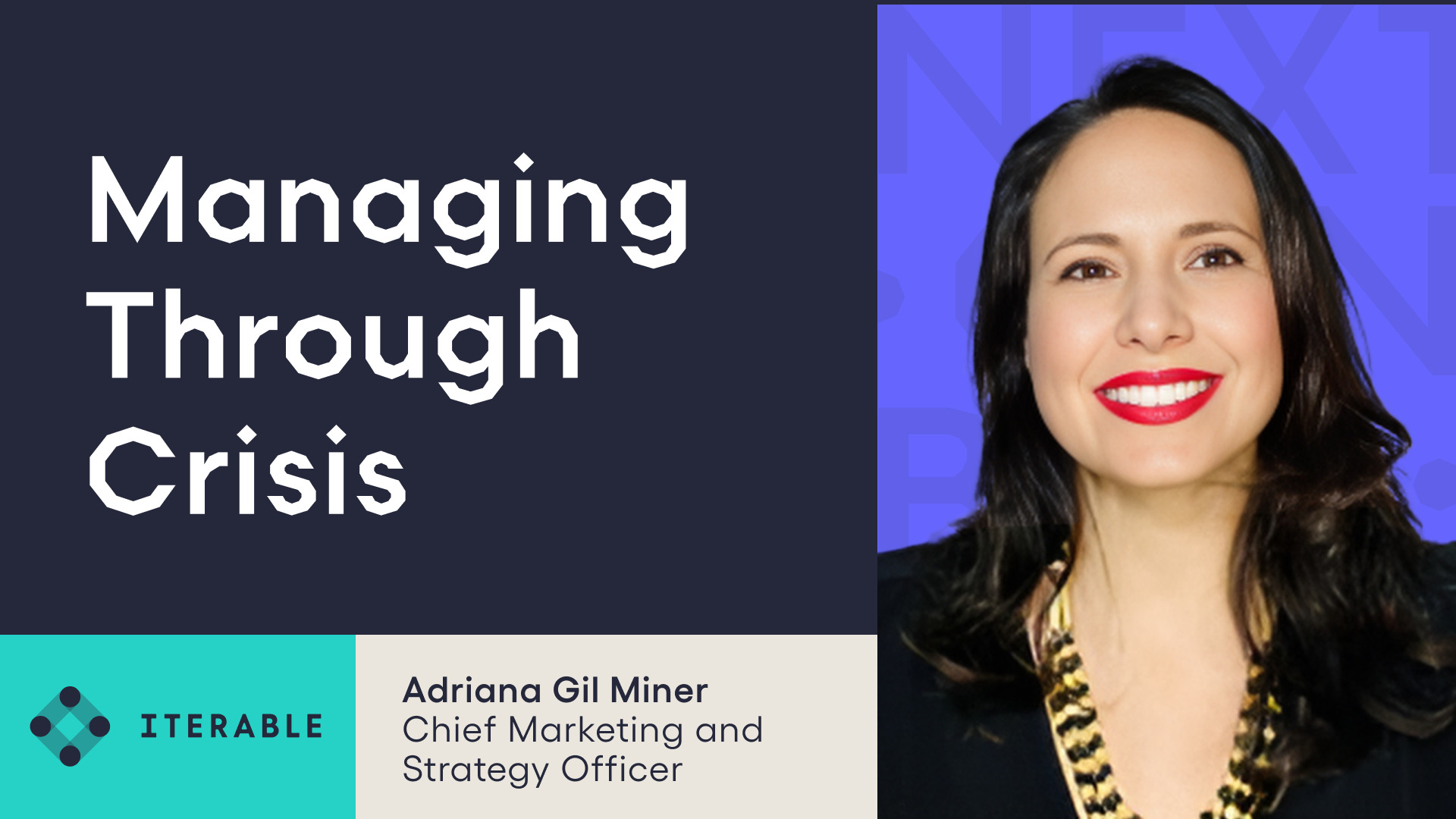
Marketing without the departmental walls
Qumulo appointed Miner chief marketing officer in June 2020. Eighteen months later she joined Iterable, where she would serve as chief marketing officer and later chief marketing and strategy officer. Her remit changed from cloud file data to customer communications, but her language remained revealingly architectural. She told marketers to think of themselves as company builders. To understand the product, learn how the company makes and spends money, and identify the people changing it.
At Iterable, her first declared task was to break down silos: in data, thought, business knowledge and organization. She argued that marketers mistake business-to-business communication for permission to be two-dimensional. A company may buy software, but people judge it. Personalization that stops at a first name is clerical work dressed for dinner. Real individualization requires attention to context, behavior and the particular journey of a customer.
Community, in her account, is not the decorative crowd gathered after a product launch. It is part of the operating system. It was the reason she joined Iterable, whose users were themselves marketers. It had guided decisions at Tableau. It also fit her life outside an org chart. She met her husband, Philip Miner, at Digitas. In a reflection on their twentieth wedding anniversary, she wrote that friends from AIESEC, Tableau, Qumulo, Weber Shandwick, the University of Washington and Artefact had helped shape their lives and raise their children. Work should not consume a life, she observed, but it can fill one with purpose and relationships.
When a voice becomes suspicious
Joining Pindrop moved Miner from software that helps people communicate with customers to software that asks whether the person communicating is real. She called deepfakes “the hard problem of this AI moment” and its dark side, sitting at the intersection of consumers and business. It can reach an ordinary person through a fraudulent call and an enterprise through a remote interview, a contact center or a meeting where a familiar executive appears to request a sensitive transaction.
The threat needs exact language because panic is also a poor authentication system. In a November 2025 article, Miner wrote that Pindrop had analyzed 1.2 billion calls and found one fraudulent contact-center call in every 599, twice the rate of four years earlier. The company's analysis said 98 percent of detected contact-center fraud still involved human impersonation and 2 percent involved AI-generated impersonation. It also reported a 756 percent year-over-year rise in deepfake or replayed voices across enterprise phone calls. The base and the acceleration belong in the same sentence. Most fraud remained human; synthetic impersonation was moving quickly.
Pindrop's technology treats identity as a layered question. Voice matters, but so do devices, behavior, risk and signs of liveness. The shift suits Miner's instinct for avoiding a single convenient metric. A face on a screen may be persuasive. A voice may carry the rhythm of a colleague. Trust now requires additional signals, considered together and fast enough to matter in a live interaction.
There is a clean line from the girl who saw the internet as text and knew it would change the world to the executive explaining what happens when the network can imitate us. Yet the line is clean only in retrospect. Along the way it passed through art school, spreadsheets, public relations, product design, billion-dollar growth, customer communities and rooms where plans had to be remade under pressure.
Miner's gift is translation, but translation is often mistaken for simplification. The better version preserves difficulty while making it graspable. A deepfake is technically a synthetic signal. Socially, it is the theft of familiarity. Marketing software can orchestrate channels. Humanly, it decides whether a message feels welcome or intrusive. A brand appears on a balance sheet as an asset. In life, it is a promise remembered by a crowd.
The art remains in the system
The childhood dancer has not vanished into the C-suite. Miner has described a “Stress Dance” playlist heavy on salsa and merengue. In the Pacific Northwest, she hikes and sea kayaks. These details resist a grand theory, which is precisely their charm. One can spend the day worrying about synthetic speech and still prefer a real paddle, a cold inlet and a song with a dependable beat.
The larger lesson of her career is similarly practical. Technical systems do not remove the need for human judgment; they increase the cost of neglecting it. Data needs an interpreter. Communities need a listener. A crisis needs someone who can separate the controllable from the merely frightening. And an age of manufactured voices needs people willing to explain, without theatrical dread or easy assurance, why trust must now be designed.
Miner entered technology through a house where the hardware arrived early and the cultures overlapped. She stayed because the machines kept creating new forms of human behavior to observe. At Pindrop, the work has become almost philosophical: teach institutions to distinguish the real human from the convincing performance. It is a hard problem. Fortunately, she has never required a problem to be simple before finding the story inside it.