The first system in Adarsh Ambati's public story was a California lawn that refused to read the room. The state was in drought. Water rules were changing. Weather moved on its own schedule. Yet automatic sprinklers kept performing their little midnight ritual, obedient to a timer and indifferent to everything else. Ambati was in middle school when he began wondering whether a watering system might consult reality before opening the tap.
His answer combined soil-moisture readings, weather forecasts, and municipal watering guidance. It could tell households when and how long to run their sprinklers, then distribute recommendations through a social network. Ten pilot homes were reported to save roughly 50,000 gallons over two months. The number matters, but the method matters more: take facts that live in separate places, join them, and turn them into an action ordinary people can use.
A decade later, the lawn has become an enterprise network. The scattered facts are searches, emails, file movements, identities, and access patterns. Ambati is a founder of Candor, a Y Combinator Winter 2025 company that builds data-loss prevention and insider-risk software. The premise sounds specialized, as security premises often do. In plain English, Candor wants to help a security team tell the difference between an isolated digital movement and a sequence that deserves attention.
The useful obsession is context
A conventional rule sees an event. A contextual system asks what surrounded it. Was a file sent to a personal address during a normal collaboration, or after a resignation? Was a broad search merely clumsy, or part of a pattern of looking for unreleased work? Candor describes its product as investigating the content, the person, and adjacent activity before a case reaches an analyst. Its advertised relief is not more alarms. It is a smaller pile of cases with a clearer story.
That framing rhymes with Ambati's older work. A moisture reading alone cannot decide whether to water. A forecast alone cannot either. A city rule is useful but not sufficient. Place them together and the sprinkler acquires judgment, or at least a respectable imitation of it. The same intellectual shape appears in his Stanford work, where he studied mathematics and computer science and participated in paleobiology research using data analysis and machine-learning models to examine extinction risk in the fossil record.
There is also a useful restraint inside this approach. Better context does not mean collecting every fact in the world. It means collecting the few facts that alter a decision. The sprinkler did not need a philosophy of California. It needed enough information to know that rain, damp soil, or a local restriction should overrule the clock. Security software faces the harder version of that design choice. Gather too little and the tool misses the plot. Gather too much and the analyst inherits a larger haystack. Candor's wager is that software agents can do the first reading and bring forward the compact, consequential version.
This is not a claim that sprinklers inevitably produce security founders. Silicon Valley would become intolerable if every irrigation controller had to include a founder mode. It is a simpler observation: people often carry a favorite kind of problem from field to field. Ambati appears drawn to systems that collect plenty of facts and still fail to make a sensible decision.
“Through innovation, education, and advocacy, even teenagers like me can make a resounding impact on the world.”
Small plots before large platforms
The sprinkler was only one part of Ambati's early environmental work. He founded The Green Environment Initiatives, worked on an amphibian-conservation testing project, and organized Gro-STEMs. The latter used a wonderfully literal funding model: grow succulents, sell them, use the proceeds to support science and technology education. Volunteers went on to teach more than 150 classes through shelters, libraries, and youth organizations. The machinery of impact included potting soil.
The awards arrived. The community sprinkler won the hardware category at Coolest Projects USA in 2019. In 2021, Ambati received a Gloria Barron Prize for Young Heroes and a $10,000 Davidson Fellows Scholarship. He graduated from Archbishop Mitty High School in 2022 as valedictorian and the class's Science Medallion recipient. Recognition made the projects visible; it did not erase the scrappy mechanics underneath them.
One of Ambati's most revealing comments from that period concerned an awards application. He advised young applicants to ask friends and family for help because, as he put it, “I am modest and they helped me see all that I've accomplished that maybe I did not think of!” It is cheerful advice, and surprisingly useful founder counsel. Other people can see both your neglected strengths and your beloved nonsense. A good feedback loop needs witnesses.
The pivot is part of the biography
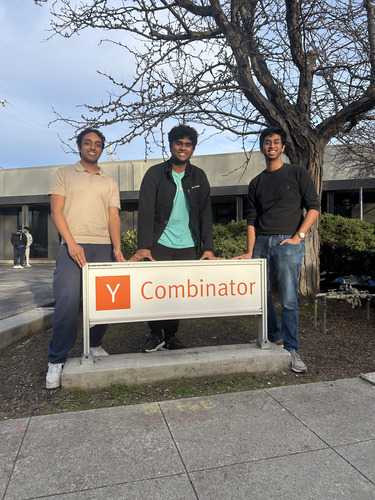
The founding team in that photograph has tried more than one answer. During YC W25, Ambati, Ansh Gupta, and Aditya Iyengar publicly launched Sophris, an AI tool designed to review circuit-board schematics and catch errors before an expensive manufacturing re-spin. Later public posts described Mirror, a workplace-knowledge product, and Haleum, an insider-threat company. Today the YC directory lists Candor as the active company.
A neat profile might hide those changes behind the latest logo. That would remove the most instructive part. A startup is a live negotiation between what a team can build, what customers will buy, and which pain remains painful after the demo. Keeping the same co-founders while revising the problem is a form of continuity. The product thesis moved. The working relationship survived the edit.
The Candor team has described learning this market in rooms full of practitioners. A year before exhibiting its product, the founders sat in conference audiences with questions about data-loss prevention and insider risk. They returned as sponsors, with demonstrations and customer conversations. There is something appealingly old-fashioned about the sequence. Attend. Listen. Build. Come back with a booth.
The company now argues that the most valuable clues are often the ones traditional tools discard because they are messy: exploratory searches, email metadata, attachment names, and natural-language prompts. These do not fit comfortably into a static rule. Their value arrives through combination. Candor calls this stitching the story. It could also be called respecting the plot.
Consider an employee searching for a password file. The phrase can look alarming in isolation and perfectly ordinary inside a support task. Add unusual access, an attachment headed outside the company, or a sudden change in behavior and its meaning shifts. A human investigator naturally asks for that surrounding scene. The product ambition is to make the software ask first. That requires technical work, but also editorial judgment: which details clarify, which merely decorate, and when does a collection of clues become coherent enough to deserve a person's limited attention?
A single event is a fact. A sequence with context becomes a decision.
What a builder keeps
Ambati's teenage aspiration was to combine environmental science and computer science, eventually leading a lab that developed useful environmental technology. His present job is different in setting and customer. Yet the arc does not feel like abandonment. Research taught him to work with incomplete evidence. Community projects taught him to test in public. Teaching demanded translation. Startup pivots demanded that the team loosen its grip on one answer without losing its appetite for the question.
His hobbies from those earlier profiles also offer a pleasing counterweight to the security dashboard: gardening, playing the flute, reading comics. Plants reward observation but decline to respect quarterly planning. Music makes timing audible. Comics turn separate panels into motion inside the reader's mind. One should resist turning every pastime into a founder metaphor. Still, Ambati has made a career of joining separate panels.
Candor's challenge is now commercial and exacting. Security teams already own tools, rules, and queues. A new product must earn trust while handling sensitive organizational behavior and must show that its added context improves decisions. The company is taking that argument on the road in 2026, appearing at security events from Black Hat USA to the National Insider Risk Symposium.
The young builder who watched sprinklers ignore a drought is now asking software to pay closer attention to people. The distance between those projects is large enough to be interesting. The line between them is clear enough to be useful: reality is noisy, rules are brittle, and the overlooked relationship between two facts may matter more than either fact alone.
That is a sound way to build a product. It may also be a sound way to build a life: change the field when the evidence asks you to, keep the collaborators who sharpen your judgment, and follow the signal long enough for it to become a story.