At three years old, Mattia Mauro walked through the Enrico Toti submarine at Milan's science museum and reacted as children often do when confronted with a machine built like a riddle: he produced questions faster than the adults could answer them. The submarine was steel, switches, pipes and pressure. To Mauro, it was an invitation. He later described that visit as the beginning of his love for science, a durable origin story for someone whose career has moved through physics, software, quantitative research, venture investing and, now, education.
The questions kept arriving. At nine, he began learning C and Objective-C. At ten, he removed the operating system from his first computer and rendered it useless, which is a remarkably committed way to discover what software does. Redemption followed in the form of a simple rocket game. It worked. Space and code, his two preoccupations, had found the same screen.
Years later, Mauro would build another piece of software around a harder puzzle: how do you help a student think without thinking for them? Excellence, the company he founded and now leads, uses AI to create assignments, read handwritten work, give guided hints and adapt practice to mistakes. The sales language is contemporary. The underlying obsession is older than computers. A good teacher must know when to explain, when to ask and when to wait.
A childhood arranged across borders
Mauro was born in Italy and grew up across Switzerland, South Korea and France. Seoul remained important enough that he later took Korean lessons in Paris to keep the connection alive. Italian and French are his mother tongues; English became another fluent working language. His biography reads less like a straight line than a railway map, with science as the station that keeps recurring.
By fourteen, Richard Feynman and astrophysicist Trinh Xuan Thuan had joined his private cabinet of heroes. Aerospace engineering had a family connection too. His grandfather was an officer who worked for NATO on ballistic missiles. Mauro trained toward a private pilot licence, studied Latin and Ancient Greek, competed in debate, took acting classes and played tennis with an enthusiasm he described more confidently than his ability.
The range matters because it complicates the familiar portrait of a technical founder sealed inside one discipline. Mauro liked models, but also argument. He liked servers, but also history. As a teenager at the Paris Observatory, he met satellite researchers and photographed the surface of the Sun. At another internship, inside a startup refurbishing used smartphones, he encountered the pace and practical mess of company building.
Service sat beside ambition. In 2020 and 2021, he spent six months working full time with ATD Fourth World in an underserved neighbourhood near Paris. Earlier, at a holiday camp, he had lived alongside young people with intellectual disabilities and helped with daily activities. These episodes do not form a neat startup parable. Their value is precisely that they resist one. They show a young engineer repeatedly leaving the clean room of theory to meet people where their days actually happen.
The ice-cube clock
At École Polytechnique, Mauro studied physics, mathematics, computer science and mechanics. The decisive extracurricular was a physics problem that looked like a party trick. Put an ice cube between layers of vegetable oil and baby oil. As it melts and releases bubbles, it moves up and down. Could the oscillation become a clock? How long would it run? How precise could it become?
That was the selection challenge for Polytechnique's International Physicists' Tournament team. The competition's problems arrive without tidy solutions. Students design experiments, build theoretical models and defend their reasoning. During each match, one team reports, another attacks the work constructively, and a third reviews the exchange. Knowledge is not displayed beneath glass. It gets cross-examined.
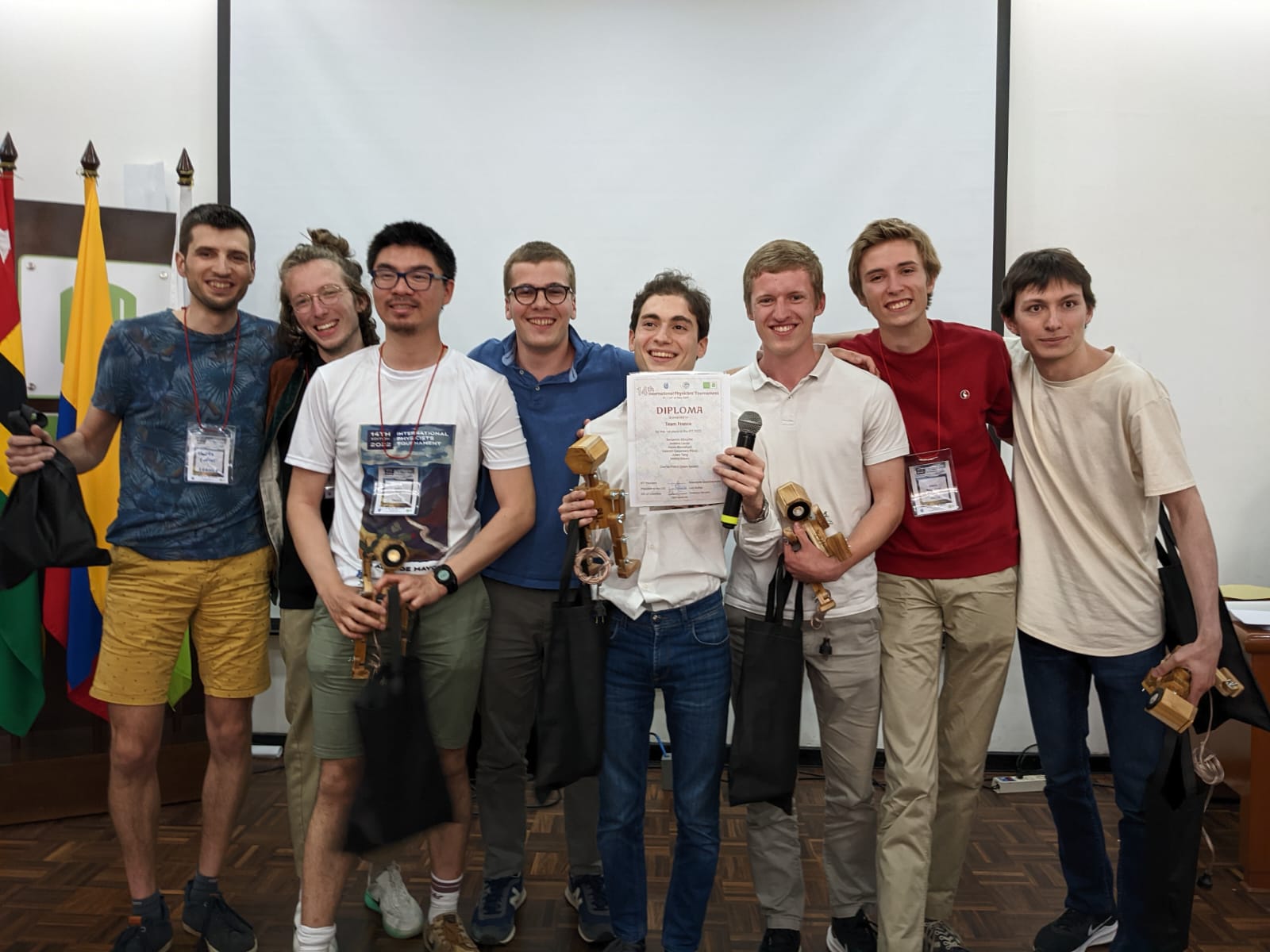
In May 2022, the Polytechnique team representing France finished first in Colombia, ahead of Brazil and Switzerland. Fifteen countries competed. Mauro and future Excellence co-founder Alexis Bonnafont were on the winning team. Years of curiosity had become a method: observe something strange, propose an explanation, invite opposition, revise.
That method now appears, in miniature, inside Excellence. A student attempts a problem. The system inspects the work. Instead of surrendering the answer, it can offer progressive hints and follow-up questions. Errors generate new exercises. Teachers can review the process. The product loop resembles a gentler physics fight.
The useful detours
Between the tournament and the startup came a sequence of careers that look, at first, like indecision wearing a good suit. Mauro interned in trading at Bank of America, worked on astrophysics research in Paris, became a quantitative researcher at Squarepoint Capital, pursued graduate work at Stanford and spent time in quantum research at Pasqal. He also joined Dorm Room Fund as an investment partner and worked on Squarepoint's early-stage investing effort.
Each stop trained a different reflex. Physics asks whether a model survives contact with an experiment. Quantitative finance asks whether a pattern survives noise. Venture investing asks whether a team can turn uncertainty into momentum. Education software asks all three at once, then adds a less forgiving variable: a student who may simply close the laptop.
- 2016Paris Observatory and startup internships
- 2022Physics tournament victory and trading internship
- 2023-24Quant research, Stanford and early-stage investing
- 2025Excellence joins Y Combinator's Winter batch
Mauro's public launch note gave the venture a personal measuring stick. He and the team could not find the learning product they would have wanted to use, or that he would have recommended to his younger sister, then in twelfth grade. This is an unusually effective product brief. A founder can forgive a mediocre dashboard. It is harder to forgive a product that wastes a sibling's evening.
Paper survives the pitch deck
Excellence began with an after-school mathematics and science program: personalized courses, an AI tutor, structured routines and optional human mentorship. Mauro spoke about attention, motivation and long-term mastery rather than the quicker thrill of producing flashcards before an exam. In one interview, he argued that autonomous commitment matters more than coercion. The aim was to create the conditions in which a student returns voluntarily.
The company's current presentation puts teachers at the centre. They can import exercises, including handwritten ones, and generate variants and detailed corrections. They can assemble exams, turn PDFs into interactive material and see where a class is stuck. Students write on paper, photograph their work and receive question-level analysis under teacher supervision. The AI tutor asks questions and releases hints gradually.
Keeping paper is the amusingly radical detail. In the fever dream version of AI education, every surface glows and every answer materializes instantly. Mauro's version preserves pencil marks because pencil marks contain evidence. A wrong denominator, an abandoned diagram, a correct answer reached by a brittle method: these are clues. The finished answer is often the least educational part of the page.
There is tension in this design, and tension is healthy. Teachers want time back without losing authority. Students want help without another system that feels punitive. Parents want visible progress. AI can create material quickly, but speed makes quality control more important, not less. Excellence's response is to keep a human supervisor in the loop and to make the student's own work the primary object.
The founding group brings complementary histories. Bonnafont shared the tournament victory and became CTO. Sovann Linden, the company's CPO, tutored mathematics for years and followed an unconventional route to Oxford at fifteen before studying at Stanford and working in finance. Mauro publicly thanked mentors from Polytechnique, colleagues at Dorm Room Fund and Squarepoint, Y Combinator partner Gustaf Alströmer, his parents and family. For someone who admitted discomfort with posting on LinkedIn, the launch announcement became an extended credits sequence.
The founder as session reviewer
Mauro has described startup mornings beginning around 5:30, when he wakes and starts thinking about the company before sleep can recover its claim. He plans, reviews student sessions, meets his co-founders, then moves between coding, marketing and email as priorities shift. The early hour is less revealing than the object of attention: sessions.
A session shows the product in its least rhetorical form. Where did the student hesitate? Which explanation helped? Did the hint invite thought or merely disguise an answer? Founders enjoy speaking about scale because scale has excellent posture. A single confused student is slouchier and more useful.
Mauro's stated horizon is broad. He wants Excellence to expand across the United States, Europe and South Korea, and across subjects including physics, literature, history, chemistry and philosophy. The Y Combinator vision imagines personalized learning that once belonged to a small elite becoming widely available. The current company language is more grounded: teachers in control, handwritten work preserved, progress made visible.
The difficult part will be holding both ideas at once. Personalization promises a course shaped around one student. A startup promises to repeat that experience for many. The work sits in the contradiction. Mauro has spent much of his life practicing for it, from multinational classrooms to physics debates, from a Raspberry Pi server to a hedge fund, from a little sister's needs to a platform for schools.
The ice-cube clock never needed to become a household appliance. Its purpose was to make a team notice, measure, argue and improve. Excellence may be judged by a similarly plain sequence. Does the student try? Does the feedback reveal something? Is the next attempt better? The rest is machinery.