Adam Moelis had a question about the American lottery. How could something so financially unpromising be so much better at attracting attention than a savings account? A lottery ticket gave its owner something to imagine before anything happened. A modest bank balance mostly gave its owner a reason to wait. He wanted to borrow the anticipation and put it to work for the saver.
The result was Yotta, founded with Ben Doyle in 2019 and launched in 2020. In its original version, each $25 saved earned a recurring entry in weekly number drawings. The headline prize could reach $10 million. The proposition was easy to remember: leave money alone, acquire something to look forward to. Compound interest had finally been offered a publicist.
That proposition makes Moelis an interesting person to follow. He left an investing job to learn to build software, talked readily about subconscious biases, and preferred experiments to assumptions about what customers ought to want. The same story now includes a prolonged loss of customer access to funds and a state penalty against his company. Both belong in the account.
His more recent venture, Tenr, asks another question about anticipation: how much of an evening should someone commit before knowing whether a date has any promise? The answer built into the product is ten minutes. Across these businesses, Moelis keeps returning to the distance between a decision and its reward. Yotta also exposed how much can go wrong behind that decision's inviting surface.
A finance education, followed by twelve weeks of code
Moelis grew up in Los Angeles with three siblings and a large extended family. Finance was a familiar occupation around him; his father is investment banker Ken Moelis. At Wharton, he studied finance and accounting, graduating in 2014. He went to Goldman Sachs, where he worked in its Special Situations Group. The early career looked comfortably legible to anyone reading a banking résumé.
But he found himself more interested in how companies used information to make products and marketing decisions than in deciding where investment dollars should go. He left Goldman after roughly a year and attended Flatiron School's in-person coding boot camp. The course lasted twelve weeks. Later, he described learning to program as one of the most useful investments he had made in himself.
His subsequent work at YipitData brought together data analysis and product development. By the end of 2018, he had left to explore business ideas. Yotta emerged from that period of trying possibilities, with the concept taking hold in 2019. There was a practical education underneath the finance degree: learning enough about software to participate in making the thing he wanted to sell.
There is a revealing smaller project on his professional profile, too. ParkShark proposed letting people rent out private parking spaces, including driveways, when they were unused. It is a compact example of the sort of problem that attracted him: an ordinary resource, an everyday frustration, and a possible system for bringing the two together. Before the savings tickets, there were parking spots.
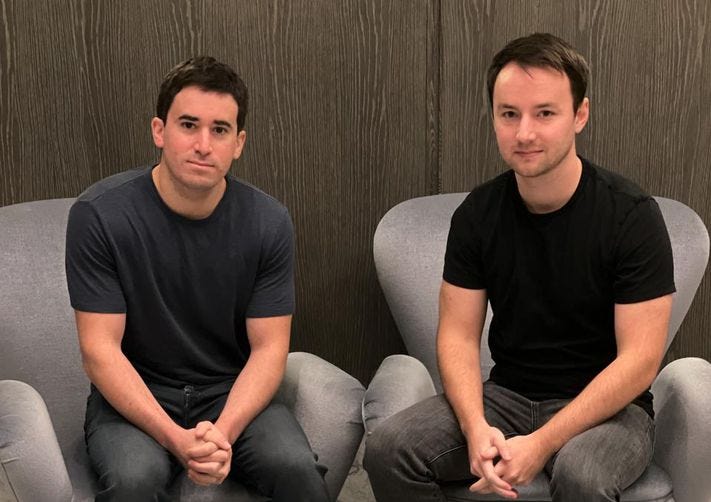
Benjamin was a difficult name to Google
Yotta's original name was Benjamin. Moelis explained that the team worried about being discoverable online: a new financial product needed a name people could search and actually find. They chose Yotta, the metric prefix denoting ten to the twenty-fourth power. The vast number suited the idea of a big win. The search problem had supplied a branding decision with a mathematics costume.
The underlying savings concept had an existing reference point in Britain's Premium Bonds, which Moelis had encountered while exploring the field. Yotta adapted the attraction of prize drawings to an American app. In October 2020, he described younger, lower- and middle-income customers as the primary audience, and said the service had more than 40,000 users.
Moelis and Doyle joined Y Combinator's summer 2020 batch, its first conducted remotely. Moelis recalled applying somewhat on a whim, going through a short interview and a second conversation, then spending a weekend deciding whether to participate. He valued the process of explaining the idea clearly even before admission. The questions themselves forced a founder to examine assumptions.
In January 2021, Yotta announced a $13.2 million Series A led by Base10 Partners, with Y Combinator, Core Innovation Capital and Slow Ventures participating. That gave a small team money to hire and reach more customers. The leap from a clever explanation to a venture-backed financial business was underway. A recurring ticket could get someone interested; a broader product would have to keep them there.
The experimenter and the promoter
Moelis has described learning as a motivation for building a company: running tests, looking at results, and finding that human behavior can surprise you. Robert Cialdini's Influence was a book he singled out. He liked its attention to the biases that operate beneath people's explanations of their own choices. That interest helps explain why Yotta's original pitch started with pleasure rather than a lecture about discipline.
The off-duty details are less like a finance presentation. He likes watching football and playing basketball. He grew up in Los Angeles but supports the Denver Broncos, an allegiance he has joked is easier to explain by telling people he grew up in Denver. He has recommended Bill Browder's Red Notice and listened to How I Built This. The person emerges in these small, slightly untidy preferences.
He could be dry about promotion, too. Sharing an appearance with Graham Stephan and Jack Selby, he wrote, “I'm just sharing to promote!” It was a useful bit of honesty in a professional feed. The founder needed people to hear about the product; pretending that a podcast link was merely a thank-you would have been an unnecessary detour.
Yotta made such appearances part of its growth machinery. In 2022, it announced an affiliate program with Fintel Connect to reach financial publishers and influencers. Earlier, it publicized a New York customer's Tesla Model 3 win. These were demonstrations of the promise: a financial habit with an event attached. They also made the product unusually easy to talk about. Nobody has ever needed to scream and dance over a routine interest posting.
“I'm just sharing to promote!”Adam Moelis, sharing his 2021 podcast appearance
The screen was the shortest part of the journey
Behind the appealing app sat a complicated chain. Yotta used Synapse to connect its product with banking partners including Evolve Bank & Trust. In 2020, Moelis explained that intermediaries made it easier for small startups to get a product to market than negotiating directly with banks. The convenience was consequential: the company customers recognized was several relationships away from the records governing their money.
Before the crisis, he could point to an operational improvement. In a February 2023 interview, Moelis said Plaid's Signal product helped Yotta vary ACH transfer settlement times by transaction risk. The share of transfers completed in one business day had risen from 10 percent to 60 percent, he reported. He described a quick integration followed by several weeks of evaluating a limited sample. It was the experimenter's approach applied to waiting.
Then the waiting acquired an entirely different meaning. Synapse filed for Chapter 11 bankruptcy on April 22, 2024. Customer access broke down in May. By June, Moelis said 85,000 Yotta customers, holding a combined $112 million, were locked out. “We never imagined a scenario like this,” he said. The chance of a prize had become a much more urgent question about access to an existing balance.
The federal Consumer Financial Protection Bureau later alleged that Synapse had failed to keep adequate records of where consumers' funds were held and to match those records with its partner banks. Those allegations concern Synapse. For Yotta's customers, however, the familiar app remained the place they had put their trust. An explanation of the chain could describe the problem without restoring the money.
- Customeropens the app
- Yottaprovides the interface
- Synapseconnects the systems
- Partner bankshold funds
A promise meets an order
California's May 2026 action brought scrutiny directly to Yotta's own conduct. The Department of Financial Protection and Innovation imposed a $1 million penalty for deceptive practices involving representations about safety and FDIC insurance. It said Yotta had moved customer accounts to Synapse Brokerage in October 2023 despite serious concerns about Synapse. The action required notices to affected California customers about potential federal relief.
The accompanying consent order recorded at least 18,155 California customers losing access to at least $28 million. It also identified Moelis as Yotta's co-founder, former chief executive and a board member. That description matters to his present biography. The episode cannot be filed away as a startup that simply had bad luck with an invisible supplier: the regulator documented concerns before the account migration.
Yotta's later updates followed efforts to obtain redress. Its August 31, 2026 entry discussed another federal Civil Penalty Fund allocation while saying the timing and amounts of individual payments remained undetermined. An allocation and a completed repayment are different events. For a business originally designed to make delayed gratification more bearable, the prolonged uncertainty was a severe reversal of its intended experience.
Ten minutes, and another test of human behavior
By 2026, Moelis was publicly associated with a new company, Tenr. Its website describes curated ten-minute video dates intended to let people assess chemistry before meeting. Applicants are vetted, matches are arranged, and the short conversation supplies information a profile cannot. The calendar has become the scarce resource. The offer is to protect an evening by spending a small part of it first.
An April 2026 feature drew attention for a more literal attempt to improve information: height verification using an iPhone measurement. Moelis said people cared about height and wanted details up front. Around 700 of nearly 6,000 sign-ups had used the feature, he reported at the time. A dating profile had acquired a measuring instrument. Romance has survived stranger administrative requirements.
He also put a limit on what the technology could do, saying he did not think AI was good at assessing chemistry. The brief date remained necessary. It is an interesting boundary for a founder drawn to data and behavioral design: software can arrange the encounter, but the people still have to discover whether they like one another.
Moelis's career now holds two very different kinds of uncertainty. One is the ordinary suspense his products try to organize, whether a drawing or a first conversation. The other concerns obligations that survive long after a product changes. Tenr gives him another setting for experiments. The unresolved Yotta balances remain part of his record, measured in a currency that no amount of anticipation can replace.