A founder can spend years looking for the right introduction. Adam LaBarbera remembers the problem clearly: he had ideas, but mentorship, connections and a route through the business world were harder to come by. By October 2025, the EETech co-founder was back around Boise State, helping manage a program where students could build companies before collecting their diplomas. The missing introduction had become part of his work.
There is a pleasing loop in that story. LaBarbera helped build a business around engineers finding useful knowledge and one another. Later came work helping prospective founders find their way into entrepreneurship. Along the way, there was considerable growth, a change of chief executive and a venture involving racing cockpits. The circuits in his career eventually acquired steering wheels.
A useful introduction, in 2015
LaBarbera graduated from Boise State in 2012 with degrees in international business and marketing. His working background included Aspen Labs, later AspenCore, where his All About Circuits biography identifies him as Head of Content Development. It was a practical preparation for a business in which understanding an audience and organizing technical information would have to coexist.
Rob Pengelly already had All About Circuits. For years, he had wanted to add an editorial team, publishing technical articles and covering industry news alongside the established community. Wanting that operation and knowing how to assemble it were separate matters. Then LaBarbera contacted him. Pengelly later credited his prospective partner’s background and organizational ability with helping move the idea forward.
In 2015, the pair launched EETech Media and released an updated All About Circuits. The sequence matters. An engineering community preceded the company that would help expand it. LaBarbera’s contribution was to help turn an editorial ambition into an operation. In Pengelly’s telling, their meeting materially changed what the site could become.
That makes for a more interesting beginning than the usual picture of a founder discovering an empty market. People were already there, asking questions and sharing knowledge. The work was to give that gathering more useful things to do, then build a business capable of sustaining the effort.
What 1,500 percent looks like
By March 2017, EETech was broadening its offer beyond advertising on All About Circuits. The additions included app design, technical search optimization, web development, video, content creation and webinars. A manufacturer could seek help explaining a product as well as finding an audience for it. Media and marketing were moving closer together under the same roof.
The reach was widening, too. Partnerships with Mikrocontroller.net and DIY Hacking connected EETech with German-speaking engineers and makers. These communities had their own reasons for existing. A forum where engineers teach one another and a site where people share projects offer something more particular than a mailing list with impressive dimensions.
People followed the expansion. In May 2018, EETech added Cody Miller as vice president of business development and global sales director, and Vicki Parker as European regional sales manager. Miller had co-founded Aspen Labs; Parker brought experience from Publitek. The company was recruiting people who knew both the industry and how its marketing worked.
Figures announced by EETech in August 2019. These describe the company during LaBarbera’s tenure.
The August 2019 growth announcement supplied the attention-grabbing numbers: No. 301 on the Inc. 5000 and nearly 1,500 percent growth over three years. EETech also placed sixth in Idaho and second in the media category. For a business serving a specialized technical audience, the figures made the commercial opportunity visible.
LaBarbera’s response made room for everyone outside the executive suite. “We certainly couldn’t have done this on our own,” he said, thanking customers and users. Both groups mattered. Advertisers bought access to an audience; users supplied the attention and participation that made the audience worth reaching. A publisher neglects either side at its expense.
That November, EETech acquired Control.com, an automation community with more than 35,000 members. Its roots reached back to an email discussion list founded by Ken Crater in 1994. LaBarbera welcomed the chance to serve automation experts. Growing the portfolio meant taking responsibility for a community that had been having its own conversations for a quarter of a century.
The boss lowers his guard
While the business was growing, LaBarbera was examining how he behaved inside it. In a December 2019 conversation with Gene Hammett, he described a serious, intense approach to work and the discovery that too much stiffness limited his ability to connect with colleagues. Becoming more approachable required conscious adjustment.
“I think you have to have humility,” he said. He discussed making room for humor, sharing strategy and asking employees to bring forward difficult news. His account of a recent town hall included discussing possible acquisitions and future markets with the team. People could contribute observations management had missed.
“I think you have to have humility.”
Adam LaBarbera · Growth Think Tank, 2019
He also described treating honest mistakes as opportunities to learn, while distinguishing them from repeated problems. The reasoning was practical: retaining capable people and improving together made more sense than continually replacing them. The picture is of a founder adjusting his own habits while asking the company to grow. An impressive ranking does little to make the next awkward conversation disappear.
A publisher learns new trades
EETech returned to the Inc. 5000 in 2020 at No. 1,289. It had also introduced a podcast for electrical engineers and was preparing a virtual conference. The community could now be reached through several formats, giving people different ways to listen, learn and take part.
The consolidation of PowerPulse.net into EE Power supplied another example of the work behind expansion. Existing articles became available on EE Power, and the newsletter continued through its Power Pulse offering. LaBarbera emphasized a place for power engineers to exchange knowledge. Moving a community meant carrying its accumulated usefulness with it.
In April 2022, EETech announced its merger with Big Zeta, effective at the end of that first quarter. The combined EETech Group paired engineering communities with capabilities including ecommerce, digital presence and specialized search. LaBarbera described suppliers, distributors and manufacturers adapting the way they did business online. The group could help with more of that work.
Later that year, All About Circuits prepared the third Industry Tech Days, a free, five-day virtual event. LaBarbera argued for continuing to invest in virtual events even as in-person gatherings returned. Access to technical learning still had value when a trade-show floor was available again. An engineer’s calendar, after all, does not expand just because the exhibition hall does.
In June 2023, EETech partnered with Women in Electronics. The announced collaboration included networking, mentoring and leadership development. LaBarbera spoke of supporting women’s careers in the industry. It was another setting in which professional opportunity depended partly on access to people and resources.
That November brought the leadership handoff. Martin Chatterton, who had joined EETech in 2022, succeeded LaBarbera as CEO. Chairman Cody Miller thanked the co-founder for nine years of leadership and service. LaBarbera credited employees past and present and expressed pride in the company’s growth alongside Pengelly. The announcement gave a date to the transition and named the people involved.
From an editorial partnership to new starting points
- Graduates from Boise State
- Launches EETech Media with Rob Pengelly
- EETech reaches No. 301 on the Inc. 5000
- Big Zeta merger forms EETech Group
- Martin Chatterton succeeds him as CEO
- Sandbox work and Race Club Boise
Back to the starting line
Boise State’s Sandbox program began recruiting its first cohort in spring 2025. By June, the university described 32 students preparing to start in the fall, drawn from an initial group of 208 interested participants. Small teams would combine disciplines, develop ventures over two semesters and receive expert instruction and individual mentorship.
The design gave students time to work on a company while earning academic credit. A business student and a computer science student could bring different abilities to the same problem. A planned investor demo day provided a deadline beyond an end-of-term assignment. The university was making room inside a degree for the uncertain business of building something people might use.
By October, Boise State identified LaBarbera as managing Sandbox. He also welcomed The Junction, a university hub intended to connect entrepreneurial programs, research expertise and industry partners. His recollection of starting out without sufficient guidance gave that support a personal basis.
“The community is highly fragmented,” he said. Useful people and organizations could be scattered across the university, venture capital and private equity. A newcomer might struggle to work out where to begin. His argument for easier navigation came from having had to navigate that terrain himself.
This is a modest, concrete way for experience to become useful. Someone who has built a business can help another person decide whom to approach or where an idea belongs. The meeting still has to happen. The work still has to be done. But a founder can spend more time testing a business when less time is spent searching for an entrance.
A different kind of circuit
There was another starting line in the Boise area. In October 2025, LaBarbera was explaining Race Club Boise, a racing simulator studio in Meridian. He described the difficulty of getting access to car racing locally and the wish to make more of the experience available. The equipment supplied a cockpit, a track on screen and feedback through the rig.
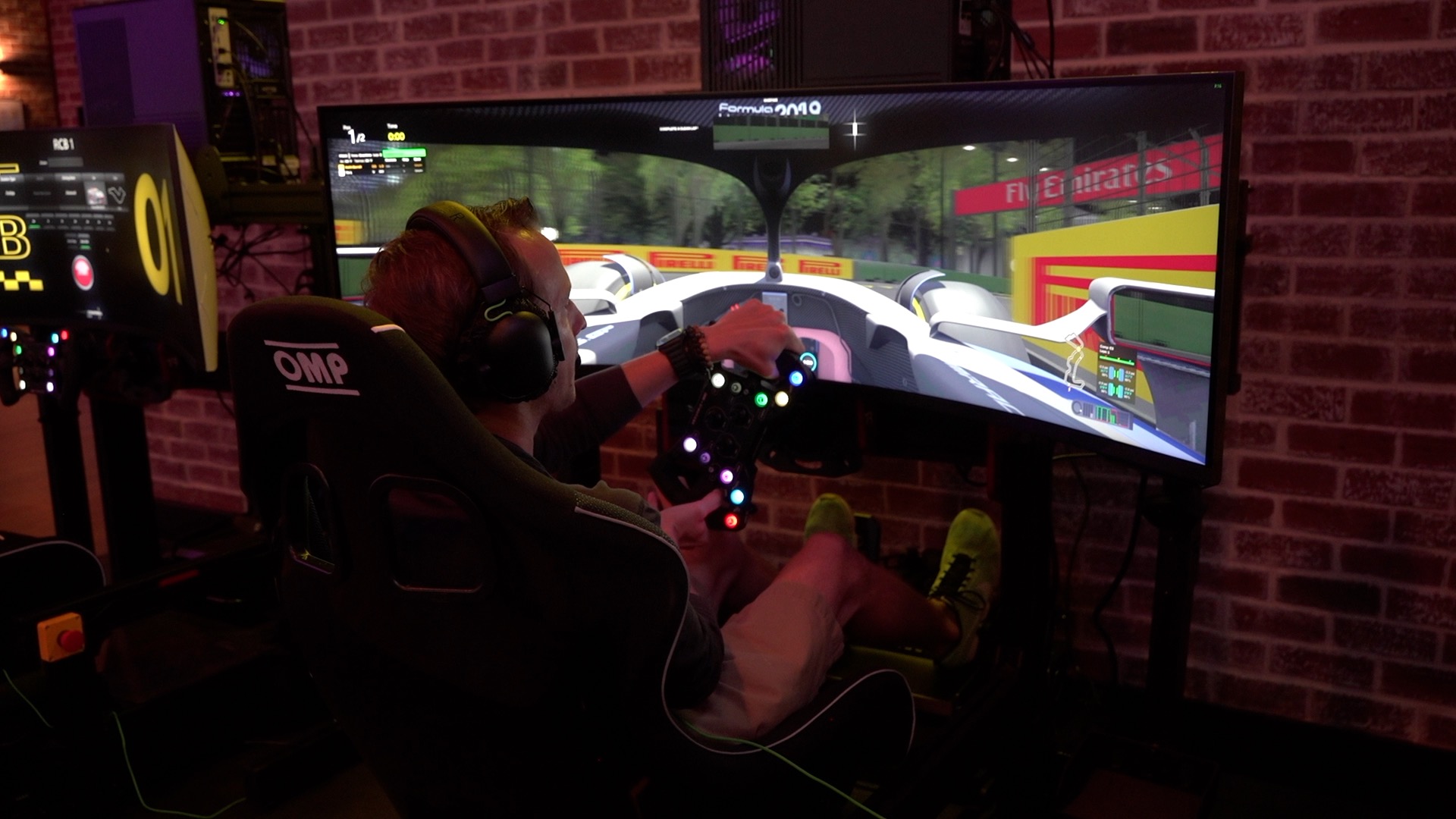
Boise State student and Wayne Taylor Racing driver Nick Persing used the studio for training. LaBarbera focused on immersion, including placing the monitor close enough to fill peripheral vision. He also described plans for studios in other states and competitions across locations. Those were his stated ambitions at the time; the Boise and Austin studios are now listed on Race Club’s location page.
There is an appealing change of scale in this part of his career. EETech worked across technical communities and international markets. A racing studio gives the idea of access a physical address and a seat someone can climb into. The customer’s next move is refreshingly easy to understand: take the wheel.
Read alongside his work with student founders, the venture suggests a recurring interest in giving people a place to begin. That is an interpretation of the career, rather than a slogan LaBarbera has assigned to it. The evidence is in the particular projects: an editorial operation, a startup program, a simulated circuit. Each offers an entrance. What people do after they get through it is where the story becomes interesting.
Follow the circuit
Explore the work, conversations and communities.