Before the databases, patents and enterprise contracts, Adam Fish made a horror movie. He was in high school in Erie, Pennsylvania, and he and a friend built their film around a local legend. It found the kind of afterlife teenage projects almost never get: a small cult following, then a VHS copy that surfaced on eBay years later and sold for a reported $360. The story is charming because it reveals an early reflex. Fish liked making things, learning the machinery behind them and putting the result in front of an audience.
The machinery changed. The reflex did not. Fish now runs Ditto, the edge-sync company he co-founded with Max Alexander in 2018. Its software lets phones, tablets and other devices store information locally, discover one another and reconcile their changes, even when the internet is absent. The places where this matters are less cinematic than a horror film but often more tense: an airplane cabin, a crowded restaurant, a wildfire response or a field operation where a dropped connection cannot be allowed to stop the work.
Most of us notice infrastructure only when it breaks. Fish has built a career by staying with the break long enough to understand it.
The detour that clarified the destination
Fish's path into software was not a straight run from computer science class to startup. At the University of Southern California, he studied biology. He also rowed, captaining the men's crew team in his junior and senior years while collecting academic honors. After USC, he moved to Kentucky with his family and entered a dual MD/MBA program at the University of Louisville.
A year into medical school, he recognized a mismatch. His attention kept returning to computers, the web projects he had built while young and the logic of information moving through a system. He left the medical program, completed the MBA in 2011 and interned at a technology and health-care investment firm. Looking at companies from the capital side sharpened his preference: he wanted to build.
“I understood myself a little bit later in life than ideal, and realized after a year of med school that my skills are rooted in my love and fascination with computers.”Adam Fish
The apparent detour supplied useful material. Biology taught him to think about systems. Business school gave him a language for markets. Venture work exposed the difference between an interesting technology and a company someone might buy from. Rowing had already taught the repetitive part: a team moves when people keep applying force in the same direction.
A problem that followed him
Fish co-founded Roobiq, a mobile-first customer relationship management app. The product was designed to work offline, which meant its data-sync engine was not a decorative feature. It was the thing that made the app dependable. The experience pulled Fish deeper into a stubborn software problem: devices were becoming more capable, yet applications still behaved as if every meaningful exchange had to travel through a central server.
He later joined Realm, the mobile database company, and became vice president of product. Realm made it easier for developers to build rich mobile applications and synchronize their data. It also gave Fish a close view of the limits of a centralized model. A local app could continue operating without a signal, but it could not share its new information with the device beside it until the internet returned.
The cloud had become the default answer to almost every data question. It was powerful, cheap to start with and conceptually tidy. But the route could be absurd: two devices a few feet apart might need to send their updates to a distant data center before either could learn what the other knew.
Two ways for nearby devices to agree
Ditto can use Bluetooth, peer-to-peer Wi-Fi and local networks at the same time, then synchronize with central systems when a route to the cloud is available.
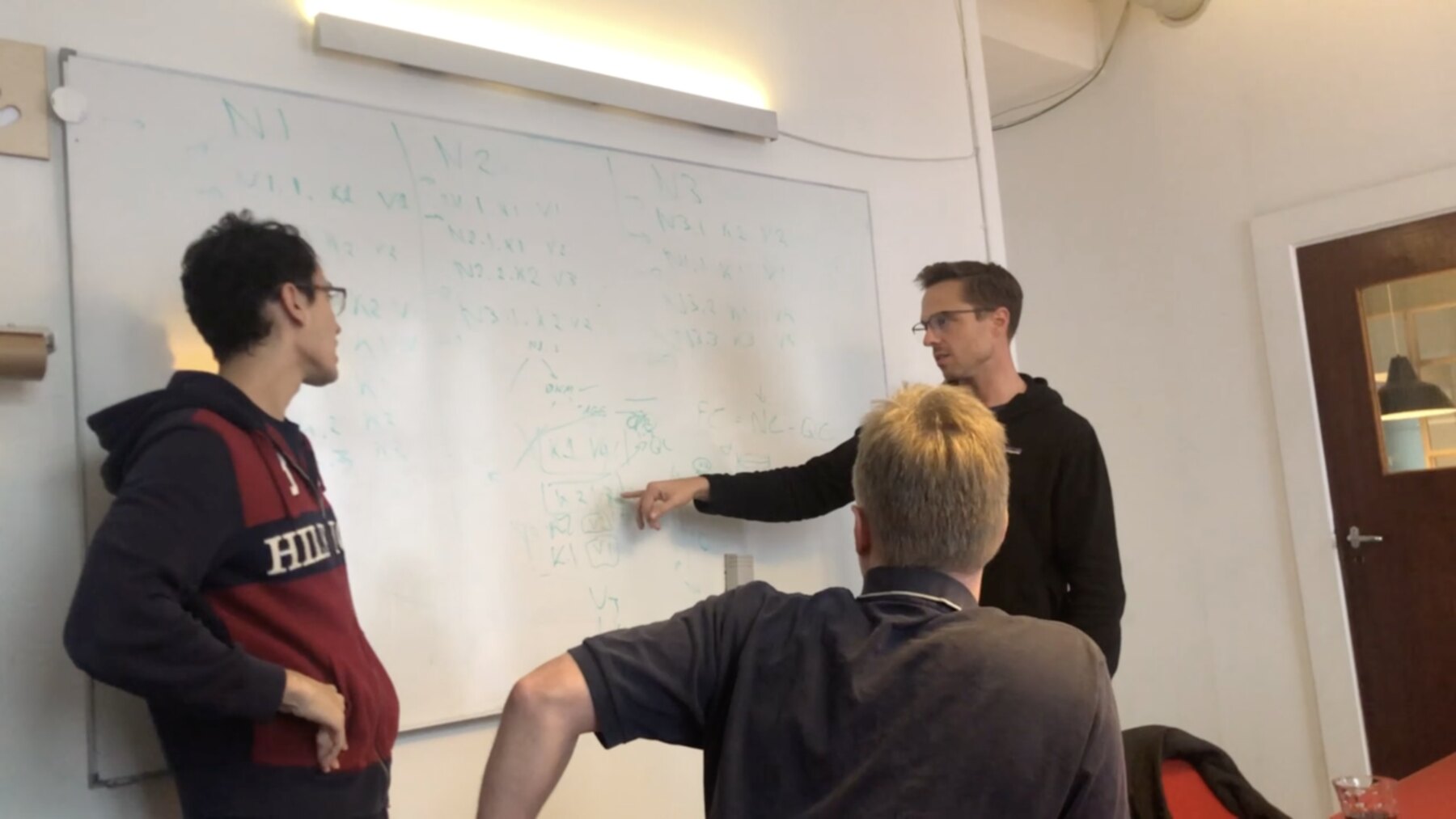
By 2018, Fish believed the hardware had caught up with the idea. Modern phones and tablets had storage, processing power and multiple radios. They could be active participants in a network instead of obedient endpoints waiting for a server. Fish and Alexander began writing the first version of Ditto. The database would sit inside an application, keep local data available and synchronize changes across whatever transports were present.
The airplane became the lab
The early company had to prove that a difficult piece of infrastructure could improve work people already understood. Aviation offered the right test. Flight crews need to coordinate, but cabin connectivity is intermittent and the metal tube itself is an unfriendly networking environment. Fish and the team tested an early prototype on a flight to a customer demo in 2018. A laptop occupied one tray table. A fan of phones covered the next, each showing the same inventory application.
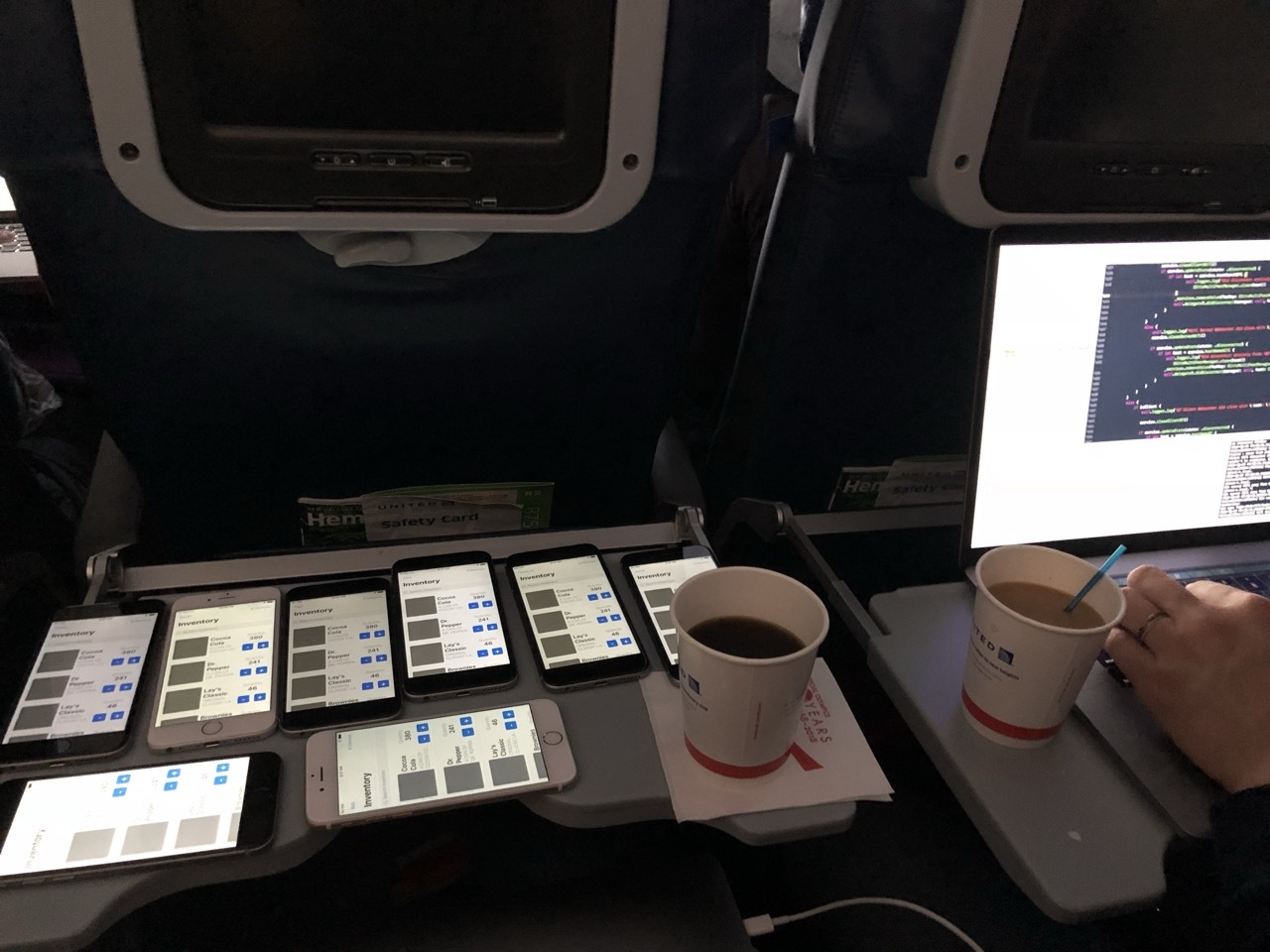
The demonstration made Ditto's promise legible. Crew devices could share updates across a cabin without treating the aircraft's internet link as a single point of failure. Airlines became early customers. Japan Airlines worked with Ditto on in-flight applications, and a deal completed just before the pandemic produced another durable image: Fish shaking hands with a JAL executive who is holding a model airplane marked with both company names.
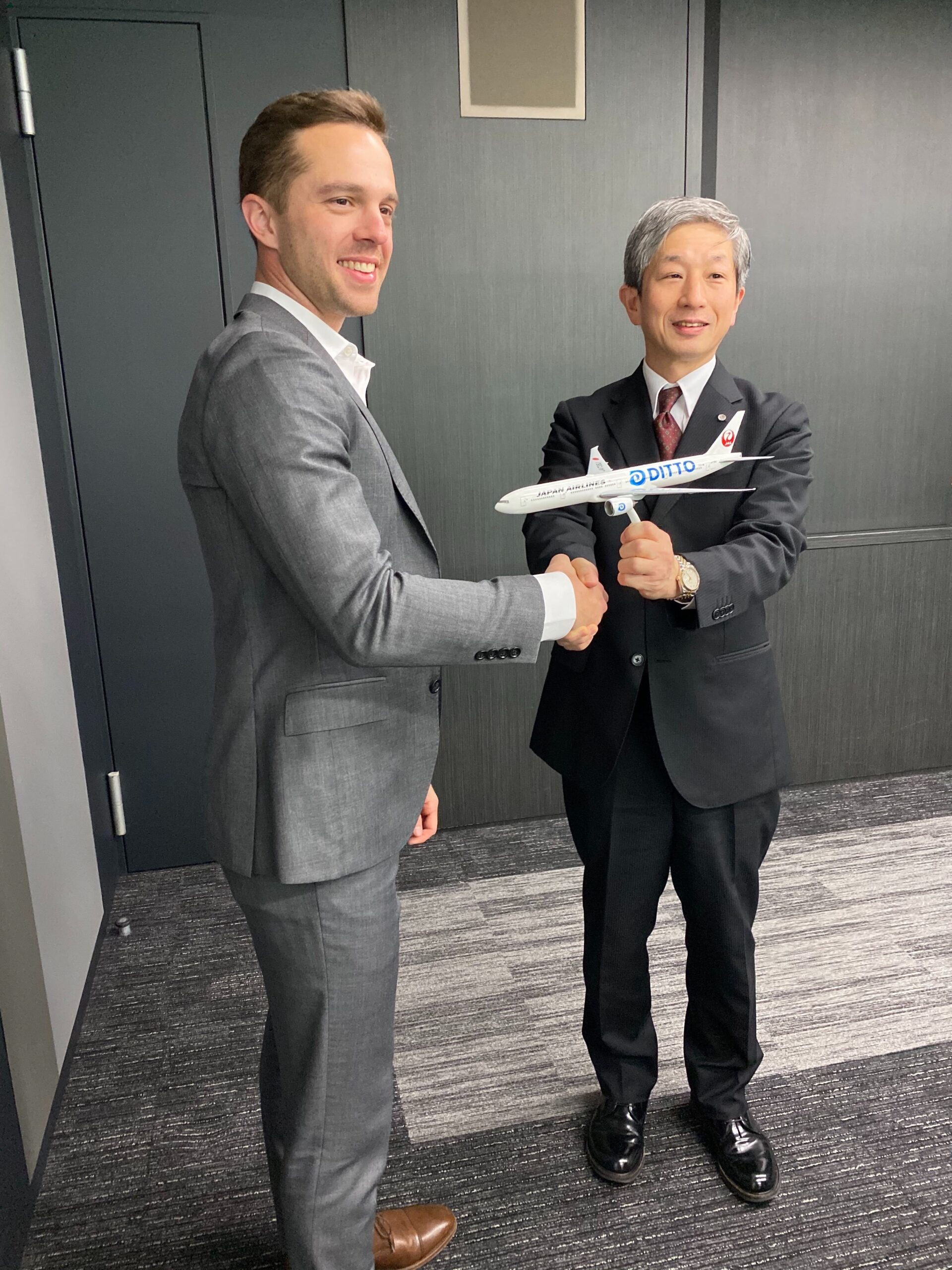
Fish has said that looking up at planes and knowing some of them are running Ditto remains motivating. It is the infrastructure founder's version of seeing a book on a shelf. The work is mostly invisible, but it has left the laptop and entered the world.
One failure mode, several industries
Ditto's market began to look broad because unreliable connectivity is broad. Restaurants need orders to move from handheld devices to kitchens when Wi-Fi falters. Cruise ships spend long stretches offshore. Field teams operate beyond dependable coverage. Defense systems work in environments where networks may be degraded or deliberately denied.
Fish took the young company into government work early. Ditto won a small-business research award in 2019 and later tested its software in Alaska with tactical teams, moving data across phones, Bluetooth links, radios and satellite connections. In 2022, the company announced an indefinite-delivery U.S. Air Force contract with a ceiling of $950 million. The ceiling is not guaranteed revenue; it is room for eligible orders. Still, the award showed that a database born from mobile-app frustration could be considered for operational systems under harsh constraints.
Commercial validation followed the same logic. Chick-fil-A used Ditto in its rebuilt point-of-sale system so restaurant devices could keep exchanging data independently of an internet connection. Delta integrated the software into an app used by flight attendants. The industry labels changed, but the sales conversation kept returning to continuity.
“We realized we weren't just syncing data. We were enabling business continuity.”Adam Fish
This is Fish's useful strategic move: define the opportunity by what fails, not by who buys. A plane and a restaurant look unrelated in a market map. On the bad day, both contain nearby mobile devices, time-sensitive information and people who cannot pause while a packet visits a remote server.
The capital to make patience possible
Distributed databases and mesh networking are expensive problems to solve. Fish has joked that building a database is hard and mesh networking is harder. Ditto raised $9 million in seed funding in 2021 and $45 million in a 2023 Series A. In March 2025 it announced an $82 million Series B, led by Top Tier Capital Partners and Acrew Capital, at a reported post-money valuation of $462 million.
The new money was assigned to product development, global operations and partnerships with cloud database vendors, including MongoDB. That last detail captures Fish's position neatly. Edge computing does not require declaring war on the cloud. Central systems remain useful for long-term storage, large-scale integration and analysis. The architectural change is to stop making them a bottleneck for every operational exchange.
Atlanta and the long view
Fish moved to Atlanta in late 2024 as Ditto expanded there. The decision put the company near Georgia Tech and other engineering programs, major customers including Delta and Chick-fil-A, and an airport that shortens a chief executive's travel map. Atlanta won an internal comparison with Washington, Raleigh and Austin. For a business selling into physical operations, proximity is product research: airports, logistics hubs and enterprise campuses are where abstract reliability problems become specific.
The founder's job changed with the company. In Ditto's early years, Fish spent about half his time coding and half cold-calling potential customers. He now spends more time visiting those customers and translating what breaks in their environment back into product direction. His public technical trail remains visible in old Realm answers on Stack Overflow, open-source work and recent tutorials. The operator and engineer have not separated so much as traded calendar space.
A 2026 company gathering supplied a bookend to the apartment years. Fish described walking in a Second Line parade down Canal Street in New Orleans with a brass band ahead and roughly 120 teammates behind him. Looking back at the line, he wondered how the company had reached that scale. It is an unusually social image for a database business, but an apt one. Synchronization is coordination. A mesh works because participants can find one another and continue moving information.
Fish reduces his founder philosophy to three words: endurance, timing and relationships. Endurance kept him on the same technical problem through several companies. Timing meant waiting until consumer hardware was capable of his preferred architecture. Relationships turned a difficult technical system into an airline workflow, a restaurant transaction and a field tool.
The next part of his ambition is larger than keeping an order queue alive. Fish sees edge computing becoming more important as AI models move onto devices, where local processing can reduce latency, bandwidth costs and unnecessary trips to central infrastructure. Ditto's wager is that those capable devices will also need a reliable way to share what they know.
The VHS horror movie survived because somebody kept a copy. Ditto begins from a related instinct: important work should not vanish because one connection did. Fish has spent his career replacing the spinning wheel with a more practical question. What can the devices in the room do for one another right now?