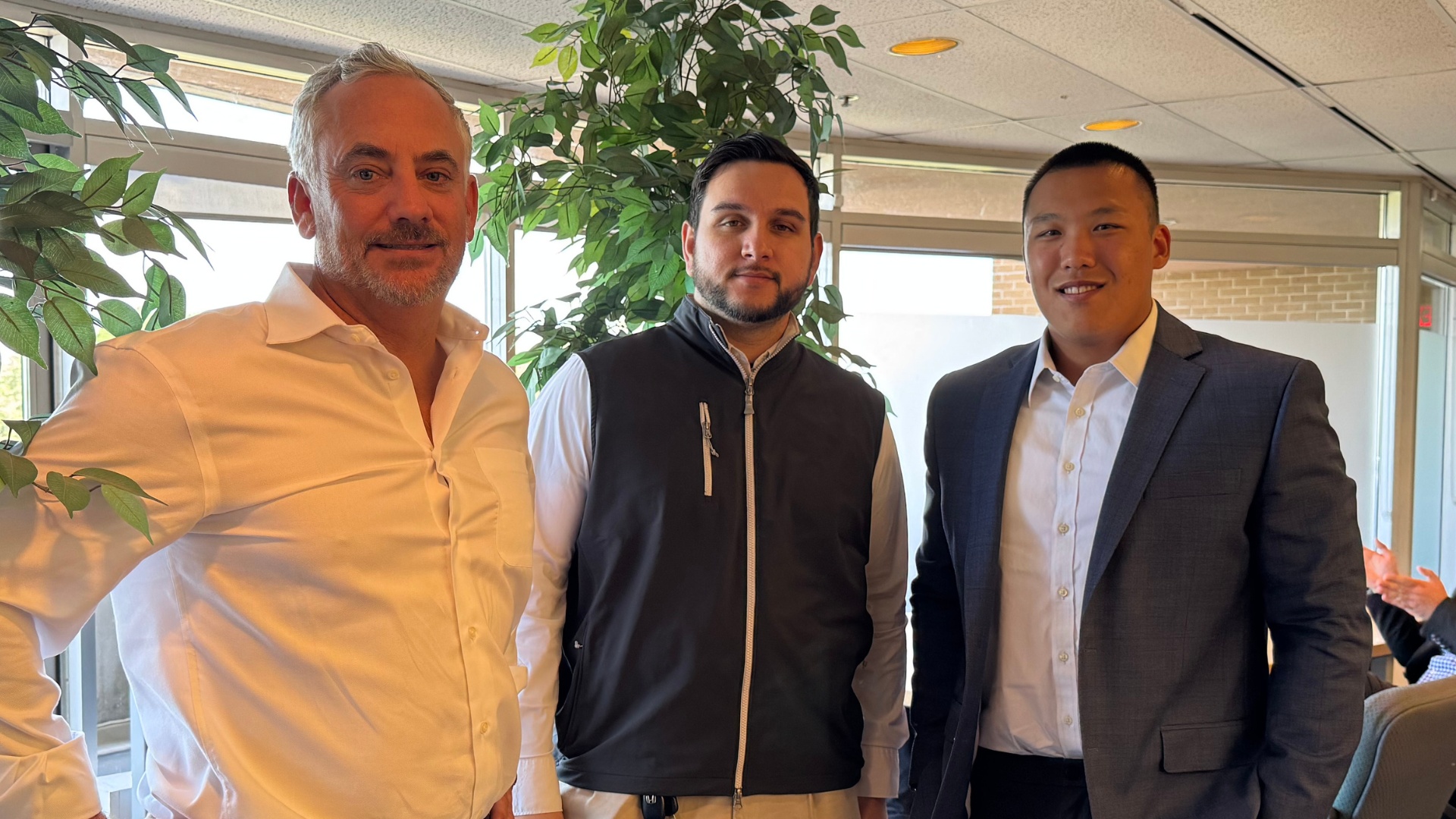
A young person meets an established investor and comes ready to ask questions. The investor starts asking questions back. When McMaster MBA student Brandon Fausto met Adam Felesky in June 2026, that reversal stayed with him: Felesky wanted to know about his plans, his work and where he hoped to go. It is a modest scene for a career spent around large pools of money. It also offers a useful way into the story.
Felesky is the co-founder and CEO of Portage, the Toronto-based investment platform focused on fintech and financial services. Earlier, he built Horizons ETFs. His working life moves between making financial products and backing the people who make financial businesses. Running through it is a recurring practical question: who can help someone take the next step?
For Fausto, the encounter offered encouragement and a chance to think about becoming a provider of services he already used as a consumer. The conversation also covered the economics of starting an ETF business. A student can leave such a meeting with enthusiasm, or with a revised spreadsheet. Both have their uses.
Two degrees, then a change of desk
Felesky graduated from McMaster in 1999 with a Bachelor of Engineering and a Bachelor of Arts in Political Science. The combination gives his biography an unusual opening. One discipline deals in systems and constraints; the other asks how people and institutions arrange power. Finance would supply plenty of occasions to encounter both.
His career began in investment banking at CIBC World Markets, followed by JPMorgan’s derivatives group in New York. Looking back, he credits a mentor there with giving him an opportunity and helping him develop confidence. An experienced colleague made room for him. Years later, he would talk about making room for others.
By 2005, he was building Horizons Canada. The first two ETFs were followed by more than 70 additional launches over the next five years. That detail is more revealing than the usual shorthand about founding a company. It describes repeated work: another product, another launch, another reason for an investor to choose the business.
The scale was already substantial by 2009. As CEO of BetaPro Management, Felesky described a family of 38 ETFs with more than C$2.5 billion in assets. Fourteen were commodity-based. His submission to the US Commodity Futures Trading Commission explained how the funds obtained exposure through swaps and how dealers hedged those positions. Here was the founder, working through the machinery under the product.
In June 2013, he was appointed Head of Americas for Horizons’ businesses across the United States, Canada and Latin America. His ETF experience also extended to Australia, where he was a founding investor and director of BetaShares. Horizons announced his departure as CEO in January 2015. The product builder’s next chapter would put him on the investor’s side of the table.
McMaster graduation
Financial products
Fintech investing
A return to McMaster
The founder crosses the table
Felesky and Paul Desmarais III co-founded Portage in 2016. Their focus was financial services undergoing technological change. Wealth management, banking, insurance and payments offered different places to work, with a shared requirement: an investor needed to understand the business behind the interface.
There is a useful continuity between the two chapters. At Horizons, Felesky had worked inside a financial services company. At Portage, he would help finance companies trying to change that industry. The perspective travels. A founder seeking an investment might also need a distribution relationship, someone who understands an institution’s buying process, or a colleague who has seen a similar problem before.
Portage’s network became part of its proposition. By the July 2022 final close of its US$655 million third venture fund, the firm reported that its value creation team had helped arrange almost 60 partnerships between portfolio companies and financial institution investors. The useful unit here is the partnership: two businesses finding a reason to work together.
The network also needed people in the markets where Portage wanted to invest. In 2019, Hélène Falchier joined as a Paris-based partner, with a focus on European opportunities. Felesky welcomed the experience and connections she brought. A global ambition becomes rather more credible when someone knows the neighbourhood.
His own board work spans businesses including Alpaca, Borrowell, KOHO, Socotra and Boosted.AI. He also serves as a managing partner and management committee member at Sagard. These roles place him around operating companies as well as funds, where broad investment ideas eventually meet decisions about products, customers and execution.
A cheque with more than one shape
Investment careers become easier to describe during a boom. Everything has momentum; every chart seems to have discovered an upward direction. Felesky’s public comments in 2022 were more interested in discipline. He told Crunchbase that Portage had held back from especially frothy conditions in 2021 and found the following year more interesting.
His July 2022 Fortune commentary argued for hands-on investing through a difficult cycle. That position carries an obligation. Once an investor promises involvement, the work continues after the announcement photograph. A founder still has to make choices when the next round looks less certain.
That same month, Portage launched its Capital Solutions strategy, led by Daniel Ballen and Devon Kirk. It targeted investments above US$50 million in later-stage fintech and financial services companies. The move widened the kinds of financing Portage could offer as businesses matured.
In a subsequent interview about structured deals, Felesky explained why the terms needed discussion early. The team had issued more than 200 indicative term sheets; those were offers to consider, rather than 200 signed transactions. Structured equity and convertible preferred financing take explanation. A number at the top of a document does not tell a founder everything about the arrangement beneath it.
The distinction fits the operator’s experience in his background. Financial products have structures, and structures have consequences. Explaining them takes time. For a founder planning the next stage of a company, an investment conversation is partly a conversation about what future decisions will remain possible.
The rules travel with the money
Felesky’s work has also taken him into policy. On February 28, 2019, he appeared before the Canadian Senate’s banking committee as Portag3 Ventures’ CEO during its examination of open banking. The hearing brought together participants from the UK’s implementation body, Deloitte and Mastercard as well as Portag3.
His firm’s submission made the case for a system that could give consumers more control over their financial data and improve competition. For a fintech investor, this is a concrete part of the environment in which companies grow. Permission, access and infrastructure can shape a market as surely as a product design can.
There is a line from the ETF founder explaining swaps and hedges to the venture investor discussing open banking. In both cases, innovation encounters existing rules. The public work is sometimes less glamorous than a launch: testimony, a written brief, an argument about how a system should operate. Finance has a generous appetite for paperwork.
Back on campus, asking questions
McMaster remained part of Felesky’s life after graduation. In announcing his 2026 honorary degree, the university reported that he had given more than $1 million to MBA students and the DeGroote School of Business. His support includes the Felesky MBA Scholarship and the annual Insight Lecture series.
The educational connection has a practical side. The Horizons Investment Decision Centre at the Ron Joyce Centre was made possible through a donation from Horizons and Felesky. Its facilities include 21 Eikon stations, Bloomberg terminals and trading simulation software. Students can work with the tools used in financial markets while still having the luxury of a classroom.
The scholarship competition adds access to the money. Published admission instructions describe awards and a possible shadow experience with Felesky for the first-place winner. That is a small but consequential change in what a scholarship can offer. The recipient gets help paying for an education and a potential look at the working day that might follow it.
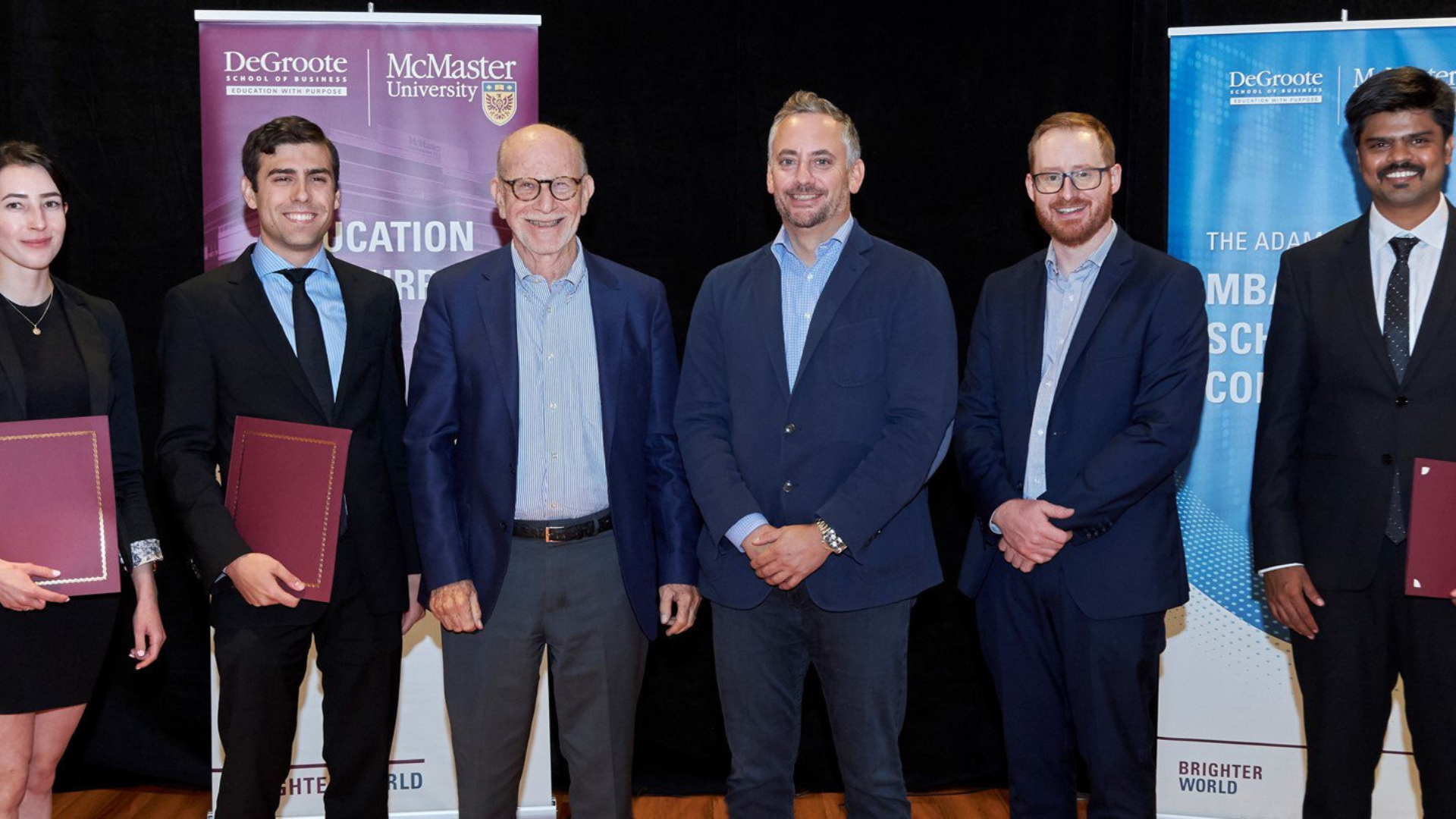
In June 2026, Felesky received his honorary doctorate. His advice to graduates placed relationships and initiative alongside intellectual rigour. He also described setting aside about a tenth of his weekly time to meet people and help them. The emphasis is on discovering what someone is trying to solve and whether a useful introduction can be made.
“show up, build relationships and show passion”
Adam Felesky, advice to graduates, June 2026
Fausto’s account gives that habit a human scale. A student’s plans received attention from someone who had already built a financial business. Mentorship rarely arrives with a tidy performance chart. The value may lie in confidence, a more precise question, or the decision to investigate an idea before committing years to it.
Ten years in, another door opens
In September 2026, Portage marked a decade in fintech and announced the final close of Ventures IV at approximately US$600 million. Its platform reported US$7.0 billion in assets under management as of June 30, including that fund, and more than 140 portfolio companies. New strategic investors included Broadridge and Fifth Third Bank.
Ventures IV final close
June 30, 2026; includes IV
Reported September 2026
Felesky’s attention is turning toward technology changing wealth management and the core workflows of financial institutions. That interest keeps him close to the industry where he built his first company. The businesses have changed; the question of how financial services get built remains.
Another university conversation is already on the calendar. He is scheduled to join the DeGroote Insight Lecture panel on November 2, 2026, discussing Canada’s productivity and the work of bringing ideas to market. It is a fitting next stop for a career that keeps moving between a promising idea and the people needed to put it to work. Somewhere in that gap, an introduction still has a job to do.
Read, listen, keep up
- Portage and its investment platform
- Adam Felesky on LinkedIn
- Portage on LinkedIn
- Portage on X
- Portage on Facebook
- The Hard Part: Adam Felesky, 39-minute conversation
- Watch: Why he created the scholarship
- Watch: Changing responsibilities of managers
- Watch: How the business landscape is changing
- His advice to McMaster graduates
- Inside the conversation with MBA students
- Portage’s fourth venture fund announcement
- Felesky’s Fortune commentary
- Open banking submission to the Senate
- The November 2026 Insight Lecture