The first version was foam. It did not produce vapor, attract investment or invite a congressional question. It merely sat in the hand. In 2004, that was enough for Adam Bowen and James Monsees, graduate students in Stanford's product design program, to begin. They watched people handle different shapes. They borrowed components from butane lighters and other devices to assemble a working model. Long before a polished rectangle reached shop counters, the pair were studying the ceremony around an ordinary object: how it was held, carried, repeated and shared.
Bowen had arrived at Stanford by way of a physics degree from Pomona College. The sequence matters. Physics asks what an object can do; product design asks what a person will do with it. His career would live in the uncomfortable gap between those questions. With Monsees, he took a graduate exercise and pursued it long after a sensible student would have filed the presentation away.
They became friends during smoke breaks, an origin detail so narratively tidy that it sounds focus-grouped. It was not. The pair were examining a habit they knew from the inside, and they approached it with the confidence of designers who believed a stubborn category could be redrawn. Their thesis was presented in 2004. Bowen completed his master's degree the following year. The company did not arrive until 2007.
- 2004Stanford thesis
- 2007Ploom founded
- 2012Pax arrives
- 2015Juul launches
- 2017Juul spins out
The useful years nobody calls overnight
For roughly a year before incorporating Ploom, Bowen and Monsees worked from a friend's office. They wrote a business plan and found early backing, including money from investor Nicholas Pritzker. In 2010, Ploom launched the ModelOne. It was a real product, which is not the same as being the final answer. Two years later came Pax, a $250 premium vaporizer with the kind of considered finish that prompted one early reviewer to compare its effect on the category with the iPod's effect on music players.
The compliment reveals the founders' native language. Ploom did not present itself as laboratory equipment. Pax did not look like a hobbyist's contraption. These were consumer objects, designed to move through daily life without explanation. Their appeal lay in removing fuss. Bowen, the engineer and eventual chief technology officer, worked on the machinery beneath that ease. Patent records name him across device systems, temperature control, formulations and cartridges. Simplicity at the surface required complication behind it.
That division between surface and mechanism also explains why Bowen can seem oddly absent from his own origin story. Monsees often supplied the language and visual framing; Bowen's work appears in specifications, filings and the repeated act of making the device function. Consumer design rewards invisibility. A hinge should not announce its calculations. A heater should not require a lecture. When such work succeeds, users notice the experience and forget the engineering that made it possible. Bowen built a career inside that disappearing act, even before he withdrew from the public stage.
In 2015, Japan Tobacco International bought the Ploom name and associated assets. The remaining company took the name of its better-known product, Pax Labs. That same year, Pax introduced Juul. Two years later, Juul Labs separated from Pax and became its own company, with Bowen as co-founder, CTO and board member. The corporate family tree looked like the output of a design studio: revise, rename, remove what no longer belongs.
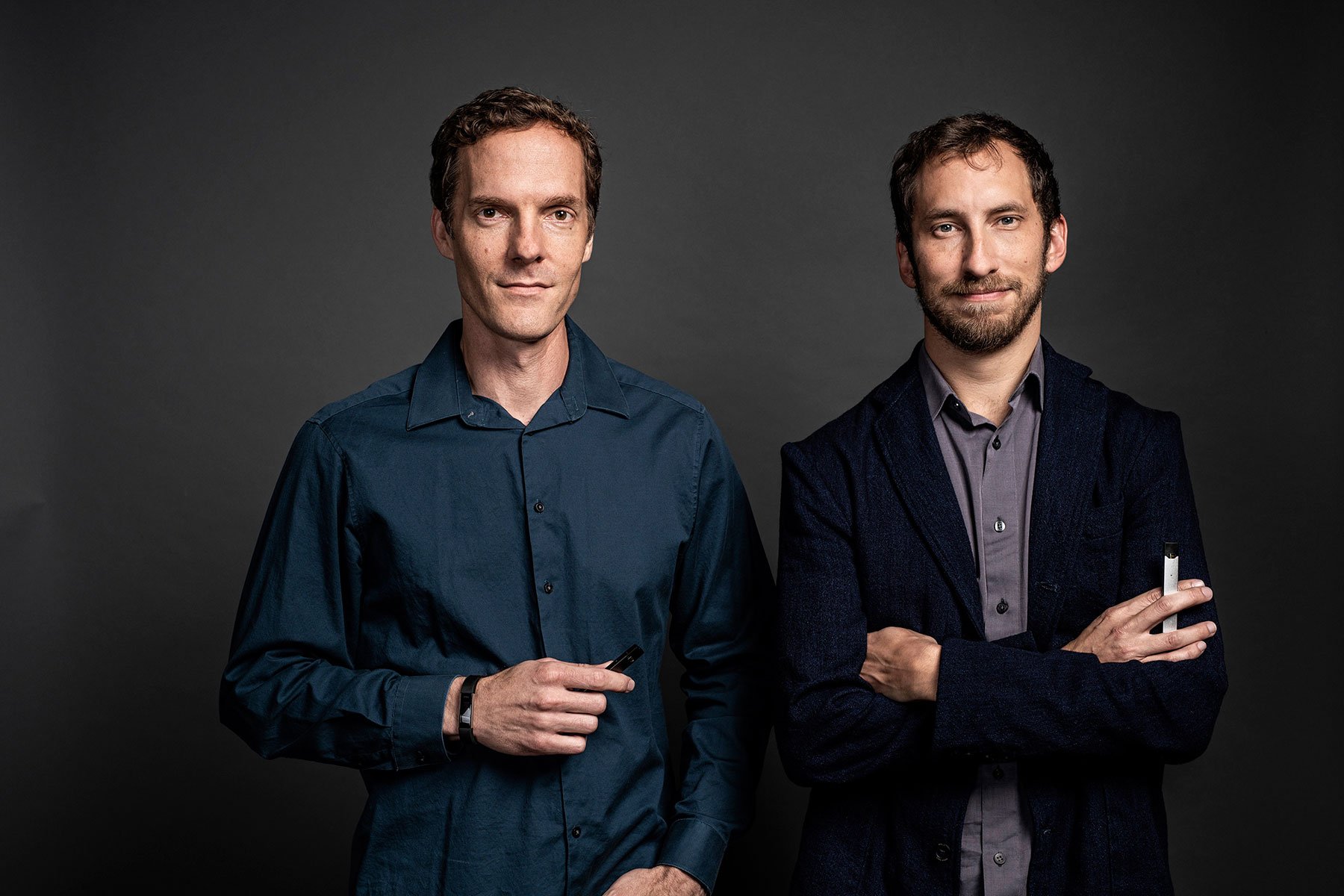
When the object became a verb
Juul was the cleanest expression of the founders' long project: a narrow device with almost no visible controls and a cartridge system intended to make use straightforward. It looked closer to a piece of personal electronics than the elaborate devices already circulating. Here was the old Silicon Valley promise in miniature. Take a behavior full of friction, hide the mechanism and leave the user with a gesture.
The market answered quickly. By the end of 2017, after growth of more than 600 percent in a year, Juul had become the emblem of its category. Its name became a verb. By 2018 it held more than 70 percent of the US nicotine-vape market. Revenue reportedly passed $1 billion. The product was compact; the numbers were not.
Then came the deal that converted a design story into high finance. In December 2018, Altria paid $12.8 billion for 35 percent of Juul, implying a $38 billion valuation. Forbes estimated Bowen's fortune at $1.1 billion in 2019. A thesis about redesigning an established ritual had produced a multibillion-dollar startup outcome.
Bowen told an interviewer that he had initially been skeptical of the Altria arrangement. He moved forward after the company promised prominent retail placement and access to its customer database. The reasoning was practical and, on its face, consistent with the founders' ambition for scale. It also bound Juul to an incumbent whose resources made the startup larger, faster and harder to explain as an outsider.
Design does not choose its audience
A product can be engineered for one purpose and adopted for another. It can also be marketed badly. Juul's 2015 “Vaporized” campaign used vivid colors and young models; critics argued that it made the device appealing to teenagers. Bowen later said he would have launched with a different campaign focused more closely on the company's stated adult audience. “It was six months and we pulled it,” he said in 2019.
The defense was factual but insufficient to close the argument. Six months can be a short line in a corporate timeline and a long time in culture. Once an object has circulated through shops, parties and social feeds, its creators cannot recall its meaning along with its advertisements. The designers had removed friction from the product. They discovered there is no corresponding button for removing consequences.
This is where Bowen's reserve becomes interesting. TIME described both founders as workaholics with bruising international travel schedules, but called Bowen the more reserved of the two. In interviews he was diplomatic, deliberate and prone to pausing before the second half of a difficult sentence. He welcomed criticism while asking for more attention to data. His manner was closer to an engineer reviewing a failed tolerance than a founder auditioning for absolution.
“You can always do things better, every step of the way.”Adam Bowen, 2019
The line arrived after a reporter asked what, beyond marketing, he would change. Bowen first joked that the question opened a Pandora's box. Then he stopped, searched for an answer and produced ten plain words. They are modest enough for a workshop wall. In context, they carry the weight of a postmortem.
The quiet after the scale
In October 2019, Bowen and Monsees left their operating posts. Bowen moved from chief technology officer to an advisory role supporting a new chief executive. Monsees later left the company entirely. Investment write-downs followed, and Forbes removed both founders from its billionaire ranks. The numbers that had made the ascent legible now charted the descent.
Bowen did not launch a second public act. He largely receded. A Delaware court filing said he remained a Juul director until at least May 2023, but his verified public presence offers little running commentary. There is a LinkedIn page, a trail of patents and old interviews. The latest patent record, published in September 2026, names him with several co-inventors on an application concerning vaporizer cartridges. A patent attribution is evidence of inventive work, not proof of a new job, and the distinction suits a biography in which the private chapters now outnumber the public ones.
The temptation is to force Bowen's career into a moral fable: the clever student, the gleaming product, the fabulous valuation, the reckoning. Real careers are less obliging. Ploom took patience. Pax required craft. Juul's rise involved genuine technical work, shrewd packaging, strong financing and choices its co-founder later said he would revisit. Achievement and error sit at the same drafting table.
There is an old designer's fantasy that better objects produce better outcomes. Bowen's story supplies the amendment. An object enters a system made of investors, retailers, advertisements, users, critics and regulators. Every participant redesigns it. The original maker retains authorship, but never sole possession of the plot.
The foam model in 2004 asked how an idea might feel in the hand. Two decades later, Bowen's larger legacy asks a harder question: what does a designer hold when millions of hands have answered back? The reply is not neat enough for a product brief. It is part accomplishment, part responsibility, and forever a work in progress.