There are easier ways to spend a Friday than submitting a pitch deck and waiting to learn whether a roomful of strangers considers your company draftable. Yet this is the small piece of theater that makes AcceleratorCON more interesting than the familiar startup conference: it gives the mingling a plot.
The New York company gathers early-stage founders, accelerator operators, venture investors, universities and economic-development groups. There are keynotes, panels, booths and workshops, all the apparatus of the modern business gathering. Then there is the Draft Experience. Tech-enabled startups from pre-seed through Series A apply. Reviewers score them. A class is announced. Selected founders receive an event ticket and scheduled private meetings with accelerator and investor partners.
In other words, the conference is the visible product, but the qualified introduction is the useful one. AcceleratorCON is not itself an accelerator, does not disclose an investment fund and does not promise a check. It is an event operator with the beginnings of a two-sided marketplace: founders bring companies; programs and investors bring opportunity; sponsors pay to be near the exchange.
A draft, not a drift
Founder Esosa Ighodaro arrived at the idea from both sides of the velvet rope. Her earlier commerce app, CoSign, participated in the Seamless Accelerator and raised $1.4 million from three principal investors. She has said the program taught her to define the problem, navigate fundraising and understand what investors wanted. She also co-founded Black Women Talk Tech, building community for entrepreneurs who rarely saw themselves in the usual rooms.
“Investing in tech is still a very relationship-based industry.”Esosa Ighodaro, founder
Her observation was plain: accelerator programs had multiplied, but discovery had not become easy. Founders outside elite schools, family networks and established technology circles still needed the elusive warm introduction. Meanwhile, programs needed credible deal flow and better applications. AcceleratorCON built a live transaction around the mutual search.
The structure matters. Most conference networking asks a guest to do all the work: identify the right badge from across the room, interrupt a conversation, deliver a miniature pitch and hope for follow-up. The Draft moves much of that labor before the doors open. Both parties arrive knowing why the meeting exists. The sports metaphor is decoration; pre-qualification is the product.
It also gives rejection a defined shape. A company that is not selected can still attend at a discount and use the general program, but it does not receive the same promise of private meetings. That distinction protects the value of the selected class, provided the scoring is serious. AcceleratorCON has described a two-phase expert review, though it has not published a universal scoring rubric. For applicants, the trade is straightforward: submit company information for a chance at access, with no 2025 application fee and no disclosed equity claim.
First, the water came
AcceleratorCON’s first failure was literal. The planned September 2023 gathering at the Brooklyn Navy Yard collided with severe flash flooding and a shutdown of the train system. The company moved the event online. For a business premised on face-to-face access, that was a particularly rude product test.
The in-person version finally arrived at the Navy Yard in November 2024. Ighodaro told Forbes that about 500 people had registered. The two-track program separated founder material from accelerator-operator material, while Seth Godin and Teachable founder Ankur Nagpal supplied headline appeal. Accelerator representatives included ERA NYC, Cela Innovation and HearstLab. Microsoft, Oracle and Techstars were named sponsors.
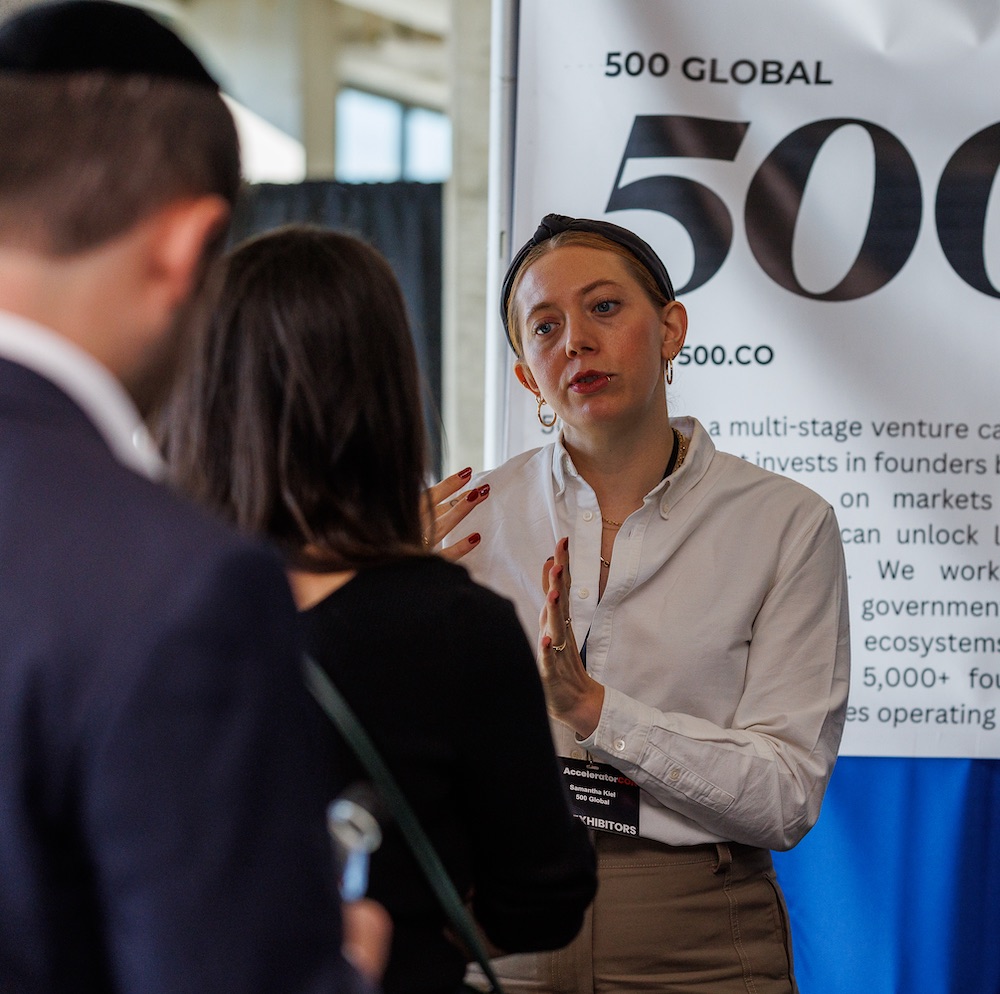
The organizer’s 2025 sponsorship deck later reported 1,000 attendees across two events in 2024, 275 Draft applications, 12,000 email contacts and 150,000 social-media impressions. It also said 92.6 percent of attendees made a new connection. These are AcceleratorCON’s own marketing figures, not audited operating results. Still, they reveal what the company considers success: applications and connections, not merely bodies facing a stage.
Who buys the room
The customer changes depending on which door you enter. Founders buy admission and attention. Accelerators and VCs buy efficient discovery, though their participation terms are not publicly standardized. Brands buy booths, stage integrations and proximity to an audience inclined to need cloud credits, banking, legal help, recruiting and software. Universities and public-development agencies use the gathering to connect local innovation programs with founders.
The audience mix clarifies the commercial design. The 2025 deck projected more than 800 attendees: 60 percent founders, 20 percent accelerators, 15 percent investors and the remainder supporters and press. It said nine in ten companies would be early-stage and 40 percent of founders would come from underrepresented groups, including people of color, LGBTQIA founders and veterans. Those were projections, not a post-event census, but they show the room AcceleratorCON was selling.
A 2025 ticket page advertised VIP admission at $249. Applying to the Draft was free, and selected startups were promised a free ticket plus guaranteed private meetings. The larger checks sit on the corporate side. AcceleratorCON’s sponsorship deck listed five packages: Interview at $20,000, Program at $25,000, Orientation at $50,000, Pitch Competition at $75,000 and Term Sheet at $150,000. It even priced a personalized Starbucks-style coffee kiosk as a $20,000 add-on. Somewhere, a latte has acquired enterprise software economics.
The sponsor ladder
Published package prices in the 2025 sponsorship deckThis is the business model in miniature: keep founder entry to the most valuable matching mechanism frictionless, then monetize access, visibility and hospitality around it. The approach can align incentives if selection remains credible. A room full of relevant founders is valuable to programs and sponsors; relevant programs make founders willing to apply.
Specific beats sprawling
The first positioning was broad: a big event for the startup ecosystem. That language placed AcceleratorCON beside every innovation summit with a lanyard printer. A later strategy project with consulting firm ImpelHub identified three problems: diluted sponsor value, weak differentiation and revenue concentrated around one annual event.
The prescription was more interesting than “grow the brand.” AcceleratorCON narrowed the high-value audience to founders actively seeking programs and programs actively scouting companies. It elevated the Draft from an activation to the central story. Sponsorship moved from impressions toward measurable deal flow and qualified introductions. A proposed Accelerator Discovery Index would extend the relationship beyond one event day.
That is what changed the company’s emphasis: evidence that sponsors wanted quality leads, accelerators wanted year-round prospects and nobody had cleanly claimed “accelerator discovery.” The change is visible in the language. The old promise was a large gathering. The sharper promise is a first meeting.
A playbook worth borrowing
Another community builder can copy the mechanics without copying the football costume. Start with the transaction the audience actually wants. Make both sides apply or declare intent before the event. Publish a selection process. Schedule the scarce meetings. Give the selected group a name people can carry forward. Measure whether introductions happened and whether they produced a second conversation.
The model has conditions. It depends on enough strong applicants, credible scouts, participating programs with genuine capacity and meticulous scheduling. It works poorly when “selection” is merely paid placement, when investors are present only as logos, or when the audience is too small or too general to create good matches. Human curation also resists cheap scaling. Every additional city creates more vetting, coordination and trust to maintain.
The event teaches the next product
By early 2026, AcceleratorCON had begun selling a different form of expertise: the Experience Architect Workshop, a two-day virtual intensive for event creators. The program covers framework design, revenue models, audience growth, brand positioning and community building. The company said 20 creators completed its January cohort and promoted later dates.
That move fits the underlying economics. Annual conferences are lumpy, expensive and exposed to everything from sponsor budgets to biblical weather. Workshops turn operating knowledge into a repeatable service. A discovery index could do the same with data. Together, they hint at a company less dependent on one giant New York room.
AcceleratorCON sits between event production, founder education and venture-market infrastructure. TechCrunch Disrupt and Web Summit offer broader stages. Demo days serve one program’s portfolio. Directories such as F6S make programs searchable online. AcceleratorCON’s narrower claim is that several programs and a curated founder class should meet in person, at once, with a schedule.
The claim is modest enough to be testable. Did a founder get the meeting? Did the program find a suitable applicant? Did either party keep talking? The confetti, coffee kiosk and famous speaker can help sell the day. The company will be judged by what happens after everyone takes off the badge.