A light switch is an unremarkable object until it works for the first time. Abhishek Vinod Singh remembers electricity arriving in the small Indian village where he grew up. He pressed a switch. A bulb came on. Years later, addressing a room of utility professionals in New Orleans, he still had a child's word for the experience: “magic.”
That memory gives his present occupation an unusually direct point of reference. Singh co-founded AiDASH, which uses satellite imagery and artificial intelligence to help utilities inspect their networks and decide where maintenance crews should go. Somewhere between the village switch and the satellite lies a career spent learning how much work an ordinary, dependable light requires.
Today he is based in Santa Clara, California. His company operates in an industry whose successful days often pass without comment. Electricity arrives; people get on with things. The applause tends to be reserved for restoring service after something has gone wrong. Singh has built a business around an earlier, less theatrical moment: finding the problem while there is still time to do something about it.
Friends first, companies later
Singh studied physics at the Indian Institute of Technology Kanpur, graduating in 2002 from its five-year master's program. Entrepreneurship was already a shared ambition among friends from his IIT years. Their plan allowed for an apprenticeship: work, gain experience, then start something together. The romance of founding a company could wait until they had a better idea of how to run one.
In 2005, he co-founded DbyDx Software. The early team included Nitin Kumar Verma, Kapil Tyagi, and Konark Singh. Looking back in 2009, Singh described the friends' longstanding wish to build a business and their decision to accumulate experience before taking the plunge. Partnership was present at the beginning, rather than recruited later to tidy up a founder's solitary inspiration.
His subsequent work included Edureka, the technology education business, and leadership at Kellton Tech. At Kellton, he served as COO for the United States and head of digital transformation. These were businesses concerned with making technology useful to other people, whether through software delivery, education, or changing the way an organization worked. AiDASH would ask him to apply that experience to a very physical customer problem.
- 2002Completes his physics degree at IIT Kanpur.
- 2005Co-founds DbyDx Software with friends from his IIT years.
- 2019Co-founds AiDASH with Rahul Saxena and Nitin Das.
- 2026Schneider Electric announces a proposed majority acquisition.
The dinner that acquired a different subject
In November 2018, California's Camp Fire brought destruction to the state and smoke to the Bay Area. Singh was driving to dinner with Rahul Saxena at San Francisco's Press Club. Their conversation turned to the fire and the satellite images showing its extent. The question was whether those images could do more than document what had already happened.
Saxena was a former colleague and another IIT alumnus. They brought Nitin Das, also a former coworker and IIT graduate, into the discussion. In 2019, the three founded AiDASH. Before settling on a product, they investigated what utilities needed. Vegetation management emerged as the first market: trees and other growth around electricity infrastructure presented a substantial maintenance problem.
The founders financed the company themselves for its first 20 months. Entergy became the first customer. The name joined AI with the speed of a dash and the information display of a dashboard. That is a considerable assignment for six letters, though perhaps easier to accommodate on a business card than “satellite-assisted decisions about inconvenient branches.”
The founding question had a practical constraint built into it. A photograph of a risk is useful only if somebody can turn it into work. A utility needs to decide which stretch of line deserves attention, who should inspect it, and where a limited maintenance budget will make a difference. Singh's opportunity lay in that journey from seeing to doing.
An AI company with branches to consider
AiDASH's first product was the Intelligent Vegetation Management System, or IVMS. Satellite observations and AI help utilities understand vegetation around their lines and plan work. The customer is a vegetation manager with an operating responsibility. The software has to fit that person's decisions, rather than invite them to admire a model's technical sophistication.
In a 2025 interview, Singh explained that AiDASH embeds its AI inside applications built for the people doing the work. Vegetation intelligence also supports its Climate Risk Intelligence System, which addresses storms and wildfire risk. Trees provide a connection between those uses: the same surroundings that require routine maintenance become consequential when severe weather arrives.
He makes a useful distinction between the two hazards. A utility cannot stop an approaching storm, but it can prepare for its effects. Wildfire prevention offers opportunities to act before ignition. Both require earlier knowledge, although they lead to different operational decisions. Satellite analytics earns its place through those decisions, rather than through a picture that looks impressive on a conference screen.
There is a pleasing modesty in the resulting division of labor. Space supplies a wider view. Software helps make sense of it. People still have to decide, travel, inspect, and maintain. For a founder surrounded by the vocabulary of artificial intelligence, Singh's business remains closely tied to the practicalities of getting a crew to the right place.
Small teams, candid conversations
Asked in 2022 to describe his creative process in three words, Singh answered: “Learn, act, adapt.” His management preferences were similarly compact. He favored small teams working toward larger objectives, with frankness between colleagues. He traced the value of that approach to his experience building DbyDx and Edureka.
He also described room for experiments that fail, alongside a rigorous interest in business outcomes. Taken together, those preferences suggest an operator who wants people to explore and then assess what the exploration achieved. The customer supplies a useful test. Cleverness has to survive an encounter with somebody else's job.
“Learn, act, adapt.”
Abhishek Vinod Singh, 2022
The economic rewards of building the business have included employees. In May 2024, following its Series C financing, AiDASH announced its first employee stock buyback program. Existing full-time employees with more than three years of tenure could cash in vested shares. Singh credited the team's work and spoke about ownership. The program put a concrete transaction behind that familiar corporate word.
By April 2024, the company had closed a $58.5 million Series C led by Lightrock. Its backing also included investors with direct connections to the utility business. National Grid Partners, Edison International, and Duke Energy appeared among its investors. Those relationships placed infrastructure operators close to the company building tools for their industry.
A wider view, including his own blind spots
At Evolve 2024 in New Orleans, Singh returned to his childhood encounter with electricity. He also discussed a problem within the industry's software: fragmented inspection and monitoring systems. AiDASH's own point solutions were part of that landscape. A broader view of the network would require a broader approach to the tools used to manage it.
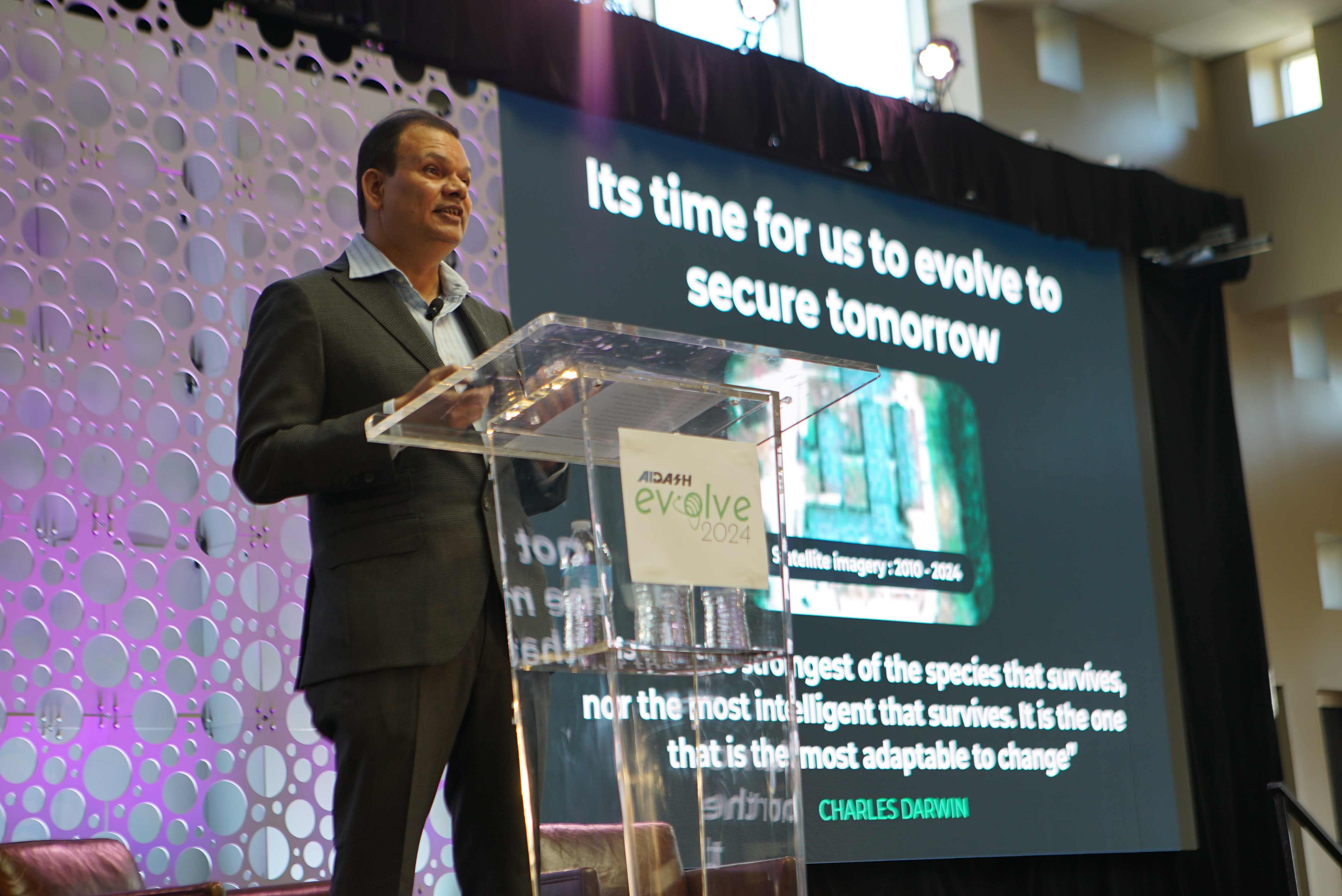
By Evolve 2026 in Palm Springs, he was presenting PreventionFirst, AiDASH's approach to connecting vegetation, asset, wildfire, and storm intelligence. Its scope crossed emergency response, ongoing maintenance, and long-term capital investment. The ambition was to help utilities assess connected risks together and explain the choices they made about them.
His description of the sensing technology included a sensible limit: “satellites cannot determine everything.” The approach combines satellite coverage with other forms of inspection, including LiDAR, ground imagery, and targeted drone or manual visits. A technology founder acknowledging the limits of his preferred technology makes for a useful conference moment. It also leaves room for a more workable system.
The bigger question is organizational. A storm forecast, a tree-trimming plan, and a decision about replacing infrastructure may concern the same section of network while belonging to different teams and time scales. Singh's later work asks those decisions to share a view. The software has expanded along with his definition of the customer's problem.
The next set of connections
Recognition followed. EY named Singh among its 2025 Bay Area Entrepreneur Of The Year winners. In 2026, IIT Kanpur listed him among its Distinguished Alumni Award recipients. The university entry recognized a career spanning AiDASH, DbyDx Software, and Edureka. His physics degree now sits at the beginning of a rather varied list of applications.
On July 30, 2026, Schneider Electric announced an agreement to acquire approximately 90 percent of AiDASH in an all-cash transaction with an implied enterprise value of $350 million. The announced deal remained subject to closing conditions and regulatory approvals. It connects Singh's work to Schneider's wider grid software business and its One Digital Grid platform.
Schneider's announcement described AiDASH as serving more than 185 customers globally. The proposed combination gives a commercial form to something Singh has argued in public: grid resilience depends on cooperation across technologies and organizations. In his own announcement, he described the opportunity to bring the company's risk intelligence to infrastructure operators at a larger scale.
That ambition can sound remote when expressed in platforms, networks, and transactions. His childhood memory brings it back within reach of a hand. Someone presses a switch and expects a bulb to light. Behind that expectation stand crews, trees, wires, budgets, weather forecasts, and now satellite images. Singh's career has become an extended examination of everything that must go right before a familiar little click.