The morning after Michael Andrzejewski graduated from high school, his father handed him an iPad and a blue Google Street View polo shirt. Abe Andrzejewski had arranged a summer education with rather more rejection than a video game. Father and son would go cold calling together. Michael, who planned to study technology, would learn how to sell it.
The lessons ran in both directions. Abe could show his son how to bring a sales conversation to a close. Michael could show his father how to work the company’s newly released customer-management technology on the tablet. The experienced salesman supplied the approach; the teenager supplied some of the operating instructions. It is a pleasingly domestic picture of a business changing its tools without retiring its old skills.
That exchange gets close to the working life of Abe, also known professionally as Abram Andrzejewski. As co-founder and chief executive of American Marketing & Publishing, he has spent decades pursuing a particular customer: the independent business owner who needs someone nearby to pick up the phone, come through the door, or ask for directions.
A smaller book, a shorter journey
His early equipment was less portable than an iPad. In Herscher, Illinois, Andrzejewski used a ruler and red pencil to pick local telephone numbers out of a regional directory, then entered them by hand. The resulting 1992 Herscher directory had errors. His parents fielded complaints about them. A publishing apprenticeship can be quite educational for the entire household.
The commercial observation was simple. A directory encompassing dozens of towns included businesses far beyond the distance someone might reasonably travel for a pizza. A town deserved a book that understood the town. Before the software, there was a question about how far a customer actually wanted to go.
Andrzejewski had begun selling coupon books while an undergraduate. The publishing work continued through graduate school and expanded into directories for students and faculty at business and law schools, including Harvard, Stanford, and Columbia. His own education took him through Northern Illinois University and Harvard Law School. Publishing, meanwhile, kept providing its own curriculum in customers, detail, and distribution.
In 1997, he and his brother Adam founded American Marketing & Publishing. Early HomePages directories served Fox River Grove, Illinois, and Lowell, Indiana. The business moved to DeKalb in 1999. Its subject was small communities; its opportunity was to keep finding more of them.
- 1997HomePages directories
- 2011CloseBy text marketing
- 2014OPTIMA online visibility
- 2021AMP Video launches
The awkward guest at the digital party
At a local advertising industry gathering in 2010, Andrzejewski was an unexpected sort of participant: a print publisher discussing growth in a room interested in digital marketing. AMP then published 331 local directories. A questioner wanted to know why his company was surviving when print businesses seemed to belong in an obituary column.
His answer concerned price and geography. Bigger directory publishers, he argued, had charged too much for too little value. Smaller coverage areas allowed AMP to offer more targeted advertising at lower rates. He said individual directories typically increased revenue by 5 to 10 percent, while new publications would help push total growth higher.
The distinction mattered. His case for print depended on the economics of a particular local transaction, rather than affection for paper. A business owner buying an advertisement was paying to reach possible customers within a useful distance. The medium had to earn its place in that calculation.
AMP subsequently added text marketing, online presence management, interior tours, and video. The sequence suggests a company following the merchant’s problem across different formats. Andrzejewski had learned to sell a local audience. He would now have to keep learning where that audience was looking.
The customer still has somewhere to go
By early 2019, his internal messages were discussing a tablet-based sales system alongside an increase in new OPTIMA sales. He also singled out back-office accounting and renewal rates. The list mixed visible products with machinery customers would never admire. There are few glamorous ways to celebrate a more efficient accounting system, but he found room for one.
Later that spring, he described the work through two customers: an Elgin towing business and a Florida motel. The figures he reported were calls and requests for driving directions. He was still thinking about the distance between someone needing a service and someone ready to provide it. A map click was a newer instrument for a familiar purpose.
In January 2023, he admitted that the immediate demands of work could narrow his attention to the day or week ahead. The annual company meeting offered a chance to look further. His account of the product set was concrete: business imagery, listings, websites, reviews, social media, and video, delivered with service around them.
That combination explains something about his role. Selling the program creates an obligation to perform a succession of smaller jobs. The customer needs a photograph taken, information maintained, or a request answered. As the product range grows, the number of handoffs grows with it. His writing repeatedly returns to the people and systems responsible for those handoffs.
“There’s no such thing as a small customer at AMP”
Abe Andrzejewski, January 2023
A company meeting, with relatives
At AMP’s twenty-fifth anniversary open house in 2022, Andrzejewski enjoyed meeting employees’ children, parents, and grandchildren. He also remembered the first five sales representatives and an early pair of difficulties: having too few orders, then struggling to fulfill the orders once selling improved. The business had supplied him with both problems in turn.
His involvement in training has remained part of the job. He regularly attends and presents at AMP’s voluntary Saturday Leadership Development Program. The company has also described him speaking with incoming classes of sales representatives and returning to the field. Those activities keep the chief executive close to the point where a company promise becomes a conversation with a prospective customer.

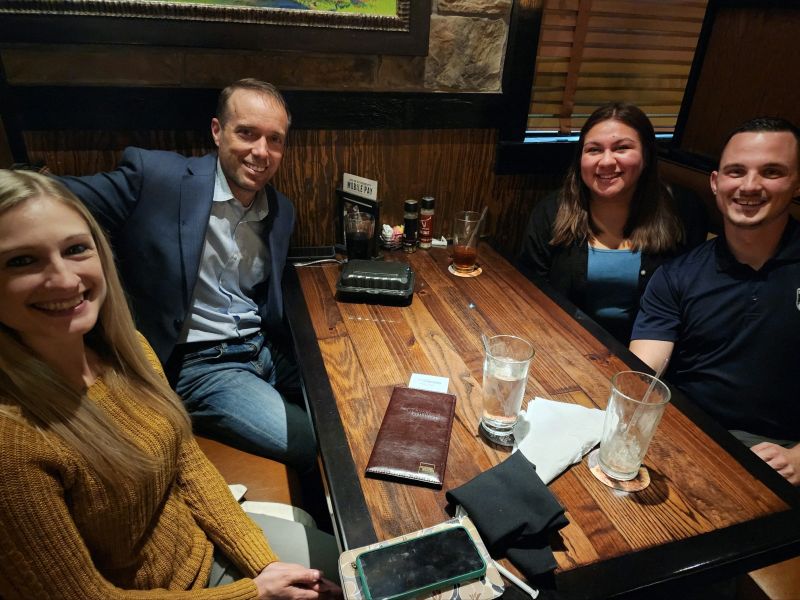
In September 2024, the first Digital Leadership Summit brought leaders from different parts of AMP together at Northern Illinois University. Andrzejewski particularly liked the circular tables, where people could exchange perspectives across teams. About a third of the company attended. The university that appears in his education had become a gathering place for a much larger professional classroom.
The agenda beyond that meeting was substantial: develop OPTIMA, improve sales systems, rework data and accounting infrastructure, and establish new sales districts. His satisfaction came partly from being able to undertake those projects simultaneously. Growth had made more work possible, while also making more coordination necessary.
The month the streak stopped
His February 2025 message included a useful interruption to the celebrations. December had ended AMP’s run of 53 consecutive months of year-over-year monthly growth. Sales had fallen about half a percentage point short of the preceding December. The holiday calendar supplied some context, but he moved quickly past it.
“No more excuses, and we all own it!” he wrote. January had then brought 28 percent growth in total sales over the previous January. The missed month belonged in the same account as the rebound. A record that can include an unflattering entry tells a reader more than an uninterrupted procession of congratulations.
By August 2025, he was discussing an enterprise software transition, changes to sales compensation, and expanded territory for photographers and field representatives. Much of this work was preparatory. Better incentives, fewer administrative obstacles, and wider geographic coverage are less photogenic than a launch, but they affect whether the next sale can be served properly.
His updates reveal an executive interested in that connective tissue. He celebrates results, then returns to the arrangements underneath them. Even the quarterly letter arrived late that summer. The explanation was a busy couple of months, which is perhaps the least surprising thing a reader could learn about someone overseeing both sales expansion and an enterprise software change.
A bigger company, a real photograph
In February 2026, Andrzejewski reported that 2025 had finished with record digital revenue and four consecutive quarters of improving client renewal rates. His attention was turning toward AI-enabled search. He emphasized consistent business information and factual website content, along with reducing extra steps in selling and onboarding customers.
At the photographer summits that March, he addressed another part of the same question: credibility. Twenty-nine photographers joined the sessions remotely from twenty states. Andrzejewski stressed the value of human-created imagery as AI changed the online environment. For a company that helps businesses appear in search, the actual room behind the listing still mattered.
By June, his stated ambition was to double AMP over four years. Leadership discussions covered acquisition, account management, and hiring. He described organizational gaps and fixable inefficiencies, as well as opportunity. The larger company he imagined needed people in roles that were still waiting to be filled.
There is a practical continuity here. The early directory required someone to get the numbers right. The digital agency requires people to maintain information, make images, serve accounts, and sell the next program. Andrzejewski’s tools have changed considerably since Herscher. The work still ends at someone else’s business, where a customer decides whether to call.