Zean Nielsen had been running an airplane company for only a few weeks when he began asking awkward questions about airplanes. Why did the pilot have to switch between fuel tanks? Why did setting up a flight require quite so much work with radios? He had started flight training shortly before the 2019 gathering at Oshkosh. The chief executive was also the beginner, looking at the cockpit without the protective coating of habit.
“The cockpit has to be easier,” he said. And, about radio communications: “Why is that not a text message?” Coming from someone who had helped sell electric cars and Danish sound systems, the questions made sense. A newcomer notices the things an expert has stopped noticing. Occasionally, the newcomer also has the budget to do something about them.
Seven years later, the G3 Vision Jet supports controller-pilot datalink communications. At participating airports, clearances can arrive as messages on the flight deck. Nielsen did not invent the technology, and aviation's development involves far more people than a CEO. Still, there is a pleasing rhyme between the question he asked as a student and the product his company introduced in February 2026.
“The cockpit has to be easier.”
Zean Nielsen, July 2019
A Danish apprenticeship in paying attention
Nielsen's route to the flight line began at Bang & Olufsen in 1997. He is Danish, with a business degree from the Herning Graduate School of Business. His early professional education was in a company where the way a product looked and felt belonged in the same conversation as what happened inside it. A loudspeaker has engineering to do. It also has to live in somebody's sitting room.
His assignments covered international distribution, retail, marketing and sales in North America and Asia Pacific. Over a roughly 17-year tenure he rose to president for North and South America. That is a long apprenticeship in the distance between a technically accomplished object and a customer willing to welcome it home.
By 2004, he was on the cover of Fast Company. The magazine described an unusually young marketing executive who had helped plan and open 43 of the company's 60 stores in the United States and Canada. Getting through the door himself had required eight hours of tests covering aptitude, personality, English and mathematics. Even the interview process seems to have come with a fairly elaborate control panel.
The stores matter to his later story. A manufacturer can spend years improving a product and lose a customer in the first ten minutes of trying to explain it. Retail makes that failure visible. Nielsen's career kept returning him to that meeting point: the machine on one side, the person deciding what to do with it on the other.
Cars, cladding, then a company with wings
In 2014, he moved to Tesla, where he held leadership responsibilities in global sales operations and Europe, the Middle East and Africa. James Hardie followed in August 2017, with responsibility for North American sales. Electronics, electric cars, building materials: the list offers no obvious reason to put him in charge of an aircraft manufacturer. It does offer experience in selling complicated products through complicated organizations.
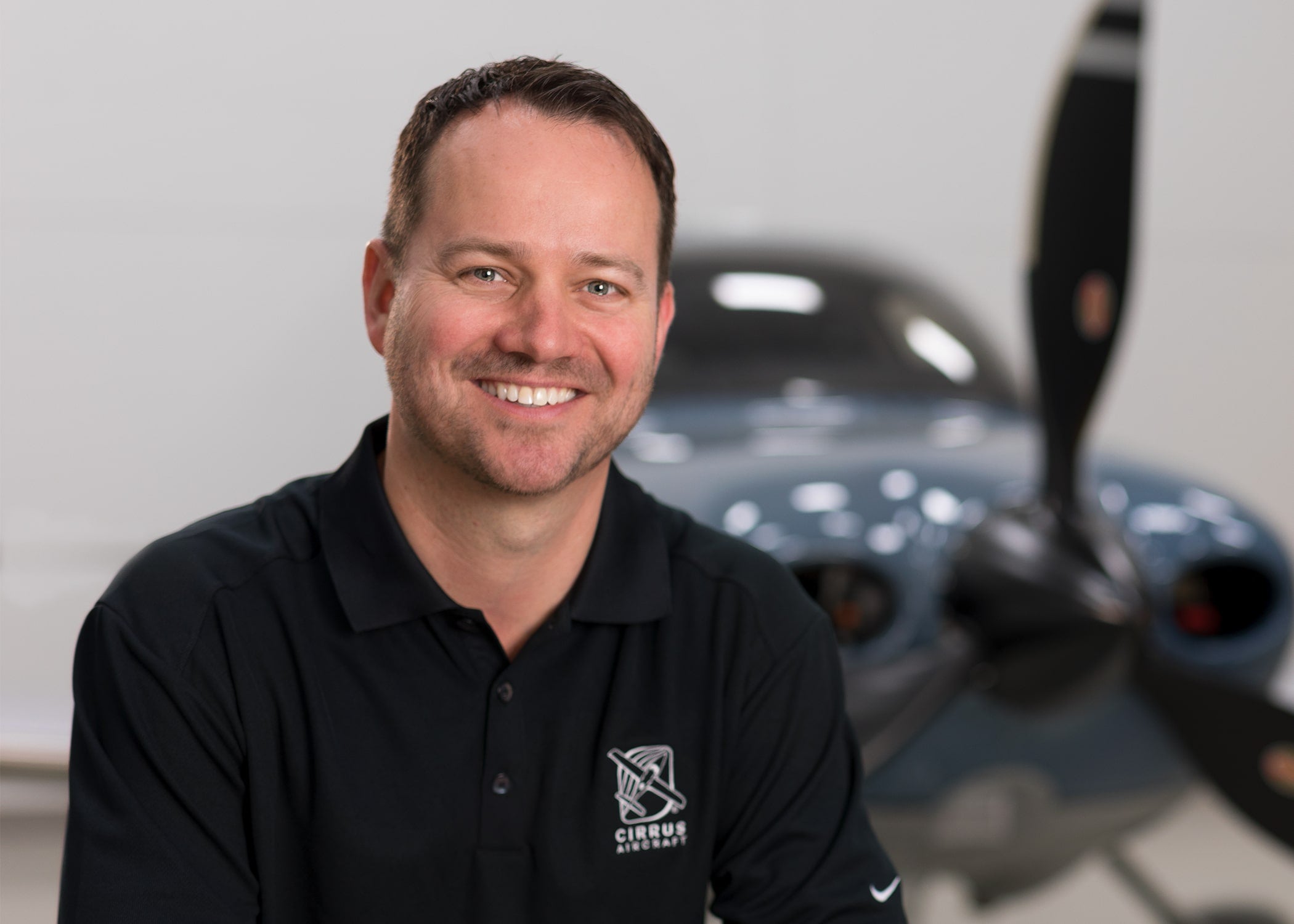
Cirrus appointed him chief executive on June 3, 2019, succeeding co-founder Dale Klapmeier. Klapmeier moved into a senior advisory role. The transition placed an executive with an outside perspective beside a business with a substantial technical history of its own. Nielsen inherited that history; he had to decide how to extend it.
The distinction matters. The Vision Jet received its type certification in 2016, before he arrived. Cirrus's whole-airframe parachute also long preceded him. A biography that hands a new chief executive every invention in the hangar makes both the executive and the engineers less interesting. Nielsen's task was to build on work already done, while bringing more people into the market for it.
The airplane is only part of the purchase
For Nielsen, the sales problem extends well beyond choosing an airplane. A prospective owner has to work out where to learn, where to keep the machine, how to finance and insure it, and who will maintain it. The questions arrive in a crowd. Owning an object that can cross a state line quickly does not automatically make the administration move any faster.
His answer has been to connect more of those steps. Training, service, aircraft management and digital tools sit around the aircraft itself. In a conversation about customer experience, he described the desired result as arriving punctually, comfortably and ready for whatever comes next. The useful unit of measurement is the day the owner gets back.
Cirrus One makes that idea concrete. Offered in the Greater Dallas, Greater Orlando and Greater Phoenix markets, the service covers such tasks as hangar storage, logbooks, maintenance coordination and preparing aircraft for departure. Professional pilot services are also available. It is a rather practical interpretation of luxury: someone else has already dealt with the list.
There is a personal reason he keeps returning to time. In 2022, Nielsen described the appeal of being able to visit three places in a day and return for dinner. That is a modestly domestic ending to a conversation about private aircraft. The destination he sells is often an ordinary evening at home.
Learning to fly has a scheduling problem
A company that wants more owners also needs more people to finish learning. Nielsen talks about training as a set of interdependent arrangements: the student, instructor, airplane and weather all have to cooperate. Anyone who has tried to organize a group dinner will recognize the difficulty. Here, one participant can be grounded for maintenance.
Cirrus Approach supplies aircraft-specific digital learning alongside practical instruction. Nielsen has also discussed designing lessons for adults who may need shorter portions of material and more hands-on learning. A busy person returning to study brings a different routine from a teenager accustomed to spending the day in a classroom. The curriculum has to account for the learner who actually turns up.
The next part of that effort appeared in July 2026 with the TRAC10, a three-seat aircraft aimed at professional flight schools. Its rear observer position gives another student a view of the lesson. Automated fuel management reduces one of the chores that caught Nielsen's attention in his early flying days. Cirrus announced more than 100 orders from 13 schools, with US deliveries planned for 2027.
Student time02
Instructor03
Aircraft04
Weather
Four schedules. One flight lesson. Training has to work around all four.
The trainer gives his argument a physical form. Curriculum, aircraft availability and useful feedback belong together. A student who loses momentum is also a person who may never become a customer. Keeping the lesson moving is an educational concern and a commercial one.
What a passenger sees
Nielsen's interest in design includes the person sitting beside the pilot. An experienced aviator may look at a panel of switches and see reassuring capability. A family member may see a collection of opportunities to press the wrong thing. In his discussion of cockpit design, familiarity is part of the argument for simpler interfaces.
Cirrus has pursued that argument with Garmin. Safe Return Emergency Autoland lets a passenger activate a system that can navigate, communicate and land the aircraft in an emergency. The SR Series G7+ brought the system to Cirrus's piston line in 2025. The whole-airframe parachute remains a separate part of the company's safety approach.
The G3 Vision Jet extends the attention to everyday details. Alongside datalink communications, its changes include alerts-linked checklists and a revised cabin with seating for six adults and one child. Tray tables and device mounts share the announcement with flight-deck improvements. That combination feels familiar in Nielsen's career: the machinery and the experience of living with it get developed together.
He is careful about the distance still to travel toward full autonomy. Aircraft must handle changing weather and unusual situations, with consequences that cannot be resolved by simply pulling over. His ambition for automation exists alongside an acknowledgment that judgment is difficult to reproduce. Making a task look simple can require an extraordinary amount of work behind the panel.
The less photogenic work of growth
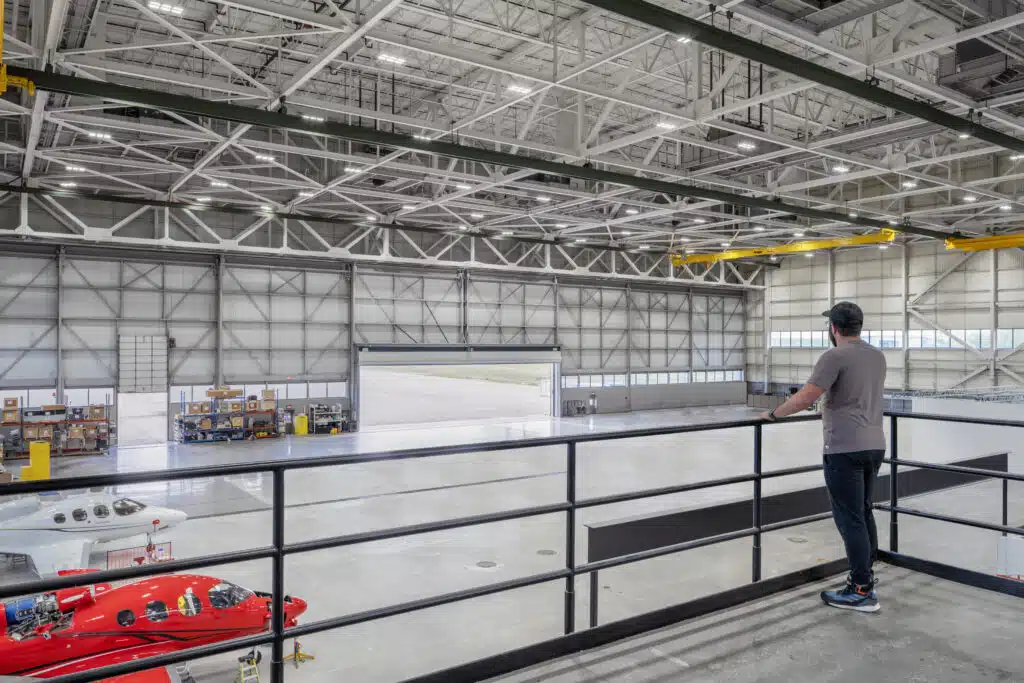
The factory has to keep up with the promise. Cirrus opened its Duluth Innovation Center in September 2023, converting a 189,000-square-foot building into space for development, laboratories and testing. More than 300 engineers and technicians worked there at the opening. A better ownership experience still needs somewhere to be designed, tested and certified.
The delivery figures show the scale of the operation Nielsen now leads. Cirrus delivered 797 aircraft in 2025: 691 SR Series airplanes and 106 Vision Jets. Those are company results produced by a workforce and supplier network, but they give his plans a useful reality check. Making ownership easier has to coexist with making the aircraft.
797 aircraft in total. Bars use the same scale.
In June 2026, the company opened a Talent Center in Duluth to bring recruitment, technical training and career development together. Partnerships include Lake Superior College and a high school manufacturing internship program. The customer journey has a counterpart on the production floor: people need a practical way into the business and a way to develop once they arrive.
Then, on October 15, Cirrus announced a 60,000-square-foot warehousing center in Duluth, consolidating satellite operations and adding capacity for parts storage and processing. A warehouse rarely gets the applause reserved for a jet. It does, however, help keep the jet's owner from spending an afternoon waiting for a part.
Nielsen's story runs from a Danish electronics company to that unglamorous building, with a fleet of aircraft in between. Its recurring question is wonderfully ordinary: why does this have to be so much trouble? He first asked it from the beginner's seat. The work now is to make the next beginner's seat a little easier to occupy.
More time with the story
- Cirrus - official website
- Zean Nielsen on LinkedIn
- The first weeks in the cockpit - 2019 interview
- A conversation about personal aviation - 2022
- Regional flying and the next questions - September 2026
- Listen: Nielsen on Pilot to Pilot
- Watch: inside the G3 Vision Jet - Aviation Week
- Cirrus on Instagram
- Cirrus videos on YouTube