Before Zarina Alexander had a concrete company, she had a keyhole. As a child, she would peer through it to watch her father teaching or working in his university laboratory. Dr. Oleg Bazoev was a civil engineering professor in North Ossetia-Alania. Concrete was his subject. His daughter found the explanations sufficiently interesting to keep watching. Most children are encouraged to look beyond the walls around them. Alexander was acquiring an interest in what held the walls together.
That interest did not send her directly into a laboratory career. She worked in finance and business analysis, including at KPMG and Discovery Inc. Years later, the family connection became a business question: could the concrete technology her father had developed find customers in New Zealand? Today she is the co-founder and CEO of Neocrete, an Auckland company trying to persuade concrete producers to change what goes into a familiar material.
Earlier accounts call her Zarina Bazoeva. The ambition attached to her name has developed too. Better concrete became a search for concrete that could use less cement, meet a producer’s requirements and justify its place on the invoice.
A customer adds an ingredient
In Alexander’s account of the company’s beginnings, she was investigating demand for the durable, high-performing concrete her father had spent his working life developing. Matt Kennedy-Good liked the idea and its use of natural materials. He introduced her to a major New Zealand developer, who added a condition: could this improved concrete also be sustainable?
It was a productive complication. A family invention could open a conversation, but the prospective customer was asking for something beyond the original brief. Trials with Higgins Concrete and Callaghan Innovation followed. Alexander and Kennedy-Good founded Neocrete in 2018.
The sequence matters. She was listening for a market before there was a company to defend. The customer’s question gave the research a commercial direction. Durability remained useful; reducing the cement content offered another reason to try the material. In this telling, the business began with an exchange between people who brought different concerns to the same concrete mix.
The useful habits of an auditor
Alexander’s education includes a BSc in Economics and a master’s degree from University College London. Financial work supplied a set of habits she still considers central to building a company: forecasting, comparing possible outcomes and checking whether a decision makes sense with the resources available.
A young materials company has plenty of ways to spend money before the next customer agrees to anything. Alexander has singled out the ability to assess different scenarios as a safeguard against spending scarce resources on an option that was never workable. An auditor’s attention can be useful beside a mixer.
One consequential piece of advice came from her mother-in-law: leave the day job and work on Neocrete full time. Alexander has said it took her a while to act on it. The advice became part of her view of leadership, linking belief in an idea to the work committed to it. She also urges students to keep learning quickly. Her own route gives that advice a practical context: a financial background, a family technology and a company requiring both.
The mixer needed a part
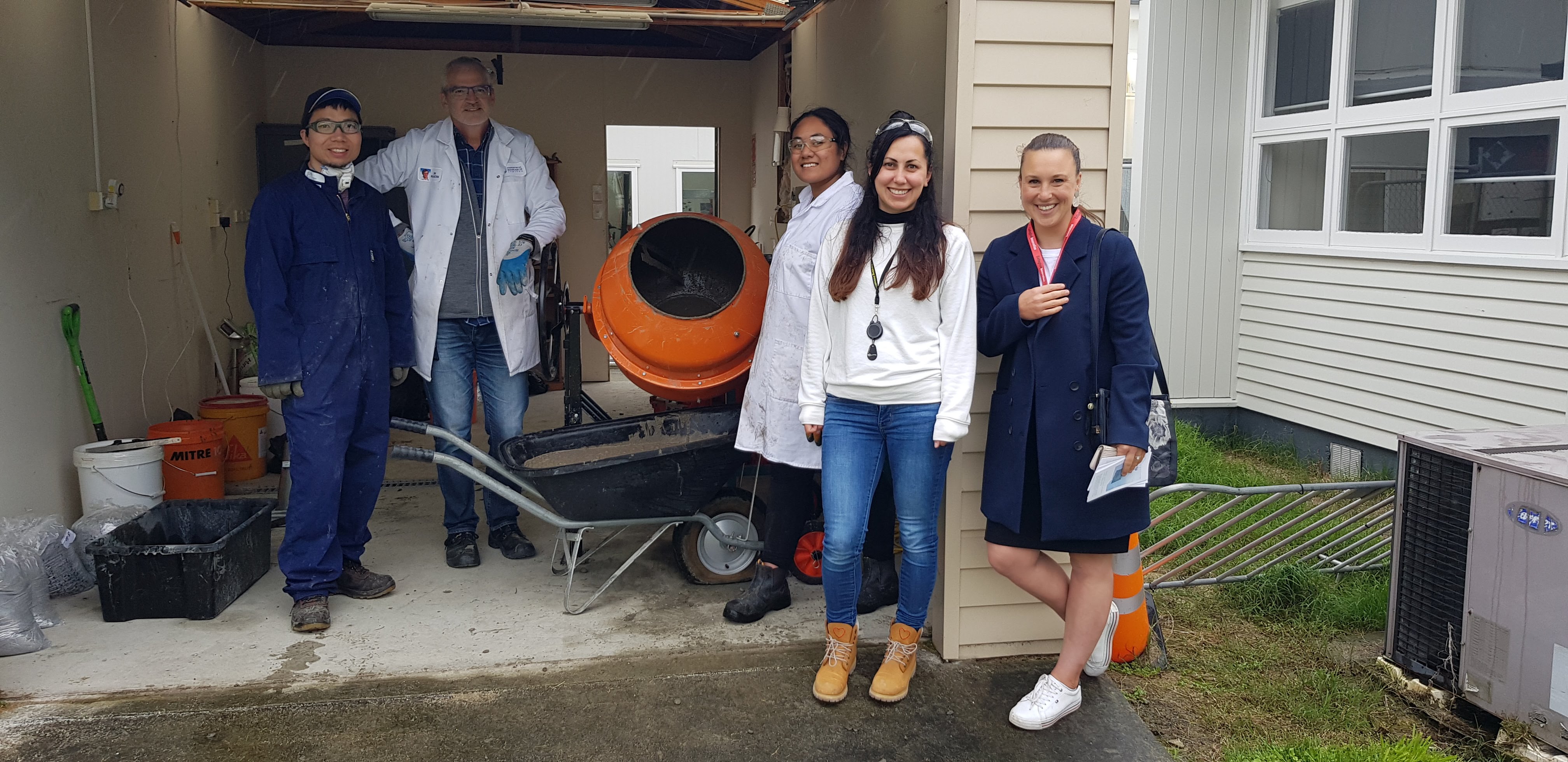
Neocrete’s first laboratory was in a shipping container. The company’s early history has the scale of a small team trying to make its work possible, with support from people and institutions around it. Callaghan Innovation helped with testing and analysis; grants brought students into the research.
One day, the cement mixer broke. A student used her 3D printer to make a replacement for the damaged part. It is an appealing detail because it puts the equipment back into a startup story. Research requires apparatus that works on Tuesday as well as an ambition that sounds persuasive on Friday.
Alexander remembers the students’ curiosity and commitment. The collaboration also connected Neocrete with independent expertise and building-code guidance. The work involved testing different mix designs and using the results to decide what to develop next. Before an unfamiliar powder could become a product, there had to be a repeatable way to understand what it did.
Permission to change the recipe
The graphs did not always win the meeting. Recalling an early presentation to a major New Zealand concrete supplier, Alexander described arriving with confidence in the trial results. A chief engineer dismissed the product and its prospects. She left questioning her fitness to lead, conscious of being the youngest person there, a woman and an industry outsider.
“What people don’t put on the graphs is the amount of self-reflection and self-doubt that happens along the way.”
Zarina Alexander, speaking to student entrepreneurs
Neocrete continued its R&D while funds were tight. Upfront support through Waka Kotahi’s Innovation Fund and the Ākina Foundation helped it continue. Eventually a Southeast Asian customer agreed to independent trials. In June 2026, Alexander brought this account to the University of Auckland’s Velocity Ideas Challenge prizegiving. Her story made room for the awkward interval between confidence in an idea and another person’s willingness to test it.
There was another, more administrative test of trust. A customer required an Environmental Product Declaration before specifying Neocrete’s Activator. The company worked with thinkstep-anz on a Life Cycle Assessment and an independently verified declaration, registered with EPD Australasia.
The assessment covered raw materials, manufacturing and packaging. Here, the commercial obstacle had a precise form: a document the buyer needed. The technical work had to be translated into evidence a specifier could recognise. A product can occupy a laboratory bench long before it earns a line in a project specification.
- Test the mixEstablish performance with the customer’s materials.
- Verify the claimPut environmental data into a recognised declaration.
- Make the numbers workGive the producer a commercial reason to adopt.
What changes inside the concrete
Alexander’s product needs a small distinction that everyday language tends to flatten. Concrete is the finished mixture. Cement is a binder within it. Neocrete works on reducing how much of that cement is required by helping other materials do more of the binding work.
Those materials include pozzolans, such as volcanic ash, and industrial ashes. Some low-cost alternatives perform poorly on their own, limiting how much cement a producer can replace. Neocrete’s additive is designed to improve their performance, allowing more substitution. The current company description calls it an SCM performance booster, using the industry abbreviation for supplementary cementitious materials.
The detail explains why a sales conversation can become local very quickly. A producer has particular materials available, a required concrete grade and an existing plant. A promising ingredient has to work in that setting. The company’s published maximum cement-reduction figures depend on the material; they cannot stand in for the result of every customer mix.
A very ordinary-looking pour
In Brunei, the customer is Readymix Brunei. Neocrete says its additive has enabled locally available, low-quality fly ash to replace 30 percent of the cement in commercial concrete, with a 25 percent reduction in embodied carbon and a 10 percent cost reduction. These are the company’s reported results for that deployment, giving Alexander’s argument a specific place and a set of commercial numbers.
Cement replaced
Less embodied carbon
Lower cost
Her response to seeing industrial-scale use was strikingly domestic in its expectations. In a public post, she described visiting Brunei before Christmas and noticing how normal the batching, placing and finishing looked. The appeal was in a change inside the material that did not make the site look dramatically different.
She has described that quality as “Boring in the best possible way.” There is affection in the phrase. For a founder trying to get a construction material adopted, an uneventful pour can be a satisfying sight. The customer still has concrete to make and work to finish.
The next room to convince
By 2026, Alexander was taking the proposition into a different kind of room. She won Reset Connect London’s Pitch & Invest competition in June. The programme drew more than 100 applicants, with 36 shortlisted finalists. The win earned Neocrete a place representing the UK at the Startup World Cup Grand Final in San Francisco, scheduled for November. It followed the opening of a London office and testing with UK and European customers.
In August, Neocrete announced US$3.5 million in new funding led by Wavemaker Ventures, with Icehouse Ventures and C3H participating. The stated purpose included expansion in Europe and the United States and deeper commercial deployment in Southeast Asia. There are more producers to convince, more materials to test and more settings in which the economics have to hold.
Alexander’s public advice to founders includes reading about how innovations spread. It fits the business she has chosen. A new recipe has to travel through people: researchers, engineers, specifiers, plant operators and customers. Each brings a question. Her father gave her an interest in concrete; building Neocrete has required learning what everyone else needs from it.