Six months after a software sale is an awkward time for a chief executive to telephone. The presentation is over. The contract has been signed. The customer has had plenty of opportunities to discover which promises survived contact with the office. Yuval Baron made that moment part of his job.
Alongside running AlgoSec, the cybersecurity company he co-founded with Avishai Wool, Baron took on the title of Chief Customer Satisfaction Officer. The work included reading satisfaction surveys, calling customers six months into the relationship, and getting problems addressed. A complaint could travel remarkably far up the organization without changing telephone numbers.
It is a useful place to begin with Baron, whose career runs through telecommunications, enterprise software, and more than two decades at AlgoSec. His business sells ways to manage complicated security policies. His extra job brought him into contact with the complications that remained after someone bought them.
The customer gets the last word
AlgoSec introduced a money-back guarantee in 2005. Its terms give the buyer the decision over whether expectations have been met. The company puts the principle in five plain words: “You are the sole judge.” That is an unusually economical sentence for enterprise software.
There is a timetable. Depending on purchase size and whether the customer evaluated the product beforehand, the published periods range from 30 to 120 days. Buyers are told to include the terms in their project proposal. The promise has paperwork, which is reassuring: a guarantee becomes rather more interesting when it reaches the contract.
“You are the sole judge.”
AlgoSec’s money-back guarantee
The arrangement makes the person selling the software share some of the uncertainty of installing it. A demonstration can show an orderly world. An enterprise network contains years of decisions, dependencies, and exceptions. Baron’s customer-satisfaction role placed him close to the gap between those two environments.
In 2015, the routine was being discussed as an example of entrepreneurial humility. The practical detail matters more than the flattering description. A chief executive who reads customer surveys has chosen a recurring appointment with other people’s opinions. Some will arrive without the customary cushioning.
He had already tried the venture route
Baron came to AlgoSec with experience on several sides of a technology business. At Comverse Technology, his work included software development and product management. He later became vice president of sales and marketing at RIT Technologies, moving from making products toward persuading organizations to buy them.
His education spans those interests: a bachelor’s degree, earned cum laude, in mathematics, computer science, and economics, followed by an MBA specializing in finance. Both degrees are associated with Bar-Ilan University. It is a combination suited to conversations in which the engineering and the arithmetic both need to make sense.
In 1998, he co-founded Actelis Networks and became its CEO. During his tenure, the telecommunications business raised $75 million from investors including USVP, NEA, Carlyle, France Telecom, and Sumitomo. He had experience with outside capital before deciding how to finance his next company.
After handing the Actelis CEO role to his co-founding partner, Baron met Wool, whose background included AT&T Bell Labs and research into security policy management. They saw room for a business in that field. Baron dates their co-founding of AlgoSec to 2004.
They spoke with venture capitalists, then chose to build on revenue. The sequence gives the decision some weight. Baron had already raised substantial money elsewhere; at AlgoSec, he and Wool chose a different starting arrangement. Customers would supply the income needed to keep the company moving.
Co-founds Actelis Networks
Co-founds AlgoSec with Avishai Wool
AlgoSec introduces its money-back guarantee
Claridge IL becomes its first outside investor
A cheque arrives after the customers
On January 3, 2018, AlgoSec announced a $36 million investment from Claridge IL. It was the company’s first external investment, arriving after years of growth and profitability. By then, AlgoSec counted more than 1,500 enterprise customers and more than 350 employees worldwide.
The order is the interesting part. A sizeable customer base preceded the financing announcement. By the time an outside investor arrived, there was already an operating business to examine, with people, deployments, and the ordinary demands that accompany both.
Claridge IL brought a partnership between CDPQ and the Stephen R. Bronfman family office, Claridge Inc. Rami Hadar, formerly CEO of Allot Communications, was to join AlgoSec’s board. Baron emphasized the investor’s long-term approach and compatibility with the company’s priorities.
This was a change in financing, rather than a conversion story about the virtues of funding. His earlier choice had been to grow through sales; his later choice was to bring an investor into an established company. Both decisions leave room for a founder to care about the terms on which growth happens.
The trouble with a rule nobody dares remove
To understand the business Baron stayed with, consider an unglamorous problem: an old firewall rule. Someone once needed it. The application may have changed. The original owner may be elsewhere. Removing the rule could improve security, or interrupt something nobody remembered to mention.
In a 2011 conversation, Baron described a financial organization that had spent three years cutting its firewall rules from 1,400 to 750. The example was a warning about the work involved in untangling accumulated permissions. A rule can be short; finding out what depends on it can take considerably longer.
AlgoSec’s answer has been to automate security-policy work and relate network connectivity to business applications. Baron has repeatedly described the application as the starting point: understand the business process, identify the connections supporting it, and give security decisions that context.
application
it depends on
that govern them
An editorial illustration of Baron’s application-first approach, rather than a product architecture diagram.
That approach also addresses a translation problem. Application owners want services delivered. Network teams understand routes and devices. Security teams need to assess risk. The same change can look like three different jobs, depending on where a person sits.
Baron’s ambition has been to give those groups a shared view. The appeal is easy to understand even without managing a firewall: fewer decisions made in ignorance of what the neighboring team is trying to accomplish. A productive meeting would be a respectable side effect.
Room for people who know more
His description of hiring is similarly direct: “I hire only people who are better than me”. He qualified the thought by referring to each person’s area of responsibility. He also valued colleagues who worked well together and were pleasant to work with. Technical ability did not exhaust the job description.
There is a connection between that preference and the extra customer title. Both put the CEO in a position to hear something useful from someone with a better view of a particular problem. A specialist knows the work. A customer knows what happened when the work reached their organization.
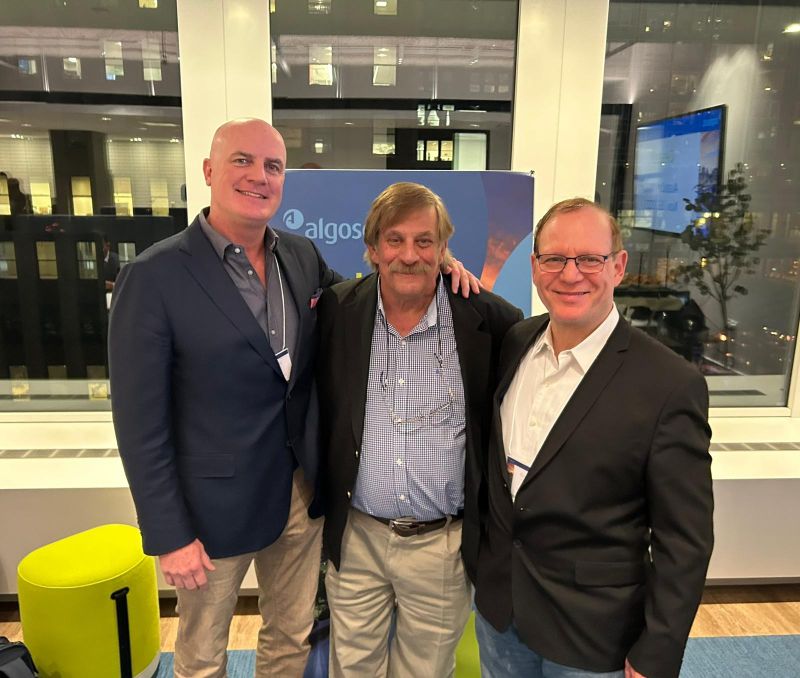
A photograph he shared from an AlgoCity event in New York places him alongside other attendees, with an AlgoSec banner behind them. The gathering brought customers and partners together for cybersecurity discussions and dinner. His own accompanying comment was brief and pleased about meeting the customers. It fits the public role he had described years earlier.
Growth has its awkward chapters
The story has included harder decisions. In May 2019, AlgoSec confirmed it was letting go of 8% of its 350 employees. The explanation at the time described a reallocation toward marketing and sales following a period of expansion. The company’s headcount had doubled over the preceding two years.
That episode belongs beside the financing milestones. A company can grow from revenue, choose patient investors, and still make decisions that cost people their jobs. The customer-focused philosophy did not remove the difficulty of running the organization around it.
The product territory kept changing, too. In December 2022, AlgoSec announced its acquisition of Prevasio, adding cloud-native security capabilities, including agentless assessment of cloud assets and containers. Applications had spread across cloud and on-premises environments; the company’s remit was following them.
Baron framed the acquisition around customers’ need to protect application connectivity across those environments. The vocabulary had expanded since the early firewall discussions, but the concern remained recognizable: understand what a business application relies on, then help people secure it without obstructing its use.
A clarinet, a bicycle, and another call
There are other ways to picture Baron besides a financing announcement. In 2011, he spoke about playing clarinet, having played in a band when he was young, and enjoying jazz. He also described frequent mountain biking and called the bicycle his favorite vehicle.
The same conversation included a small surprise for a technology executive of that period: he owned none of the iPad, iPhone, or Android devices offered in the interviewer’s question. He favored open systems. These are details from that moment, rather than a claim about what sits in his pocket today.
More recent business developments give his attention plenty of places to go. AlgoSec received the 2025 SC Award for Best Security Company. In February 2026, the company reported 37% year-over-year growth in new business during 2025 and gross dollar retention above 90%. It also said it had remained cash-flow positive and debt-free throughout its history.
Year over year, as reported by AlgoSec in February 2026. This measure describes new business, not total revenue growth.
By July 2026, its Horizon A33.30 announcement was focused on unified application-connectivity governance across hybrid and multi-cloud environments. Baron continues as co-founder and CEO, with Wool as co-founder and CTO. Their early problem has acquired more locations in which to become complicated.
For all the changing product names, the customer call remains the detail that makes Baron’s story personal. It begins after the easy part of selling is finished. The buyer has used the software, formed an opinion, and perhaps prepared a list. A CEO who asks for that conversation has given the other person the floor.
Conversations & further reading
AlgoSec - official websiteYuval Baron on LinkedInWatch: it-sa 2022 interview on YouTubeWatch: Baron’s business-driven security visionRead: Behind the Software Q&ARead: the 2011 Network World conversationExplore: AlgoSec’s blogRead: the 2018 investment announcementRead: the 2019 staff reductionsRead: AlgoSec’s 2025 resultsRead: SC Media’s 2025 award announcementExplore: AlgoSec’s recent announcements