A firewall rule is a tiny sentence with expensive consequences: this machine may talk to that machine, on this port, for this reason. An enterprise can accumulate hundreds of thousands of those sentences across Cisco, Palo Alto, Fortinet and Check Point gear, then sprinkle more into AWS, Azure and microsegmentation software. The grammar changes. The owners leave. A temporary exception acquires tenure. When an auditor asks why the access still exists, someone opens a spreadsheet and begins an archaeological dig.
FireMon built its business around making that dig less frightening. The Lenexa, Kansas company does not sell a firewall. It sells the layer above the firewalls: software that collects policies from different vendors, translates them into a common model, watches changes, tests proposed access, finds waste and produces compliance evidence. Its core customer is not a person worried about the Wi-Fi router at home. It is the team responsible for a sprawling bank, manufacturer, hospital, retailer, telecom network or public agency where a bad deletion can stop an application and a bad permission can expose it.
A physics graduate finds the policy problem
Jody Brazil came to the problem through the service side of enterprise security. Before FireMon, he spent eight years at FishNet Security, where he became chief technology officer and saw how practitioners investigated firewall configurations in the field. His biography credits him with developing a graphical firewall policy change view in 2001 and a firewall rule-usage analysis application in 2004. Those are narrow inventions with a broad implication: configuration history and actual use could be software objects, not facts trapped in an engineer's memory.
Brazil and Gary Fish started Secure Passage in 2004 to develop and market FireMon. The product name eventually became the company name. Its early category, network security policy management, sounds engineered to repel civilians. The underlying idea is friendlier: security policy should be inspectable as a whole, even when dozens of appliances enforce it in different dialects.
The product widened in deliberate steps. Policy Planner arrived in 2012 to structure the request before a rule changed. Policy Optimizer followed in 2014 to revisit rules after their original purpose faded. Risk Analyzer added attack simulation in 2017. The sequence matters. Visibility found the mess; workflow slowed the creation of new mess; review attacked the backlog; modeling helped decide which cleanup mattered first.
The ownership story is equally enterprise-shaped. Insight Venture Partners acquired a majority interest in 2014 on undisclosed terms, after FireMon reported sharp sales growth. The company later took $40 million in debt financing from Silicon Valley Bank in 2020, according to CB Insights. No reliable public valuation is available. FireMon remains privately held, with roughly 269 people visible on LinkedIn and a company-provided estimate of about 280.
Acquisitions filled gaps around the original policy engine. Lumeta brought a lineage in network discovery, letting FireMon find assets before judging the controls around them. DisruptOps brought cloud-security operations in 2021 and returned Brazil, who had founded that company after leaving FireMon, to lead the combined business. The reunion was strategically neat: the founder came back carrying the cloud piece his first company needed.
01 / The jobWhat FireMon actually does all day
Security Manager is the foundation. It ingests configurations and changes from supported enforcement points, then lets practitioners ask questions across them without hopping between consoles. Which rules allow traffic from this source to that destination? Which are unused, redundant, shadowed or excessively broad? What changed last night? Does the current policy match PCI DSS, NIST, HIPAA or an internal standard? FireMon says its platform connects with more than 120 firewall, cloud, network, segmentation and workflow technologies.
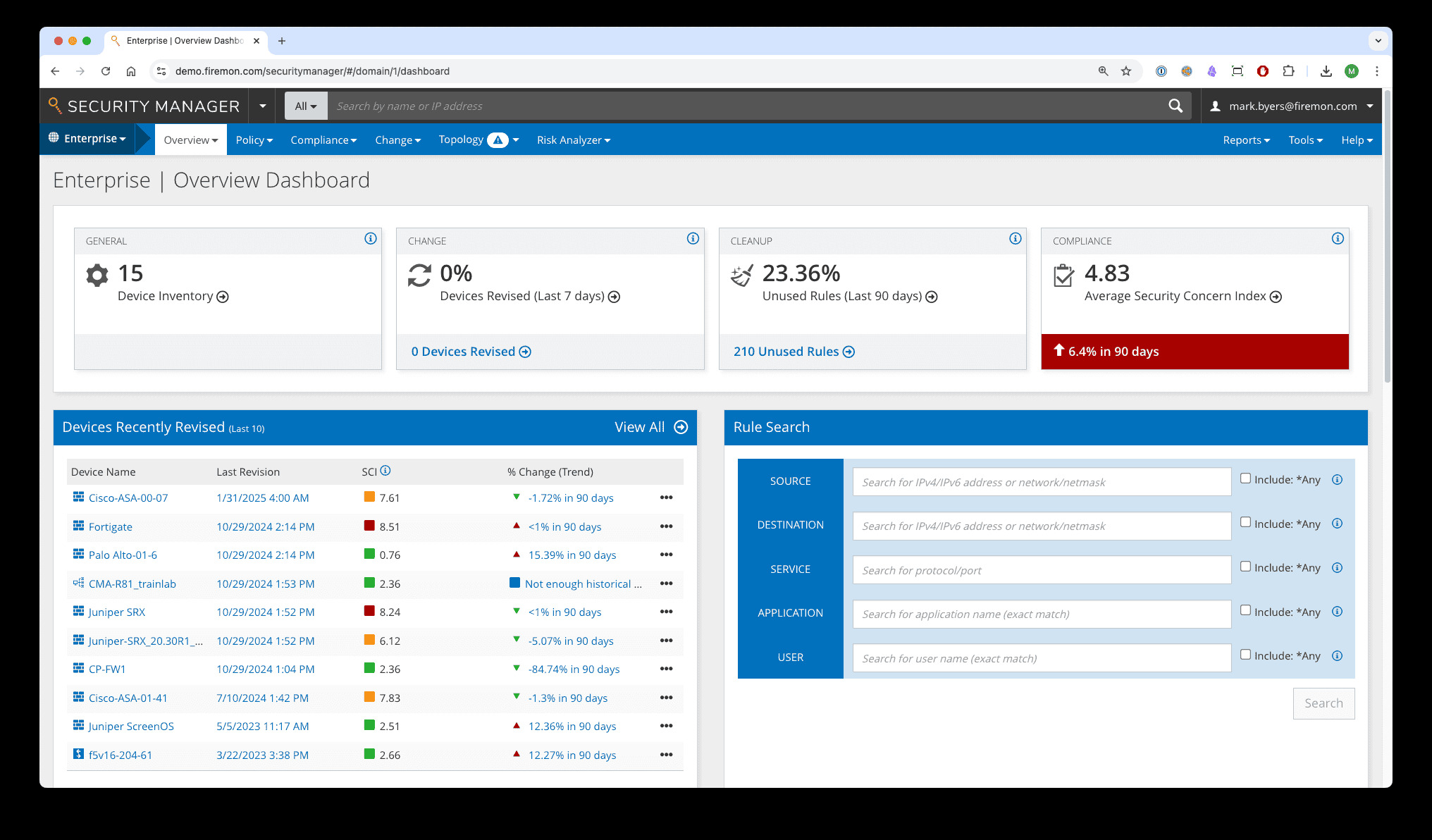
The add-ons follow the policy lifecycle. Policy Planner turns a request into a ticketed workflow, assesses risk and compliance before approval, and preserves an audit trail. Policy Optimizer prompts owners to review and recertify old rules. Risk Analyzer models possible attack paths and ranks exposure. Insights 2.0 adds AI-assisted benchmarking and prioritization. Asset Manager, descended from FireMon's 2018 acquisition of Lumeta, discovers devices that vulnerability scanners and asset databases missed. Professional services help connect the machinery to ITSM systems and the customer's peculiar approval rituals.
What failed first was the process
The firewall did not necessarily fail. The choreography around it did. Rapid growth outran manual reviews. Cloud teams created controls outside the old network workflow. Documentation drifted away from deployed reality. Point-in-time audits rewarded a frantic cleanup, then the rules began decaying again on Monday. In one FireMon automotive case study, the customer wanted a single view across Palo Alto, AWS and a fast-growing hybrid network because its manual process could no longer keep pace.
The policy-debt pile
FireMon's 2025 and 2026 policy analyses put numbers on that decay: large shares of evaluated rules lacked an owner or documentation, went unused, or failed serious checks. These are vendor-reported findings, not a census of every firewall on Earth. Still, they describe a familiar incentive problem. Availability pressure says leave the rule alone. Security says remove unnecessary access. Nobody gets promoted because an old rule disappeared without incident.
What changes a buyer's mind is usually not a grand theory of zero trust. It is seeing the platform survive the buyer's own mess. FireMon quotes a security operations manager who doubted any vendor could unite on-premises firewalls with Azure and AWS. A proof of concept reportedly did it in less than a week. That is the enterprise lesson worth stealing: demonstrate on the ugly production-shaped problem, not on a polished sample network.
03 / The moneyThe price is private; the labor is visible
FireMon sells enterprise software through partners and does not publish a sticker price. Every deployment starts with Security Manager. The quote changes with the number and type of managed devices, the modules selected and the support tier. Customers can add implementation, training, workflow integration, consulting, custom development and a Technical Account Manager. This is a channel-only model: FireMon says every deal, integration and deployment runs through partners.
So, what did it cost?
No defensible public license figure exists. The honest comparison is the cost of policy labor, extra hires, audit preparation and preventable mistakes.
One manufacturing customer said automation avoided the need to hire or outsource five additional security engineers and produced $1 million in annual savings compared with manual work. Another customer cut rule-review effort by 85%. Case studies are selected success stories, so a buyer should treat them as hypotheses to test, not guaranteed returns. FireMon is valuable when repetitive work is genuinely large enough to automate.
04 / The wedgeWhy the neutral layer can win
Palo Alto, Cisco, Fortinet, AWS and the rest can manage their own territory. FireMon's advantage appears when no single vendor owns the whole map. It normalizes policy across brands, ties network controls to ServiceNow-style workflows, adds vulnerability context from tools such as Tenable or Rapid7, and brings supported Illumio microsegmentation policy into the same conversation. The customer keeps the enforcement products. FireMon becomes the place where the organization asks whether they collectively match intent.
That position also defines the competition. AlgoSec and Tufin are the closest broad NSPM alternatives. Vendor-native managers may be simpler inside a single ecosystem. Illumio and Akamai Guardicore approach the problem through segmentation. A capable team can build scripts around APIs. FireMon differentiates on real-time change visibility, customizable search, policy normalization, compliance controls and the accumulated integration work required to make many vendors behave like one system.
The playbook a reader can copy
- Find a workflow fragmented across products the customer cannot realistically replace.
- Normalize the data before promising automation. A common model is the product.
- Attach the pitch to hours, headcount, audit evidence and change-cycle time.
- Run the proof of concept on the customer's exceptions, not your happy path.
- Keep a human approval step where a confident mistake could cause an outage.
When the control plane becomes another console
This approach does not work everywhere. A business with one firewall, few changes and no demanding audit regime may buy more platform than it needs. The deployment must have working integrations for the customer's exact product versions. Device data needs to be accurate. Rule owners must respond to recertification requests. Change teams must adopt the workflow. Automation cannot rescue an organization that refuses to decide who owns access.
The software also carries enterprise weight. An independent review has noted technical deployment demands and a learning curve. FireMon itself sells guided implementation, integration assistance and dedicated account management, which is a clue about the work involved. AI does not remove that constraint. Insights can prioritize a suspicious rule, but a practitioner still needs application context before closing access that might run payroll at 2 a.m.
The company has expanded by following the map outward. Lumeta added unknown assets. The 2021 acquisition of DisruptOps added cloud-security operations and returned co-founder Jody Brazil to the CEO role. In 2026, Insights 2.0 applied AI to policy intelligence, while a Palo Alto Networks Strata Cloud Manager integration extended normalization into another modern control surface. Each move asks the same plain question: what is connected, what is allowed and who can prove it should be?
That is FireMon's place in the market. It is neither the wall nor the burglar alarm. It is the operations desk where somebody can finally see the keys, the doors and the record of who changed a lock. The work is not cinematic. It is cleanup, explanation and controlled change. In enterprise cybersecurity, those quiet verbs are often where the budget and the risk have been hiding.