Before Yulai Weng was asking people to put a robot on their lawns, he was working on one that could pick things up. In 2019, while preparing his master’s thesis at the University of Pennsylvania’s GRASP Lab, his prototype included a robotic arm for clearing debris from the grass. A lawn, in this version of the future, was somewhere a machine might do several jobs. Cutting it was only the beginning.
The detail is useful because it puts a pair of mechanical hands into an otherwise familiar startup story. Weng would go on to build NOVABOT and lead BESTMOW, businesses associated with autonomous mowing. But the early arm reveals a broader ambition: send robotics out into the yard, where the scenery refuses to stay still and the work obligingly returns.
Grass is a demanding customer. It grows while you are discussing the roadmap. A machine can earn admiration at a demonstration and still have to prove itself again on Tuesday. Weng’s career has taken him through that passage, from university research to crowdfunding, manufacturing, public demonstrations and the less photogenic business of keeping a connected product working after the sale.
A club, a lab, a lawn
At Penn, Weng’s interests extended beyond building machines. He founded and led the Penn Robotics Entrepreneur Club, listing his presidency from 2018 to 2020. The combination matters: research asks whether something can work; entrepreneurship adds the awkward question of who will want it. He was putting both questions into circulation before his lawn-care businesses emerged.
His academic background spans Tsinghua University and Penn. His engineering training at Tsinghua preceded graduate work in mechanical engineering and robotics at Penn. The institutions connect a career that would move between research and commercial hardware, rather than beginning with a lawn-care franchise or a gardening business.
Weng also appears alongside Andrew Specian and Mark Yim on the 2018 paper “Low Cost Optical Mechanical System for Human Robot Interaction.” Other robotics publications connect him to work on variable-topology trusses. These are different problems from mowing a yard, but they establish the technical work behind the founder title. There were mechanisms and research collaborations before there was a consumer pitch.
The lawn-clearing prototype brings that background into focus. Clearing an object and moving around one are separate tasks. Put them on the same lawn and a machine needs to understand enough about its surroundings to choose what happens next. Weng’s later recollection of the arm makes his interest in outdoor robotics concrete, without requiring a prediction about what any future mower will be able to do.
- 2019A thesis prototype with a debris-clearing arm
- 2022A letter to NOVABOT’s early backers
- 2023Bronze recognition in Robotics Appliances
- 2025BESTMOW’s Boston center opens
The thank-you letter had new tires in it
In 2020, Weng founded Laifei Intelligence. NOVABOT became its robotic lawn-mower brand, with an Indiegogo campaign helping introduce the project to early buyers. By January 2022, Weng was writing directly to backers from Pennovation in Philadelphia. His letter, dated January 15 and published January 20, reported more than $1.4 million raised at that stage of the campaign.
Money supplied the opening headline. The more revealing passages concerned conversations. Backers had been offering suggestions through a Facebook group and other channels, and Weng described changes to the machine: an upgraded off-road tire design and a screen on top. The future of lawn care had acquired a very practical discussion about traction and what a person could see while operating the robot.
“Feel free to share your ingenious ideas and engage with us,” he wrote. It was an invitation attached to a product still being refined. He promised to keep backers informed as the team worked toward delivery. The tone was appreciative, but the letter also set out the relationship the company wanted: customers would contribute observations, and the machine would change.
A tire revision sounds small beside the ambition to automate outdoor work. That is precisely its appeal as a detail. Homeowners encounter a product through such particulars. An improved wheel or a clearer display belongs to the same undertaking as navigation software, even if neither is likely to receive the dramatic music in a launch video.
“Feel free to share your ingenious ideas and engage with us.”
Yulai Weng · letter to NOVABOT backers, January 2022
Later that year, robotics engineer Arnav Dhamija spotted NOVABOT at ICRA, the International Conference on Robotics and Automation. He recognized Weng as his former CIS581 teaching assistant. It is a pleasingly compact career crossover: someone remembered from a course had turned up with a machine of his own. The classroom connection survived the trip onto the exhibition floor.
A mower meets the people who sell mowers
By 2023, NOVABOT was appearing before a different audience at Equip Expo, the outdoor-power and landscaping trade show. Its pitch emphasized visual navigation and dispensing with perimeter wires. Weng was identified as CEO. For a robot company, a landscaping exhibition creates a useful change of company: the people looking at the machine have reasons to care about what happens after the demonstration ends.
Removing the perimeter wire made a technical choice legible. A buyer could understand the avoided task without studying the navigation system. This is one of the recurring features of Weng’s businesses: a considerable amount of engineering sits behind an offer expressed in household terms. The desired result is a maintained lawn and more time to spend elsewhere.
NOVABOT also received Bronze recognition in Robotics Appliances in the 2023 International Design Awards. Weng was named lead designer. That places him inside the product’s design history as well as its business history. A founder’s name can appear on a company page for many reasons; here it also appeared beside a specific machine and a specific award category.
The sequence gives his career some texture. Research papers, a backer letter, a trade show and a design award ask for different kinds of attention. Each brought the robot into another setting. None made the next setting automatic. A convincing account of Weng’s progress needs those changes of audience as much as it needs the company names.
Boston adds a human address
BESTMOW followed, with Weng as founder and CEO. Its early proposition included robotic mowing as a subscription service. In late 2024, he launched Garden Providence Limited to build the business. The emphasis widened from selling an autonomous mower to arranging how a household would obtain and use one.
On October 5, 2025, BESTMOW opened its Boston 4S Center. Weng introduced the company and its products to guests, explaining autonomous navigation and obstacle avoidance. The event moved outdoors for a ribbon cutting and a live mower demonstration. The robots had grass to attend to; the humans had speeches, photographs and, eventually, a raffle.
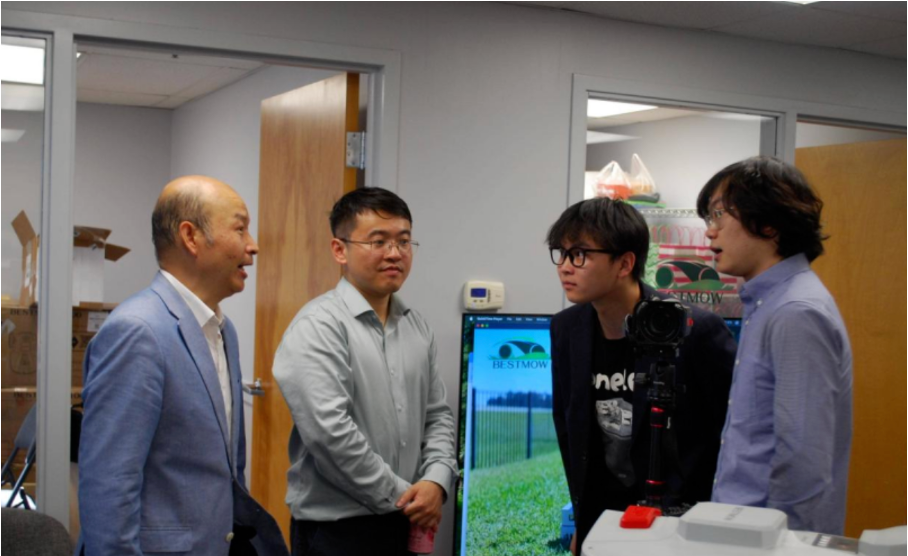
The center’s director, Chen Qicheng, presented a limited-time free trial and a same-day response plan for the Boston area. Those offers introduced a human timescale to the robotics pitch. A customer could try the service and ask how quickly somebody would respond. Weng spoke about expanding coverage to more communities.
The local center adds another dimension to the engineer’s job. A machine that navigates autonomously still reaches its owner through people, places and service arrangements. Boston gave that network a visible setting. It also supplied a reminder that the work of making a robot ordinary includes answering questions in a room, rather than solely improving what happens on the grass.
The applause, and the work after it
In a report published in February 2026, BESTMOW announced that Weng had received a Rising Star Award from the Greater Philadelphia Asian American Chamber of Commerce. His remarks returned to Pennovation and to Philadelphia’s startup community. He thanked colleagues, mentors, partners and family, describing the recognition as belonging to the team.
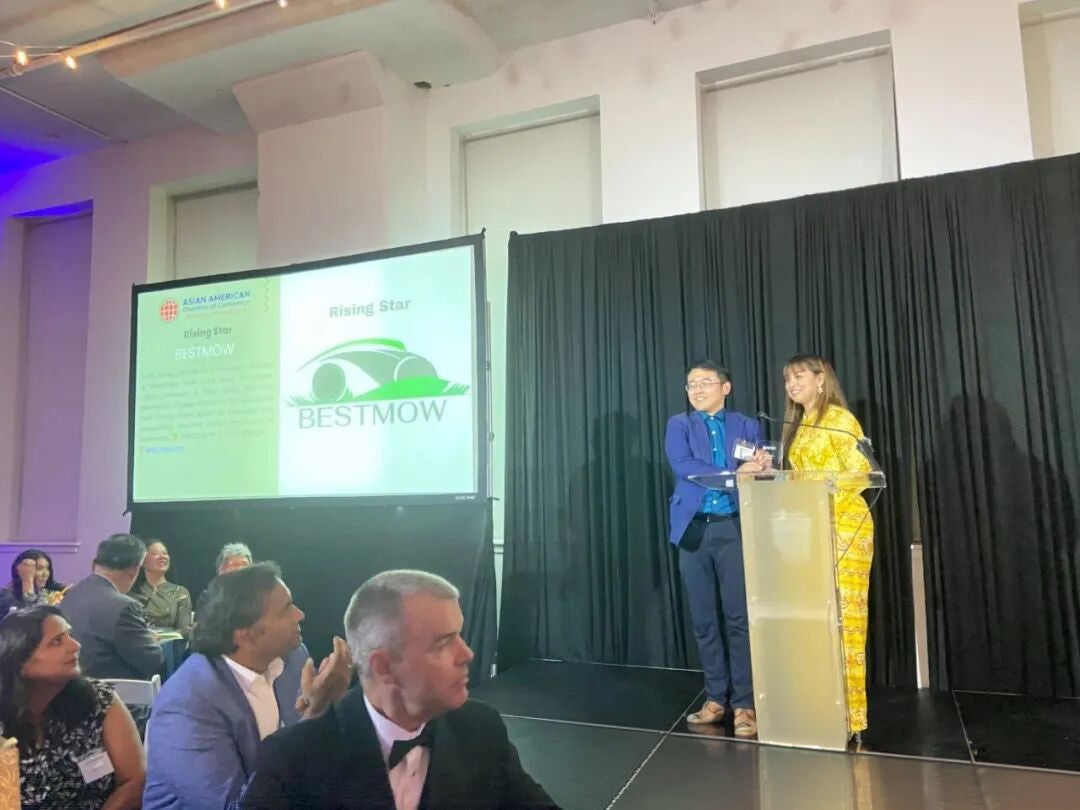
There is continuity between that account and the early backer letter. Both give other people a place in the enterprise: the buyers suggesting changes, the collaborators making the product and the city providing a place to begin. Weng’s public language repeatedly returns to shared effort. It offers a view of how he presents his work, rather than a shortcut into his private personality.
Meanwhile, the business continued to change. BESTMOW’s July 2026 transaction update said new orders in the United States and Canada were moving to one-time purchases, with subscription and financing routes being retired for new customers. Existing arrangements had their own migration or continuation terms. The earlier subscription pitch is part of Weng’s history; it should not be mistaken for a current universal offer.
That shift leaves the central engineering ambition intact while changing the commercial arrangement around it. Building the mower and deciding how people pay for it are connected responsibilities. A founder who begins with a prototype eventually has to make decisions about ownership, accounts and support. The robot may operate in straight lines. The business has taken turns.
Weng’s original debris-clearing arm remains an apt place to end. It was a specific attempt to give a machine another useful task outdoors. Years later, the scale of the undertaking has grown to include customers, manufacturing, demonstrations and local service. The yard is still there, presenting fresh work. For Weng, getting the robot out of the laboratory was the start of a longer assignment: making it useful enough to stay.
Continue the conversation
- Weng on LinkedIn
- BESTMOW website
- NOVABOT backer letter
- NOVABOT at Equip Expo
- International Design Awards · 2023
- Boston center opening
- Rising Star announcement
- 2026 purchase and subscription update
- Tech Talk with Josh · BESTMOW engineer interview
- BESTMOW on YouTube
- BESTMOW on Instagram
- Research bibliography