By August 2025, FLOQ had a number worth taking to a gathering in Bali: nearly a million registered users, less than three months after its launch. Yudhono Rawis, its founder, credited the team and the community. Then he reached for a word that rarely enjoys a holiday in the crypto business: structure. Speed, he said, depended on how people organized and coordinated their work. Somewhere behind the app and the registration count was the less photogenic business of getting a company to function.
It was an answer with a résumé attached. Before founding FLOQ, Rawis had advised on mergers and acquisitions, led a fintech lender and taken charge of Tokocrypto during a change in ownership. He had spent years around institutions where a transaction creates work long after the signatures dry. A deal can be announced in a morning. Making the resulting business run is a rather longer appointment.
His path into digital assets makes an interesting departure from the familiar crypto origin story. There is no need for a sudden revelation to explain it. Follow the jobs, the education and the people who have worked with him, and a more gradual story emerges: a finance professional moving closer to the machinery, until he was responsible for building it himself.
Fifteen years before the opening bell
Rawis spent 2004 to 2019 at KPMG Indonesia, eventually becoming a partner and head of mergers and acquisitions. The work involved global and local businesses considering deals and carrying them through. A 2016 KPMG publication on financial inclusion also listed him among its financial-services contacts. His professional world already included the question of how financial services could reach more Indonesians, well before FLOQ had a name.
In 2019, he moved into fintech lending as CEO of Ringan, associated with China’s Ping An group. He stayed until April 2022. His account of that period includes establishing the Indonesian business, obtaining its OJK license and completing a joint venture with Lippo Group. The adviser had become an operator, responsible for turning a business proposition into an organization with customers and obligations.
The continuity matters. Across lending and digital assets, access is only the beginning of the problem. Someone must build the operation that stands behind the screen. Rawis’s career put him on both sides of that question: first examining businesses and transactions, then accepting responsibility for a business of his own.
- 2004-19KPMG IndonesiaDeal advisory & M&A
- 2019-22RinganFintech lending
- 2022BinancePortfolio Company CEO
- 2022-24TokocryptoExchange leadership
- 2025 →FLOQFounder & CEO
A scholarship with a second life
Education runs alongside that corporate chronology. Rawis earned a Bachelor of Business Administration at the University of North Texas, then completed an MBA at the University of Virginia’s Darden School of Business in 2016. His Darden studies were supported by the Indonesia Endowed Fellowship Fund, covering tuition and fees. In July 2019, the school announced his election to its Global Advisory Council.
The smaller, more personal evidence appears in other people’s milestones. On graduating from Darden in 2020, Berthin Saragih thanked Rawis for mentoring him since 2015. Saragih described advice that helped him look beyond oil and gas during an industry downturn. Years later, he again referred to Rawis as his mentor while reflecting on the Indonesian fellowship community.
In 2022, Tenno Sutyandi also thanked Rawis for help during his Darden application and interview process. These acknowledgments put a human scale on an otherwise institutional biography. An MBA can appear on a profile as two dates and an abbreviation. Here, it also left a trail of conversations, introductions and help with the next application. The scholarship continued working after its recipient graduated.
The job arrived with a restructuring
Rawis joined Binance as a Portfolio Company CEO in May 2022. That December, he became interim CEO of Tokocrypto as Binance increased its ownership. He succeeded Pang Xue Kai, who moved to the board of commissioners. The transition included a sharp reduction in staffing, making this a leadership appointment with immediate consequences for the people inside the company.
At the time, Rawis publicly acknowledged the layoffs and said affected employees would receive their entitlements and assistance, including recommendations to other businesses in the blockchain sector. There was little room to treat the acquisition as a ceremonial change of stationery. The new chief executive had inherited the task of reshaping the operation while trying to give it a future.
By 2023, his public account had turned toward the team’s response. Sharing coverage of Tokocrypto’s pursuit of profitability, he thanked colleagues by name and credited their work through a difficult period. He also shared the exchange’s release of proof-of-reserves information with a brief endorsement of transparency. His professional timeline records the Tokocrypto role ending in December 2024. The next month, the FLOQ chapter began.
“Kecepatan bukan hanya soal waktu”
Yudhono Rawis, August 2025
“Speed is not just about time.” Translation from Indonesian.
A new exchange, an old argument
FLOQ launched on May 30, 2025. By the August gathering in Bali, Rawis was explaining how a new platform had accumulated nearly a million registrations. His explanation emphasized collaboration, accessibility and education. An exchange needs people to arrive, of course. It also needs newcomers to understand enough to participate, and a team capable of delivering the experience it promises.
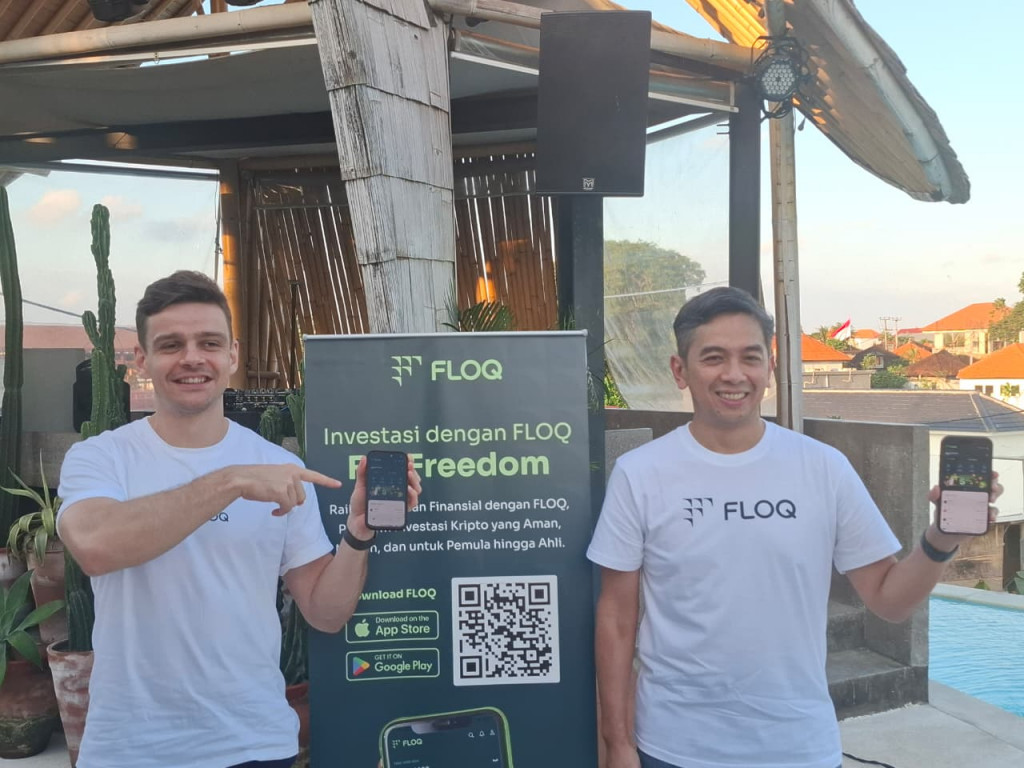
The photograph from that gathering is agreeably practical. Rawis and Paul Versley stand beside a FLOQ banner, each holding up a phone. The product fits in a hand. The organization required to support it does not. That gap between a simple interface and a complicated business is where much of Rawis’s earlier experience becomes relevant.
His own investing habits offer another piece of the picture. In September 2025, he discussed shifting nearly 90 percent of his personal portfolio into digital assets over the preceding five years. The account emphasized a long-term approach, continued research and patience rather than daily trading. This was his stated allocation at that time, a personal commitment that helps explain his interest in the sector without providing a forecast for anyone else.
By January 2026, he was making a related argument about the industry. In a Jakarta media gathering, he described a market increasingly shaped by accountability, clearer structures and repeated participation. He wanted growth built around trust that would persist. In a business accustomed to counting in seconds, he kept returning to things that take a while.
Counting carefully
FLOQ’s announcements supplied several measures of progress. Its first-quarter 2026 update reported more than two million downloads and over 100 listed tokens. In June, Rawis discussed more than 1.8 million registered users and US$11.3 million in strategic funding as the company reflected on its first year. These figures describe different parts of the business. They deserve separate places on the page.
A download is an installation. A registration is an account. Neither figure, by itself, tells us how frequently a person trades. Funding supplies capital, while the list of available assets describes product breadth. Putting them together as one smooth curve would produce a pleasing graphic and a less useful understanding. Even a good-looking chart should occasionally be asked for identification.
Rawis’s own language at the end of the first quarter paired expansion with governance and regulatory alignment. His ambition for FLOQ was getting larger, but the explanation remained recognizable from the Bali gathering: growth requires an organization underneath it. For a founder whose earlier career included both transactions and restructuring, the distinction between announcing progress and supporting it is a familiar one.
Company-reported milestones. Registrations and downloads do not measure active users.
The next connection
At a June 2026 briefing in Jakarta, Rawis outlined a more connected financial future. He wanted digital assets to work alongside institutions such as banks, fund managers and insurers, with FLOQ helping make those connections. He also acknowledged the regulatory challenge. This was an aspiration, with conditions attached, rather than a description of a system already in place.
The idea brings his career into a circle. The institutions he once encountered through traditional financial services now appear in his account of where digital assets could go next. Blockchain, in that view, becomes another way to access and exchange financial assets. The interesting question is how the established participants and the newer infrastructure learn to work together.
In September, he was also watching a quieter, more cautious market. On September 2, Rawis argued that smaller transactions did not necessarily mean Indonesians were abandoning crypto. It was a reading of participant behavior that looked beyond the immediate transaction total. Later that month, at BINUS Crypto Week, he joined Crypstock founder Andy Lynn for a discussion aimed at people learning about the sector.
There, Rawis returned to tokenization, integration with conventional finance and expectations for the next phase of the market. His advice included a compact phrase: “Stay for the long game.” Coming after the deal work, the lending business, Tokocrypto and FLOQ’s opening year, it sounded consistent with the route he had taken. He was asking people to allow time for an industry to become useful in more ways.
There is room for other interests, too. A FLOQ World Cup campaign announcement in June described Rawis as an enthusiastic football follower. Community, participation and loyalty were part of his explanation for the campaign. Football offers a convenient reminder that people can be devoted to something whose short-term results are persistently uncooperative.
For now, the distinctive feature of Rawis’s story is the accumulation: an adviser’s experience of deals, an operator’s experience of institutions, a scholarship recipient’s continuing connection to education. FLOQ is the current expression of those experiences. The registration counters can move quickly. The work he keeps describing takes longer, measured in the decisions and relationships that give people a reason to return.