An overseas speaker arrives at a Korean technology meetup with something worth saying. The presentation can be prepared. Slides can be translated. The difficult part comes when conversation moves off script: a question, a technical aside, the small exchange that turns an audience member into a customer or a collaborator. Being invited into a room is only the beginning of being included in it.
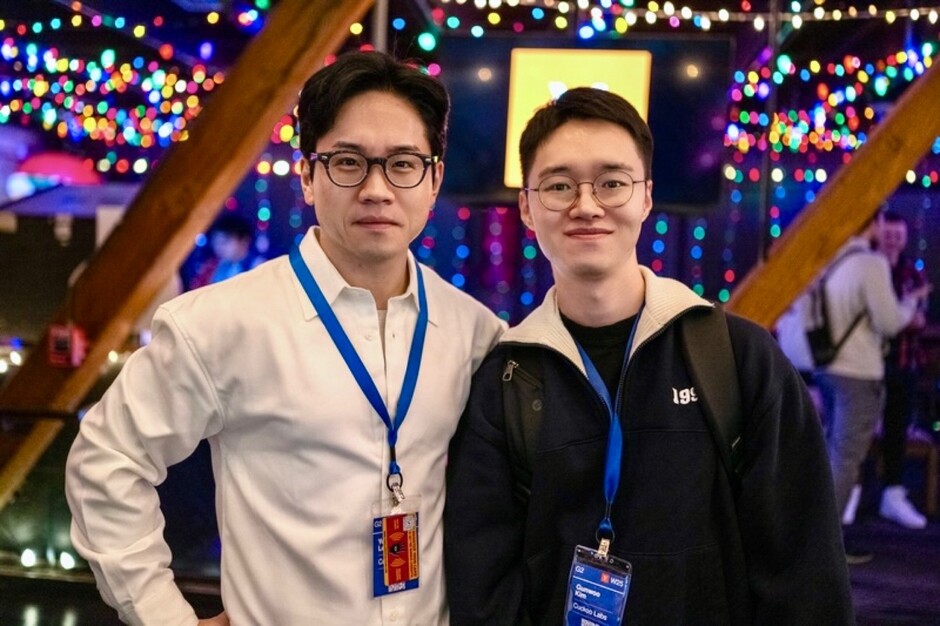
Yong Hee Lee had helped organize those rooms. He and his future co-founder, Gunwoo Kim, hosted community meetups in Korea with visiting product leaders. They saw technical detail disappear between languages. They also saw guests unable to follow Korean discussions, losing opportunities to meet people and explain their products. The visitors had come a long way to spend part of the occasion on the edge of the conversation.
That experience became the starting point for Cuckoo, where Lee is co-founder and CEO. The company builds AI interpretation for business meetings and events, with an emphasis on the vocabulary people use at work. It asks for context: the product names, documents and terms that explain what everyone is actually talking about. A dictionary can tell you a word has several meanings. The people in the meeting need the relevant one.
Lee's story begins with the practical work of getting people together. It now returns, again and again, to the practical work of helping them stay together once they start talking. In between are an old university friendship, early marketing jobs and a company whose first users helped decide what it would become.
A friendship with a long incubation period
Lee and Kim met in 2015 through a student club at KAIST. Together, they organized an annual international conference for undergraduates. They began talking about starting a company. At that point, the shared project was a conference rather than a business, but both required an idea to survive contact with other people's schedules.
An international student event has a useful way of making ambition concrete. Someone must invite the guests. Someone must make the program work. People who have never met need a reason to take the occasion seriously. The result depends on many small arrangements, most of which are noticed only when they fail. It is a plausible place for two future founders to discover how they work together.
Lee studied electrical engineering and science and technology policy at KAIST. His professional account describes being the first go-to-market hire at two Korean startups, one in online programming and the other in AI infrastructure. He also led event marketing with international speakers. Technical material and its public explanation were already sitting next to each other in his working life.
There is an appealing continuity here. The student conference and the later meetups put Lee near people with ideas to share. His work in bringing products to market put him near customers who needed to understand them. Cuckoo occupies the space where those two activities meet. The software has to carry an explanation clearly enough for another person to respond.
Selling the thing meant explaining the thing
At VESSL AI, Lee's name appears on technical publishing as a growth manager. A June 2023 article about running models from the CVPR computer vision conference credits him alongside machine learning colleagues. Another tutorial, on building a Stable Diffusion playground with VESSL Run and Streamlit, also carries his credit.
These are unusually concrete artifacts of a marketing career. They involve model demonstrations, deployment and the small obstacles between an interesting research result and a working application. A reader needs more than an attractive promise. The instructions must get them somewhere. Marketing, in this setting, includes helping a technically capable person spend less time wrestling with the machinery.
The CVPR article also announced VESSL's presence at the conference, including a student social event and product demonstrations. Lee's work thus moved between the written explanation and the live gathering. Both depend on knowing what an audience already understands and where it needs help. Both offer immediate evidence when an explanation has failed.
That background gives his role at Cuckoo a particular texture. Go-to-market work can be described as a sequence of campaigns and sales targets. In Lee's case, the visible trail also includes tutorials and events. The potential customer is someone trying to do a job, often with complicated tools, often alongside people who use different words for the same thing.
July 2024: the room gets an interpreter
Cuckoo launched in July 2024. Its early workflow was deliberately short: choose languages, add keywords or slides, start a session. Audience members could follow interpretation on their own screens through a link or QR code. The technical preparation happened through the material supplied to the software, rather than through an audience learning a new meeting ritual.
One early example involved Weights & Biases, which used Cuckoo at a Seoul meetup and then again in Tokyo. A recurring event is a useful test for a young product. The second invitation matters because the organizer has already seen the first performance. The software must fit the occasion well enough to be asked back.
For Lee, the business problem was recognizable from his own work. A technical event is full of terms whose meaning depends on the topic. An unfamiliar product name can sound like an ordinary word. A sentence may contain several ideas that belong together. Translation has to preserve enough of that structure for a listener to ask an informed question.
His approach leaves a place for the user's knowledge. The person organizing the meeting already has the slides, documentation or terminology. Providing those materials gives the interpretation a briefing. It is a modest but consequential design choice: the product makes preparation useful instead of pretending the conversation begins with no history.
Midterms, a video, then Winter 2025
When Cuckoo announced its place in Y Combinator's Winter 2025 batch on January 9, 2025, Lee recalled a much earlier encounter with the accelerator. He and Kim had watched a video by YC partner David Rusenko during midterms. The university calendar was still demanding their attention; the possibility of a company had found some space beside it.
The recollection is pleasantly specific. Midterms are rarely improved by another video to watch, although students have always found reasons to investigate. Years later, the founders were joining the community they had watched from a distance. Lee named companies they admired, including Airbnb, Stripe and Dropbox, as part of what made the occasion meaningful.
The first customers mattered in a less ceremonial way. Lee described them introducing new uses and helping find bugs. In the founders' launch account, Cuckoo itself was the first customer: the team used the software in demonstrations and feedback conversations. A company selling help with multilingual communication had plenty of opportunities to test its own argument.
In November 2025, Cuckoo announced a $1.8 million seed round. The financing supported a wider enterprise language ambition. The amount is a company milestone, rather than a measure of Lee's personal wealth. Its significance in this story is the chance to keep developing software around the work customers were already bringing to it.
- 2015Lee and Kim meet at KAIST
- 2024Cuckoo launches in July
- 2025YC Winter batch; $1.8M seed round announced in November
- 2026October redesign puts translation and follow-up together
When customers borrow the wrong tool
By August 2025, Lee was describing a curious pattern. Teams were using Cuckoo's live translation for prerecorded material. Regional marketers needed localized videos, and the existing sequence of transcription, subtitle timing and translation could hold up a campaign. A tool built for conversations had become a workaround for a publishing delay.
Cuckoo for Videos followed. It offered transcripts and multilingual subtitles, editing workflows and downloadable captioned videos. Lee described Weights & Biases expanding from community events into other meetings and then content localization. The useful detail is the progression: a customer with one immediate problem kept finding adjacent ones.
A workaround is a rather blunt piece of customer feedback. It says that someone wants an outcome enough to tolerate an awkward route. For a founder, it poses a decision: keep explaining the intended use, or make the improvised use easier. Lee's account of the video product shows the latter response, with human review still part of the workflow.
His other updates keep returning to ordinary working conditions. He described using Cuckoo's mobile app during customer meetings on a Tokyo business trip. He discussed recurring company meetings at semiconductor manufacturer SIMMTECH. These are settings in which interpretation has to become routine. The meeting cannot spend its opening minutes admiring the translation software.
A small pause before the answer
Lee's explanation of event audio translation contains a revealing choice. Cuckoo waits for a complete thought before translating, rather than immediately streaming each fragment. He pointed to differences in the structure of Korean, Japanese and Chinese compared with English. Moving too early can damage the meaning the software is trying to deliver.
He also described using a neutral translated voice layered over the original speaker and removing voice cloning. The listener can keep some of the speaker's vocal cues while receiving the interpretation. This is a practical concern about how an audience follows someone, beyond whether the translated words look plausible on a screen.
There is a small lesson in the pause. A live product is under pressure to be quick, but a sentence needs enough room to become a sentence. The founder's explanation acknowledges that tension. Speed has to serve comprehension. Otherwise the audience receives an answer promptly and spends the next few moments repairing it.
That attention to the listener echoes the original meetup problem. The overseas guest needed access to what was happening around them. The audience needs an interpretation it can follow. In each case, success depends on the experience of the person receiving the conversation, who may have very little control over how it is being delivered.
October 2026: give the conversation more room
Lee's October 6, 2026 update described a redesign spanning the moments before, during and after a meeting. Translation gained more space. Desktop controls were gathered into an overlay beside the call. Sharing tools brought the translation link, access settings and QR code together. Follow-up summaries grouped action items by owner.
These are the sorts of changes that rarely lend themselves to a grand announcement. A button moves. A link becomes easier to copy. An assigned task becomes easier to find. Yet the small inconveniences of a meeting are exceptionally good at accumulating. Removing one can save a participant from becoming the unofficial operator of everyone else's software.
The update keeps Lee close to the work that first interested him: making a gathering function for the people attending it. A translated conversation has several stages. Someone has to start it, another person has to reach it, and afterward the participants need to know what they agreed to do. The words alone cannot complete those arrangements.
Cuckoo's ambitions now extend across business language tasks. Lee's distinctive contribution remains visible in the details: the briefing before a technical discussion, the link an audience member can open, the material a regional marketer needs to publish. The old conference organizer is still there. He is trying to make sure the guest can join the conversation after the talk.
“The person who needs the translation most often isn't the one who started it.”
Yong Hee Lee · October 2026
Continue the conversation
Follow Lee’s work and the products taking shape around it.