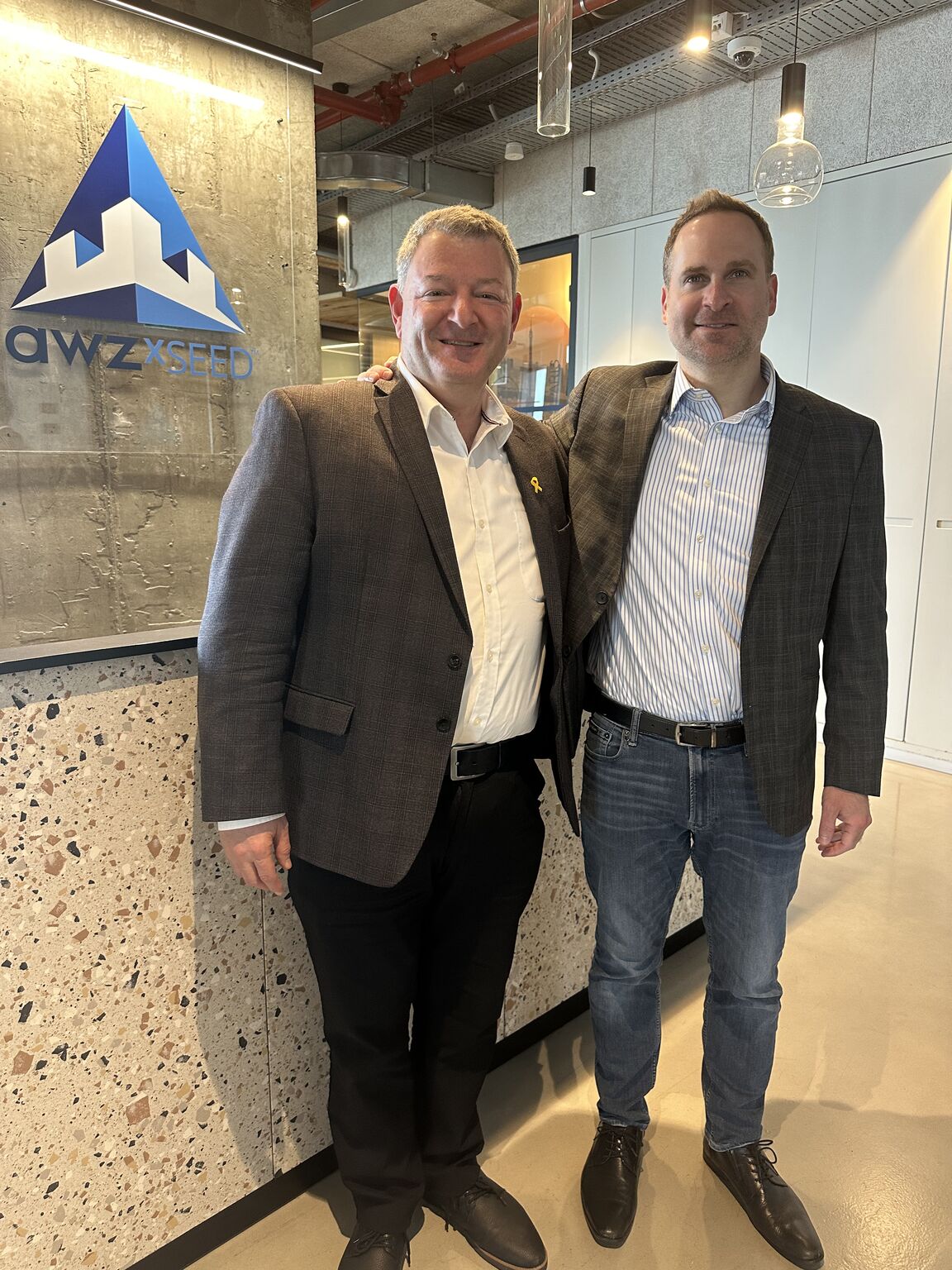
In a photograph from an Awz visit, Idan Zachar stands beside Ran Bar Or beneath exposed pipes and hanging lights. The Awz X-Seed name is on the wall. There are jackets, open collars and an arm around a shoulder. It is an ordinary business photograph, which is part of its appeal. Technology investing has a fondness for pictures of the future. This one contains two people who have to arrange its next meeting.
Zachar’s work concerns the stretch of ground between an invention and a customer. Awz assigns him responsibility for North American sales and revenue strategies across portfolio companies through its Velocity Hub. He is also CEO of Corsound AI, a voice-intelligence business. An investment partnership and an operating company put different demands on a calendar. One looks across businesses; the other requires attention to a particular business, day after day.
The career behind that combination is worth following. It passes through commercial law, enterprise software and portfolio growth. Those jobs have different vocabularies, but they all involve getting people to agree on something consequential. A technology may be ingenious. Someone still needs to understand it, trust the arrangement and sign.
A lawyer crosses the table
Before the venture role came legal work. Zachar’s professional record includes counsel work at Elbit Systems and commercial counsel responsibilities at Amdocs, followed by business leadership there. His education spans law at the University of Haifa and an MBA at NYU Stern. Awz’s biography also identifies him as a member of the New York State Bar.
That sequence gives the later jobs an interesting texture. Commercial agreements concern the details people prefer to postpone during an enthusiastic demonstration: responsibilities, commitments and the terms under which a relationship will continue. Enterprise selling brings those questions forward. The buyer has to work out how a proposed product fits an organization that is already running.
Amdocs provided an enterprise setting for that transition. Awz describes Zachar’s former North American business role in terms of complex sales cycles and business growth. The phrase sounds dry until you consider what a complex sale involves. Several people may care about different parts of the purchase. The person attracted to a capability may have little authority over the money. The person responsible for implementation may have very good reasons to ask another question.
A signature is a small mark at the end of a considerable amount of work. Zachar’s route from counsel into business leadership places him on successive sides of that work. It makes the move to portfolio growth easier to understand: the product changes, while the problem of reaching agreement persists.
- 01LawTerms & commitments
- 02AmdocsEnterprise business
- 03AwzPortfolio growth
- 04CorsoundCompany leadership
Two weeks, several roadmaps
In May 2025, Zachar described spending two weeks at Awz’s Tel Aviv offices with portfolio leaders and research teams. The work included product roadmaps and go-to-market planning. The companies he named ranged across AI governance, model security, voice and facial intelligence, screening and quantum software.
It is a useful picture of portfolio work because it contains both halves of the assignment. A roadmap asks what a company will build. A commercial plan asks how that work will reach people willing to use and pay for it. Keeping the two conversations close can expose awkward questions early. A feature may be technically impressive and commercially difficult to explain. A market may be attractive while requiring a buying process the company has yet to navigate.
The visit also puts geography into the story. Zachar is based in the New York metropolitan area; the portfolio work takes him into an Israeli technology network and outward toward international customers. A new market has its own partners, habits and expectations. Getting there involves people as well as products.
In a public recommendation, Awz adviser Bob Hoey describes Zachar’s attention to listening and competitive differentiation. That is a colleague’s assessment, and it fits the documented remit. Before a startup can persuade a customer, it needs a clear account of why its offering deserves attention. The explanation should survive outside the room where the technology was invented.

The buyer already has a business
In June 2026, Zachar announced his participation in an Amdocs partner event with three Awz-backed companies: Classiq, DeepKeep and CyberRidge. Their work concerned quantum software, AI security and post-quantum photonic encryption. Ran Bar Or publicly credited him with leading the engagement with Amdocs and its partner community.
The gathering brought his earlier enterprise world into contact with his portfolio responsibilities. It also showed why a partner relationship can matter. A customer organization can encounter several emerging technologies through a business it already knows. That does not settle a purchase decision, but it supplies a setting in which a serious conversation can begin.
ClassiqQuantum software
DeepKeepAI security
CyberRidgePost-quantum photonic encryption
His public activity also includes exhibition plans for GSX in Orlando in 2024 and ISC West in Las Vegas in 2025, both involving Corsight AI and Neural Guard. Those appearances concerned facial recognition and AI-assisted X-ray screening. In March 2026, he posted that he was heading to RSAC.
Conference announcements are modest pieces of evidence, but useful ones. They put commercial work on a floor plan and a schedule. The abstract market becomes a set of conversations. A booth requires someone to explain what a product does to people who have heard several explanations already that morning. The coffee may be excellent. The attention span has limits.
A familiar voice gets complicated
At Corsound AI, Zachar’s responsibilities narrow from a portfolio to a company. The current leadership roster names him CEO alongside research and development leader Arkady Krishtul. The board includes Awz’s Yaron Ashkenazi and Daniel Mak, and Cortica chairman Igal Raichelgauz. It is a concrete connection between the investment organization and the operating business.
Corsound offers voice-based identity tools, including synthetic-voice detection and voice-to-face matching. These are company-described capabilities. Their commercial setting includes financial services and security organizations, where determining whether an interaction is authentic can be part of an existing verification process.
A voice is an especially interesting place to locate that problem. Conversation encourages quick judgments. People recognize cadence, tone and familiar ways of speaking. A verification system has a different task: it must assess an interaction under rules that can be applied consistently. The customer then has to decide how the result affects what happens next.
“Is the voice real? Who is speaking? Does that voice belong to the person being presented?”
Idan Zachar, on voice identity
Zachar has used those questions to explain the market his company addresses. They divide a broad identity problem into decisions a buyer can understand. Authenticity, identity and consistency are related, but each asks something different. Explaining the distinction is part of explaining the product.
Corsound’s earlier history supplies useful perspective. Its 2024 Finovate demonstrations were presented by Gal Haselkorn and Orel Agmon, before Zachar’s current leadership. The company had a product story and public demonstrations before he became its CEO. His task belongs to the next part of that history, with the obligations that come from running an existing business.
A strategy that can change machines
Quantum computing adds another kind of uncertainty to his work. In a January 2026 post, Zachar argued for software approaches that can move across processors rather than binding an organization’s strategy to a single hardware choice. It was a business argument about flexibility, expressed through a technical subject.
That position should be read as his view of how organizations ought to prepare. It does not provide a timetable for every quantum application. Its interest lies in the purchase question underneath it: how much of today’s decision will remain useful when the technology changes?
Enterprise buyers have to make choices before every uncertainty has been resolved. Waiting has consequences; committing has consequences too. Software portability is one way to frame the problem. Zachar’s emphasis connects with the commercial background running through his career. The agreement made today needs room for the business that will exist tomorrow.
Classiq’s place in the Amdocs event announcement gives that discussion an operational setting. Quantum strategy appeared alongside AI security and encrypted communications, in front of a telecommunications partner community. A technology can have a long research history and still enter a buyer’s calendar through a very ordinary meeting.
The next conversation
Zachar occupies two vantage points on that process. At Awz, he works across companies with different products and commercial needs. At Corsound, he leads one of the businesses trying to establish its place in a market. The combination brings investment language into proximity with operating decisions.
It also makes the photograph at Awz X-Seed a fitting place to return. No chart in the picture promises an inevitable result. Two colleagues stand beside a company sign. Around them is the ordinary furniture of work: an office, a visit, a relationship. The next customer is outside the frame.
There is a temptation to tell technology stories as if the invention supplies its own ending. Zachar’s career draws attention to the intervening work. A product needs an explanation that travels, partners who understand the opportunity and a buyer with a reason to act. The distance can be considerable. His job is to keep working across it.
Follow the work
Awz’s team · Idan Zachar on LinkedIn · Corsound leadership · Corsound’s blog
Watch: Corsound’s FinovateFall 2024 demonstration ↗
Presented by Gal Haselkorn and Orel Agmon, before Zachar’s current CEO role.