A treacherous word in a technical meeting may be Kafka. To a literature reader, it means bureaucratic dread and a man waking as an insect. To a data engineer, it means distributed event streaming and, very possibly, the reason everyone has joined the call. A translation tool can know both definitions and still pick the wrong life entirely. Gunwoo Kim has built a company around that awkward little gap between vocabulary and meaning.
Cuckoo, the company Kim co-founded with Yong Hee Lee, supplies real-time AI interpretation for sales calls, support sessions, team meetings and events. It does the recognizable work of translation, but first it asks for the materials scattered around the conversation: API documentation, pitch decks, meeting notes, internal terms and keywords. The ambition is to behave less like a pocket dictionary and more like the colleague who actually read the briefing.
This is an engineer’s answer to an old social problem. Nuance goes missing long before a meeting becomes incomprehensible. A product name gets flattened into an ordinary noun. A troubleshooting detail becomes vague. The room technically understands, yet somebody leaves with the wrong picture. Kim’s career has repeatedly put him near systems where “almost right” is an expensive condition. Before language, there were moving cars.
A friendship before a cap table
Kim met Lee at KAIST in 2015 through a student organization that staged an annual international conference for undergraduates. Kim studied computer science; Lee studied electrical engineering and science and technology policy. The club required a different sort of engineering. Speakers had to be invited, partnerships maintained, and hundreds of attendees from many universities made to feel that they belonged in the same conversation.
Kim served as head of global partnership for the ICISTS organizing committee. His work covered relationships with student organizations and conference teams in seven countries, with participants arriving from 15 countries and more than 70 universities. The numbers are tidy. The human arrangement was not. International events expose every rough edge of communication: accents, idioms, specialist language, shy questions, jokes that reach one half of the room a beat before the other.
The pair saw visiting speakers lose the thread of Korean discussions and technical details thin out as they crossed languages. They also began talking about starting a company together. That idea survived graduation, different jobs and the usual migration from student certainty to adult calendars. Nine years later, in July 2024, they started Cuckoo.
Working (and now living) with someone who shares so many values has become one of the most satisfying parts of my life.Gunwoo Kim, on building with Yong Hee Lee
There is something charmingly severe about co-founders who choose to share both a company and a home. Strategy discussions do not need scheduling, though neither do disagreements. Kim’s remark is revealing because it puts shared values ahead of complementary résumés. Their partnership had already been tested on work that paid in experience rather than equity. By the time there was a cap table, there was history.
Software that meets the world live
At KAIST, Kim was the sort of computer science student who left artifacts behind. His public GitHub contains a shell-learning tool for beginners, an indoor mapping experiment based on Wi-Fi signal strength, a travel recommendation project and the website for a campus social-inclusion committee. In 2017, he co-authored research on context-aware notifications that received an Outstanding Paper Award at the Korea Software Congress. The title now reads like an early clue. Context kept returning.
His undergraduate years were interrupted by national service and industry experience from 2017 to 2020. In software work, he moved through VCNC and later KRAFTON. At VCNC, he helped build a Korean ride-hailing app that reached one million users in nine months, outpacing Uber Korea over the same period.
Ride-hailing is a useful apprenticeship for real-time interpretation. Both products are judged in motion. A car arriving five minutes after the interface claims it has arrived is not mostly correct. A translation that recovers the technical noun after the customer has answered is similarly decorative. The system has to absorb messy live input, maintain state and offer the right result while people are still deciding what happens next.
Cuckoo’s context loop
Cuckoo’s interface reflects this bias toward immediacy. Invite it to an online meeting or capture audio from a laptop for an in-person conversation. Select the languages, feed it context, then let people speak naturally. The product runs across Zoom, Google Meet, Slack and Microsoft Teams, on desktop or mobile. It can detect language changes rather than insisting that a lively multilingual room behave like a form with one dropdown.
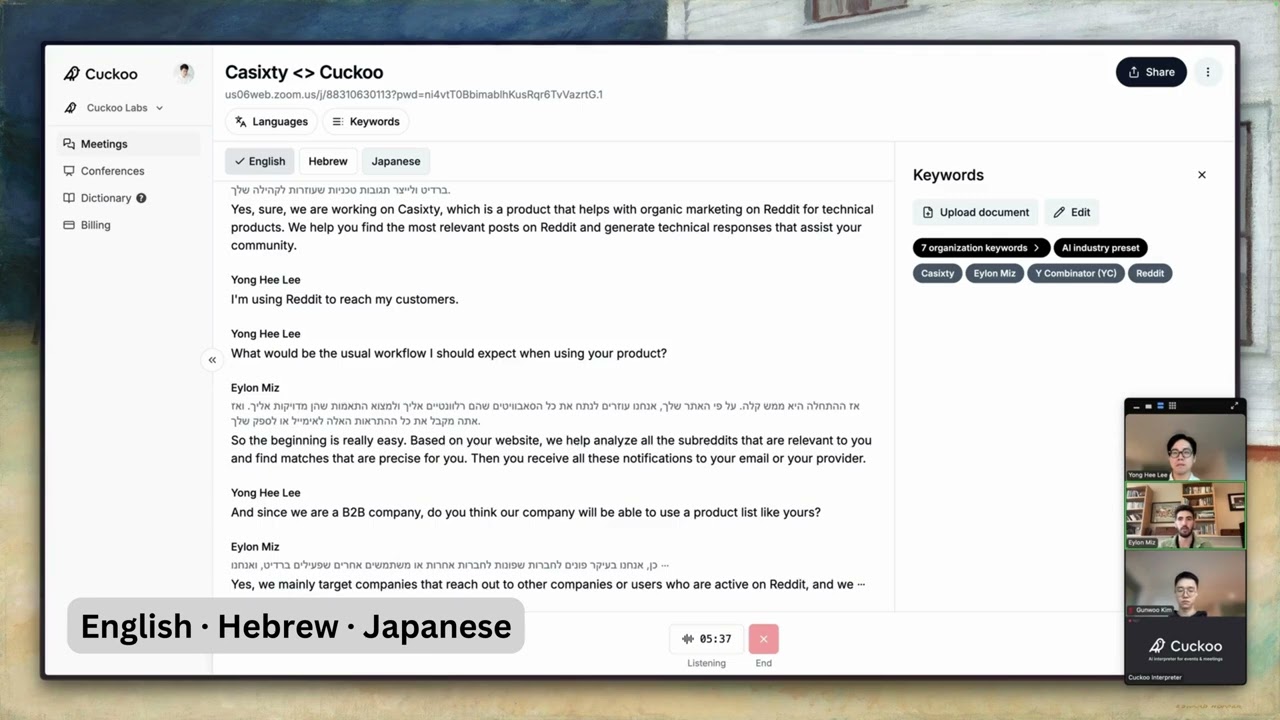
The first customer sat at their own desk
Kim and Lee described themselves as Cuckoo’s first customer. They used it for demonstrations and feedback while selling across regions. That is a convenient founding arrangement: every sales conversation is also a product test, and every mistranslated technical term arrives in front of the people who can fix it. There is nowhere for abstraction to hide.
An early public trial came at the first Weights & Biases meetup in Seoul. Cuckoo interpreted Korean, Japanese and English for the local AI community, a team visiting from Japan, and a company executive. The product then went to a related event in Tokyo. Live events are unforgiving theater. There is no polite “regenerate” button for the audience, and a term lost on Wednesday can become a room lost by Thursday.
Early users named by the company included Snowflake, PagerDuty, ClickHouse, dbt Labs and Weights & Biases. Their use cases make a compact map of global friction: customer-experience events, troubleshooting with partners, team syncs across headquarters and regional offices, and webinars for markets where English is not the only serious language in the room.
That distinction helped Cuckoo stand apart from translation features already bundled into meeting software. Stanford GSB student Stephen Li, after a conversation with Kim, offered a memorable example: does “Kafka” mean the author or the streaming platform? He argued that the remaining margin of translation quality was what made the young product interesting. For an enterprise buyer, that margin is not polish. It is whether a customer hears expertise or mush.
The language layer gets larger
Cuckoo entered Y Combinator’s Winter 2025 batch. The accelerator was not a sudden conversion. Kim and Lee had spent years passing Y Combinator essays and videos back and forth, internalizing the instruction to make something people want. By the time the acceptance arrived, the company already had customers who were teaching the founders where the product bent.
In November 2025, Cuckoo announced a $1.8 million seed round backed by Y Combinator and several Korean and international investment firms. The company said the money would support product development, global expansion and wider interpretation and localization services. The broader direction matters. Meetings are only one place where companies repeatedly explain themselves across borders. The same private vocabulary appears in webinars, customer support, documents, websites and videos.
The opportunity is to become a language layer that learns the organization once and carries that understanding into each format. A glossary that improves as work happens is more useful than a translation tool that wakes with amnesia every morning. Cuckoo’s current product already extracts team keywords and accumulates context across conversations. Its founding problem is growing into an architectural idea.
For Kim, the progression is consistent. The student organizer wanted people from different countries inside one useful room. The engineer worked on software coordinating people and vehicles at speed. The founder now builds for meetings where meaning has to arrive on time. His public record is not crowded with manifesto writing. It is crowded with systems, clubs, experiments and products - practical things that connect one person’s intention to another person’s next move.
They teach us something new and drive us forward every day.Kim, on Cuckoo’s early customers
That sentence supplies a quiet, useful portrait of his ambition. The customers are not logos arranged around a founder. They are instructors. Cuckoo’s task is to listen closely enough that a troubleshooting call in Seoul, a webinar in Tokyo and a team sync in San Francisco can retain their peculiar nouns and human rhythm.
Machines have long been good at replacing one word with another. Kim is chasing the harder competence: knowing why this word, in this company, spoken by this person, matters now. Somewhere between Kafka the novelist and Kafka the platform sits an entire business. Cuckoo would like everyone in the meeting to find the same one.