In 2005, Yehuda Shmidman had a solution for a rather specific storage problem: thousands of recorded Talmud lessons, scattered across tapes and CDs. He put them on an iPod. The ShasPod held 2,711 lectures, enough for the daily study cycle that takes seven and a half years. Apple had supplied the device. Rabbi Dovid Grossman supplied the recordings. Shmidman supplied the arrangement that made them easier to use.
He was 24, a Yeshiva University graduate, selling a product that cost $100 more than the ordinary 20-gigabyte iPod. His customers included people in South Africa, Romania and Venezuela. A substantial library had acquired white earbuds. The proposition was practical, almost cheerfully literal: take something people already care about and put it somewhere more convenient.
“Daf Yomi should be about accessibility and ease,” he said at the time. Two decades later, that small venture offers an unusually useful way into a career now conducted through toy stores, department stores and fashion houses. Shmidman’s transactions have grown considerably larger. The relationship between a valued thing and the route that delivers it remains the interesting part.
The education behind the label
Shmidman studied political science, earning his bachelor’s degree from Yeshiva University in 2004. His early commercial education came at a startup licensing agency in New York. It helped introduce Isaac Mizrahi to Target, putting a designer’s name into a mass retailer’s aisles. The experience placed him close to a business in which the agreement between two companies could change what millions of people were able to buy.
In 2005 he joined Iconix Brand Group, the year the company began its transformation into a business devoted to brand licensing. Over seven years, he worked across business development, acquisitions, international joint ventures, finance and investor relations. He became chief operating officer in 2010. By November 2012, he had moved to Sequential Brands Group as chief executive.
Those jobs put him among an eclectic collection of names. Martha Stewart and Snoopy appear in his career biography alongside fashion labels. They also taught a less picturesque discipline: how to connect the owner of a name with the people who manufacture, distribute and sell things under it. The consumer might see a shirt or a familiar cartoon character. Shmidman was learning the agreements behind the encounter.
Fortune included him in its 2015 “40 Under 40” selection. Recognition arrived before the company that now defines his public career. He would spend another several years working in the field before putting his own brand-management firm together.
A company begins with Anne Klein
In 2019, Shmidman founded WHP Global with Oaktree Capital. Its first acquisition was Anne Klein, a label already supported by specialist partners making shoes, bags, watches, jewelry and clothing. Taking ownership did not require replacing that entire network. Existing licensing agreements remained part of the proposition. The name had a history; the businesses around it had useful expertise.
The following March, WHP completed its purchase of Joseph Abboud. Oaktree increased its equity commitment to $350 million, including its original $200 million. WHP identified existing partners in North America and Japan while setting out to find more elsewhere. That early sequence established the pattern: acquire a brand, keep useful relationships, then look for places and product categories where the name might travel.
Annual retail sales across WHP’s brand portfolio, reported in September 2026. This measures products sold under the brands, rather than WHP’s corporate revenue.
By September 2026, WHP described a portfolio of more than 16 brands operating across more than 80 countries. More than 200 operating partners were involved. Ares, Solus and BlackRock had joined the list of financial backers over the company’s development. The collection had expanded beyond the first fashion purchases into sports, toys and premium designer names.
A firm assembled this way has to be good at choosing other firms. A trademark cannot staff a checkout, judge a fabric shipment or make a late delivery arrive on time. Each new agreement gives another operator a role in how the public experiences the name. That dependence helps explain the severity of Shmidman’s preferred maxim.
“Partner or Perish.”
Yehuda Shmidman’s guiding principle at WHP Global
A former Toys“R”Us kid gets the keys
The Toys“R”Us transaction carried a more personal charge. Shmidman has described himself and many colleagues as former Toys“R”Us kids, now participating in the brand’s return. A licensing acquisition rarely comes with a childhood soundtrack quite so readily supplied by its customers.
He had already been vice chairman of Tru Kids, the owner of the Toys“R”Us and Babies“R”Us brands, since early 2019. WHP acquired a controlling interest in March 2021. The familiar American chain had liquidated its stores in 2018, but the brand’s international business continued. At the time of WHP’s investment, nearly 900 stores and associated ecommerce businesses operated in more than 25 countries outside the United States.
That geography mattered. Americans could look at the empty local store and see an ending. Elsewhere, customers were still shopping under the same sign. Shmidman’s task was to rebuild an American presence around a name that already retained a business overseas. At the announcement, he discussed possibilities ranging from shops inside other stores to pop-ups and airport locations.
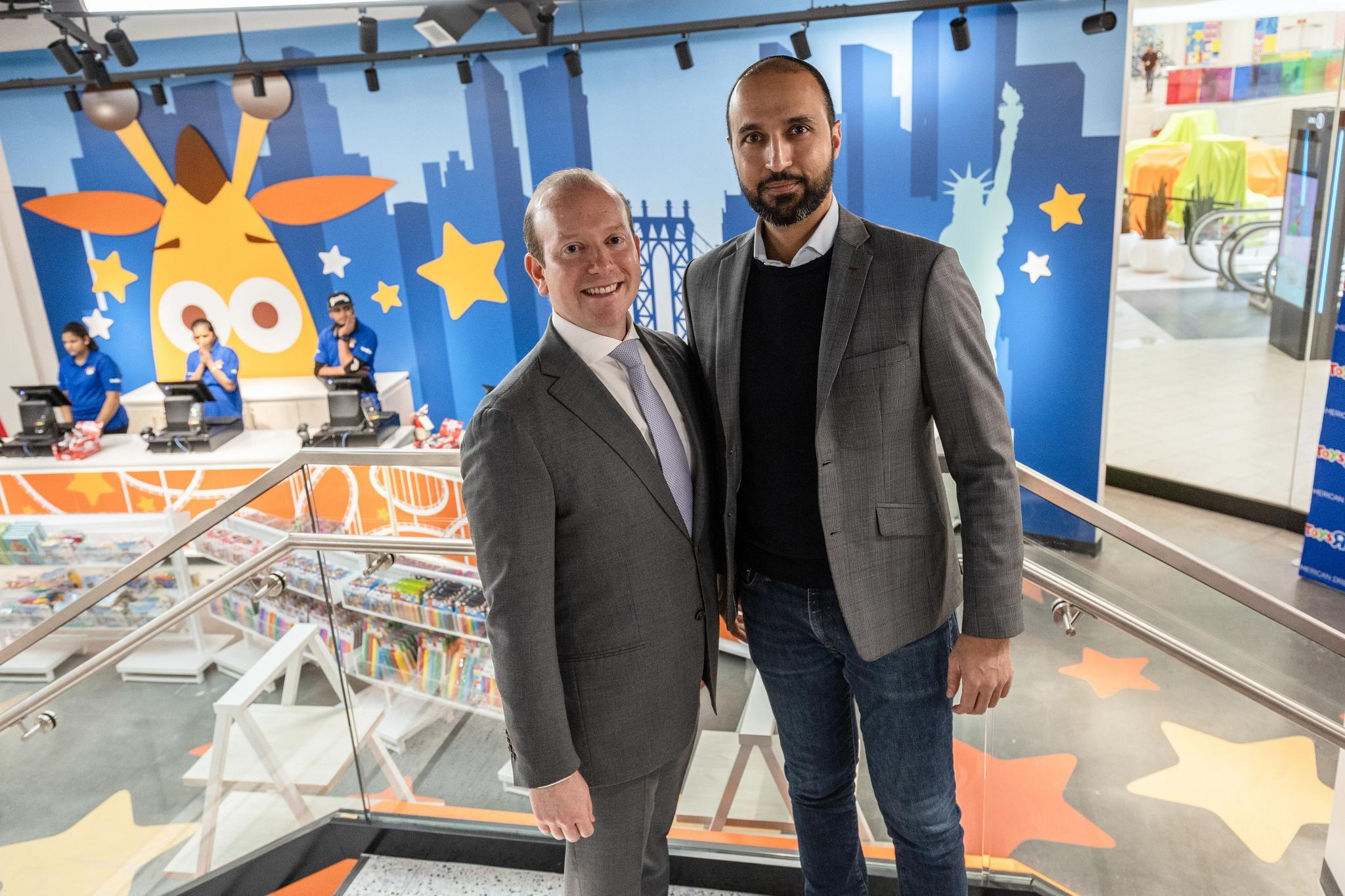
The Macy’s partnership gave that return a route across the country. Shops within the department store chain allowed Toys“R”Us to reach customers without independently finding and leasing hundreds of sites. A flagship at American Dream in New Jersey supplied a different setting: a large toy store inside an entertainment and shopping complex. The same name could occupy different amounts of floor space.
In September 2026, Toys“R”Us announced plans for 120 additional standalone American stores with Go! Retail Group for the holiday season. The announcement described an existing base of 40 standalone locations, alongside the Macy’s shops. It also outlined airport and Navy Exchange locations. These were several ways of reaching shoppers, with different partners doing the work.
The holiday plan included creator studios at selected stores, with some locations offering cafés and candy shops. The giraffe was returning to a retail world where a visit might produce a video as readily as a shopping bag. For Shmidman, the emotional attraction of the brand had become a series of very concrete decisions about formats, operators and addresses.
The designer stays in the room
Vera Wang introduced a different kind of relationship. WHP completed its purchase of the brand’s intellectual property in January 2025. Wang continued as founder and chief creative officer and became a shareholder in WHP. A living designer remained responsible for the creative identity attached to her own name while joining the larger company’s ownership.
The arrangement gives Shmidman’s partnership language a particular meaning. Wang brings the design authority accumulated over her career. WHP brings a structure for extending the business. Neither contribution is especially useful in isolation when the product being sold depends on customers believing in a recognizable point of view.
In June 2025, WHP announced a partnership with Batra Group for Vera Wang ready-to-wear in the UK and Europe. Shmidman described geographic expansion, media initiatives and hospitality projects as three parts of the brand’s longer-term strategy. Those plans reveal his ambitions more clearly than a general promise of growth: he wants a designer’s name to support new kinds of encounters in new markets.
WHPGlobal brand licensing
G-IIIWholesale, retail & ecommerce
Marc JacobsCreative direction
Joint ownership of the intellectual property. Distinct responsibilities for growing the business.
On September 1, 2026, WHP and G-III completed their acquisition of Marc Jacobs from LVMH. The two companies each owned half of the new intellectual-property venture. WHP led licensing; G-III acquired and led the operating business. Marc Jacobs continued as founder and creative director. Shmidman had a new partner in Morris Goldfarb’s G-III, with responsibilities divided explicitly between the brand and its operations.
Earlier that year, WHP’s Lands’ End venture had applied another version of this approach. Lands’ End received $300 million for a 50 percent controlling interest in the intellectual-property joint venture, while retaining operational control of its core direct-to-consumer and business-to-business activities. Most of the proceeds went toward repaying its $234 million term loan. For the seller, a brand transaction could alter the balance sheet as well as the expansion plan.
Three questions before the next deal
Shmidman has a compact way to explain the consumer side of all this. Speaking to a Columbia University class in 2021, he described an evaluation model called AAP: awareness, affinity and purchase intent. The sequence asks whether people know a name, feel something toward it and intend to spend money on it. He also emphasized delivering on the brand’s promise.
- 01AwarenessDo people know the name?
- 02AffinityDo they feel a connection?
- 03Purchase intentWill that feeling become a sale?
These are useful questions to bring back to the acquisitions. Recognition can survive a closed store. Affection can outlast a previous owner. A purchase still requires something desirable, available and worth the price. His business depends on getting those conditions to meet, repeatedly, across companies that have separate owners, employees and obligations.
Seen together, these arrangements suggest a particular idea of leadership. Shmidman’s role is to make agreements that let the designer, the toy buyer and the department-store operator do useful work under a shared name. Each has expertise the others need. The questions become personal even when the contracts are corporate: whom do you trust with an identity, and what do you owe the people who recognize it?
The young entrepreneur with the ShasPod had faced a smaller version of the delivery problem. The lectures existed. The device existed. He found a way to bring them together for people who wanted to listen. Today, a child walking into Toys“R”Us need never hear of WHP Global, much less understand a licensing agreement. Shmidman’s work becomes visible at the moment the familiar name leads somewhere worth going.