A bank can know your balance, your birthday and the date your next payment is due, then send you a message that might as well be addressed to the entire postcode. Yaron Kalish built a company around that small corporate absurdity. The information was personal. The communication often sounded as though nobody had met you.
Today he is the co-founder and CEO of Idomoo, working in a video market crowded with artificial intelligence. His career began well before a typed sentence could summon an animated scene. It includes a law background, a mobile-internet startup founded with his brother, and the practical business of persuading enterprises to buy unfamiliar technology. The recurring subject is the distance between what a system knows and what a person can actually use.
There is something appealingly uncinematic about this ambition. A clarified bill rarely wins applause. A loyalty benefit successfully explained will struggle at the box office. Yet these are precisely the encounters that decide whether a customer feels served or merely processed.
A lawyer in the mobile-internet business
Kalish studied law and economics at the University of Haifa. His professional background included corporate and trade law. In late 1999, he and his brother Danny founded Niragongo, a company developing infrastructure for transmitting data over wireless networks. Yaron’s responsibilities included business strategy and the company’s vision; Danny worked on the technology.
This was the mobile internet before the smartphone became a slab of everyday life. In March 2002, Niragongo announced its participation in Hewlett-Packard’s Mobile e-Services Bazaar, an alliance bringing together carriers, technology providers and other participants in wireless services. Kalish, then executive vice president, spoke about removing barriers to mobile-internet adoption. His concern was already the awkward passage from technical possibility to something a subscriber could use.
By July 2004, Niragongo and Cash-U had signed a preliminary merger agreement. Niragongo employees had moved into Cash-U’s offices, and Kalish had taken a business development role. The connections were close: another brother, venture capitalist Rami Kalish, sat on Cash-U’s board on behalf of Pitango. Technology businesses may promise frictionless networks; building them still involves people who know one another.
Kalish’s subsequent career included finance and business development at Unipier and strategic alliances at Flash Networks. Those roles put partnerships and commercial decisions alongside product development. Reading the sequence, one can see why enterprise distribution would later occupy so much of his attention: a functioning product still needs a route into somebody else’s organization.
- 1999Niragongo
Mobile-internet infrastructure - 2013Idomoo funding
$9m round; international expansion - 2021Public listing
Tel Aviv Stock Exchange - 2026Lucas + Strata
Enterprise AI video
A name with a pronunciation guide
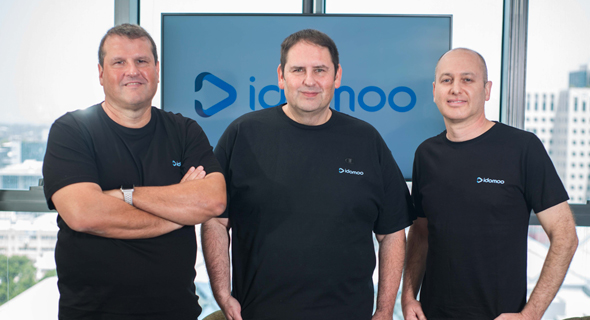
At Idomoo, Kalish joined Danny and fellow co-founder Assaf Fogel in applying software to video communication. Danny became CTO; Fogel led research and development. The name came from “I do movies.” In a 2013 interview, Yaron explained that its final syllables were supposed to rhyme. A technology pitch had acquired a small elocution lesson.
His argument was straightforward: a company could combine customer information with video, changing the message for each viewer. A broadcast about the wrong product wasted an opportunity. A film using relevant account information might help someone understand an offer or a statement. The ambition borrowed from an older commercial relationship, the service provider who remembered the customer.
Kalish described helping executives connect loyalty with revenue. “We help CEOs connect those dots,” he said. That sentence captures a substantial part of his job: translating a communication idea into a reason for a business to spend money.
As president and co-founder in 2013, he discussed a roughly $9 million financing round and expansion in the United States and South America. The international business was already part of the plan. Video could travel; the account details, language and useful next step had to travel with it.
“We help CEOs connect those dots.”
Yaron Kalish · 2013
The useful part comes after play
A phone upgrade provides a less abstract example. In an O2 campaign using Idomoo, customer information included device type, interests, tenure and position in the contract. The campaign used those differences to change the advertising. Someone interested in photography could receive a message connected to that interest and an appropriate handset.
The published case study reported that click-to-conversion rates doubled for certain devices compared with previous O2 campaigns without Idomoo’s offering. That qualification matters. A result for particular devices in one campaign gives the example its shape; it supplies no universal multiplier for every marketing department. The useful observation is that customer differences were allowed to influence the content.
In November 2021, Idomoo announced work with El Al on its customer experience system. The airline’s frequent-flyer club wanted members to understand their entitlements and how to use the benefits. For Kalish, the project also represented deeper relationships with Israeli clients following the company’s stock-market listing.
The two applications reveal different kinds of attention. One seeks a purchase; the other helps explain a service. Both depend on choosing information that belongs in that person’s message. A customer’s name can open a film. It cannot, by itself, make the remaining minute worth watching.
These projects also help explain why Kalish’s public story is so closely tied to other organizations. An enterprise video business lives among airline programs, telecom systems, creative teams and customer databases. Its work becomes visible when it fits into the existing relationship between a company and its customers.
A public company has another audience
In 2019, Idomoo raised $18 million in a round led by Target Global and Disruptive. In June 2021, it completed an initial public offering on the Tel Aviv Stock Exchange, raising NIS 75 million at a reported company valuation of NIS 344 million. Kalish was now leading a business with public shareholders as well as enterprise customers.
The listing added another sort of communication to his responsibilities. A buyer wants to know whether a product solves a problem. An investor also wants to know whether solving it produces a durable business. Revenue, costs and the timing of contracts become part of the story, however photogenic the software happens to be.
There is a technical detail in Kalish’s record that complicates a neat division between commercial founder and technical founder. He is named with Danny Kalish and Assaf Fogel on a United States patent, granted in June 2019, titled System and Method for Generating Videos. The lawyer appears in the inventor list. A company biography can flatten people almost as efficiently as a video export.
The next movie has layers
The newer chapter concerns Lucas, Idomoo’s AI video agent, and Strata, the generative model announced in March 2026. The company describes Strata as producing editable compositions with separate layers for elements such as text, animation, footage and actors. Those parts can be adjusted and personalized within the composition.
Consider the ordinary nuisance of a changed word. A finished video may look persuasive until a product name needs replacing, a caption needs translating or an offer needs updating. Keeping the composition editable gives those changes somewhere to happen. The problem sounds modest beside the spectacle of generated footage. In a business workflow, it can determine whether the spectacle survives its first correction.
Idomoo says Lucas analyzes approved company content to understand design, narrative and assets, then applies those brand requirements to generated video. These are the company’s product claims, and their practical value depends on how the tools perform in a customer’s workflow. The promised benefit is easier revision and personalization across many versions.
A composition that keeps its parts editable.
Conceptual illustration of Idomoo’s described architecture.
Distribution remains central to Kalish’s work. A December 2025 announcement described an AWS integration connecting Lucas with Amazon Q Business and approved organizational information. In August 2026, Lucas arrived on Samsung VXT, the digital-signage platform. The screen in a business became another potential destination for video created through the software.
By June 2026, Idomoo’s release notes listed Strata among the style options in Enterprise AI Video. That is the less glamorous companion to a launch announcement: a feature appearing among creation modes, duration limits and ordinary product updates. It is where a new technical idea begins meeting the daily habits of its users.
The arithmetic after the announcement
Kalish’s next task is visible in the August 2026 results update. Idomoo reported first-half revenue of about $7.5 million, down approximately 7% from the comparable period, with annual recurring revenue of about $19.2 million. The company attributed the revenue decline chiefly to delays in completing deals. Kalish described a transition toward enterprise AI video and the effort to turn Lucas into a business engine.
The company forecast about $6 million in 2026 AI-solution bookings, compared with about $2 million in 2025, and operating cash-flow break-even from the fourth quarter. Those were expectations stated in August. They belong on the forward-looking side of the ledger. A CEO has to carry that distinction even when the product can make a very convincing film.
The next chapter will be written in contracts, repeated use and the economics of making another version. Kalish’s earlier ventures make the continuity worth watching. Mobile services needed a path to subscribers. Personalized video needed a path through enterprise systems. AI video now needs a path from a promising demonstration to work someone routinely pays to have done.
His audience of one remains a demanding customer. That person is unlikely to care how many layers a video contains, how it was financed or which model arranged the scene. They want the relevant benefit, the understandable explanation, the useful next step. For a career spent selling better communication, it is a suitably exacting final editor.