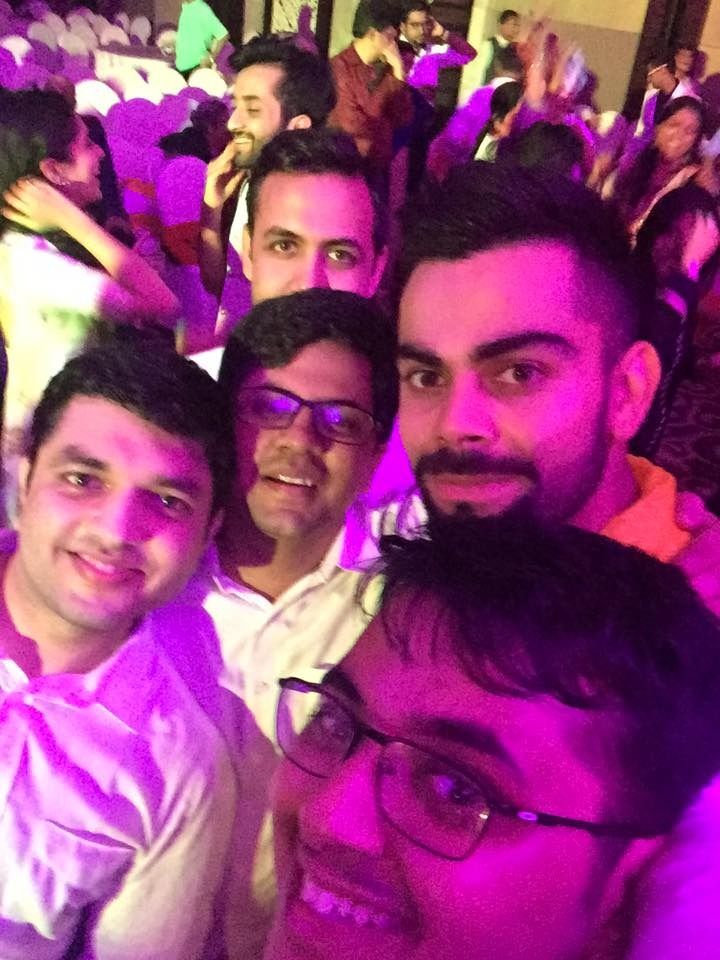
The useful thing about being a fan is that dignity becomes negotiable. In 2016, Nimish Goel wanted to meet Virat Kohli, who happened to be attending Rohit Sharma's wedding. Goel was not. He went in anyway. The evidence survives as a wonderfully imperfect photograph: party lights, crowded faces, Kohli at the right edge, and Goel squeezing himself into the frame at the left. It is less a polished founder-origin portrait than a small act of cheerful trespass.
Goel later described that meeting, and seeing Roger Federer play live in 2019, as fanboy moments whose meaning only became clear in hindsight. He understood the peculiar ache of fandom: millions of people feel they know a public figure, while the public figure cannot possibly know them back. Social media offers proximity without reciprocity. The comment disappears. The direct message sinks. Five seconds of genuine recognition feels almost illicit.
This was the emotional premise of TrueFan, the company Goel started in January 2020 with Devender Bindal and Nevaid Aggarwal. The first product asked users to pay a modest fee and answer quizzes about celebrities. Winners received personalized video messages from stars including Ranveer Singh, Kareena Kapoor, Hrithik Roshan and Tiger Shroff. It was part game show, part fan club, part proof that a famous person had briefly spoken to you rather than past you.
An analyst walks into show business
Goel arrived at entertainment by an unusual route. Born and raised in Jaipur, he attended IIT Kharagpur from 2010 to 2015. He then spent two years in strategy consulting at EY-Parthenon and roughly two more in private equity at Warburg Pincus. Those are professions that train a person to make the impolite calculation hiding beneath a charming idea.
TrueFan had early momentum and expensive backing. In August 2020 it raised $4.3 million from Ronnie Screwvala, Saama Capital and Mayfield India. The company itself had acquired a name only shortly before. Goel has recalled climbing the stairs to Screwvala's Mumbai home with his co-founders and realizing they had an idea but no answer if their host asked what it was called. Somewhere on the way up the staircase, “TrueFan” was chosen. The name survived the pitch, the seed round and a complete change of business.
“The harder you work, the luckier you get.”Nimish Goel, 2020
The original model had a flaw no growth tactic could repair. Celebrity attention is a finite inventory. Every new personalized greeting consumed more of the exact input that was difficult and costly to acquire. A star has only so many hours and rather better things to do than repeat birthday wishes to strangers named Rohan.
This is where Goel's story becomes more useful than the standard founder fable. TrueFan did not merely encounter a constraint. It promoted the constraint into the product roadmap. If the human performance was scarce, the company would capture it once and make it reusable. Goel has said the team put its roughly $4 million of seed capital into AI infrastructure, hired engineers across Ukraine, Israel and the United States, and spent 12 months developing technology that could turn about 15 minutes with a celebrity into a much larger supply of personalized videos.
Bollywood was the laboratory
In late 2021, TrueFan launched an AI avatar of Ranveer Singh. The technical bet gave the celebrity something no scheduler could provide: multiplication. One licensed performance could address many fans. The company eventually said it had built avatars for more than 150 celebrities and brand ambassadors, including Shah Rukh Khan, Kareena Kapoor, Rohit Sharma and Rishabh Pant.
But a useful capability has a way of seeking a larger budget. The same machinery could make a bank manager appear to explain a product in a customer's language, let an insurer localize a campaign, or allow a consumer brand to create thousands of variations without booking another studio day. By 2024, TrueFan was turning decisively toward enterprise AI video. Fandom had been the laboratory. Corporate communication became the market.
This was less a glamorous reinvention than a transfer of the original insight. A personalized video matters because the recipient feels specifically seen. The emotional unit stays intact whether the speaker is a film star wishing someone happy birthday or a business leader welcoming a new customer. What changes is the workflow around it: customer databases, consent, rendering queues, WhatsApp, rich communication services and the sober obligations of an enterprise contract.
The expensive route to trust
Generative AI rewards a convincing demonstration. Enterprise software punishes an unreliable second act. Goel has written about the decision to build TrueFan's own video foundation models instead of stitching together third-party interfaces. It was slower, costlier and riskier. It also gave the company control over details that become glaring at scale: wandering eyes, flattened emotion, synthetic movement and lip-sync that lands a fraction too late.
“Almost real” is a curious category. It can win a meeting and lose the account. A novelty clip may survive a wobble. A bank producing two million personalized videos cannot. Goel's lesson from enterprise AI is that trust compounds faster than speed. The line carries the faint echo of his finance career, where exciting projections eventually meet due diligence.
“AI has fundamentally changed the economics of video creation.”Nimish Goel, 2026
By June 2026, TrueFan AI said it could generate as many as 500,000 videos per minute in more than 175 languages. Its customer roster had passed 100 enterprises across banking, insurance, healthcare, consumer goods and media. Reported names included HDFC Bank, Bajaj Finance, Zomato, Cipla, BharatPe and Goibibo. The company said annual production rose from five million videos in fiscal 2025 to more than 20 million in fiscal 2026. Two months later, Goel wrote that the current-year trajectory was 110 million.
The numbers require a certain adjustment of scale. A normal production company thinks in shoots. TrueFan wants its customers to think in messages: one for each customer, dealer, product, language and moment. In that world, video stops behaving like a campaign asset and begins behaving like mail merge with a human face.
Six years old, day zero again
The capital market eventually endorsed the new shape. In June 2026, TrueFan AI raised a $10 million Series A led by Baring Private Equity Partners India and Z3Partners, with IAN Alpha Fund and 3Lines Venture Capital participating. The money was earmarked for AI infrastructure, international expansion and real-time video agents that could move beyond one-way messages into sales, onboarding, support and product discovery.
There is an entertaining symmetry here. TrueFan began because Goel wanted a public figure to acknowledge a fan. Its next act is building agents capable of acknowledging customers in real time. The stage grew from a wedding selfie to an enterprise system, but the desired reaction remains recognizably human: this message knows who I am.
Goel's public writing has grown more institutional as the company has matured. At four years, he urged his team to “respect the game” and think beyond short-term swings. At five, he described the anniversary as a prologue. He wants TrueFan AI to become a full-stack agentic platform for marketers and, eventually, a company that can celebrate its 50th birthday. He has compared the desired place in marketing to the roles Figma holds in design and Cursor in software development. It is a serious ambition, and the next stage will test whether India's demand for high-volume, multilingual, price-sensitive video can travel to Southeast Asia, the Middle East and the United States.
The more personal detail may be a better guide. In 2020, asked how he motivated himself, Goel said he thought about giving a smile to fans across India. Asked what he wished to be remembered for, he did not offer a market category, a valuation or an annual render count. He said: “A nice human being.”
Technology founders enjoy talking about scale because scale turns effort into leverage. Fandom works in the opposite direction. Its magic is a brief collapse of distance, one person meeting another. Goel's company lives in the tension between those two forces. The bet is that intimacy can be manufactured without feeling manufactured. At a wedding in 2016, all it took was the nerve to enter the room. Now comes the harder trick: making the room feel large enough for everyone.