Yali Saar and his friends had a problem familiar to people who are young enough to want to go clubbing and insufficiently impressive to be admitted. They could not get in. Their solution, as he later recalled it, was to organize a party themselves. The party became a recurring venture that helped support the group for several years. A closed door had acquired a rather noisy competitor.
It is a useful place to begin with Saar, the co-founder and CEO of Tailor Brands. His career has involved several professions, two countries, and a willingness to start projects before the plan looks respectable. The party story contains the basic motion: encounter an obstacle, make something, find out whether anyone else wants it. The business vocabulary can arrive later, once there is something to describe.
A career with several opening nights
Saar grew up in Tel Aviv. His early working life included the Beit Lessin theater and Israeli children’s television. He appeared in Zoom Zoom, and later moved into journalism and political communications. The childhood performer became someone who wrote about events, explained them, and helped other people present themselves. Those jobs required different skills, though all involved judging what an audience might understand.
There is little vanity in his account of the acting years. He has described making more than 160 episodes and joked about his failure to collect a Cannes award. The self-mockery is welcome in a founder’s biography, a genre that can make a childhood lemonade stand sound like the establishment of a central bank. Saar seems comfortable allowing an earlier ambition to remain an earlier ambition.
Creative advertising supplied another education. At BBDO, he worked on projects for large organizations and saw how professional branding depended on time and skilled labor. A large client could pay for both. A small operator faced the same need to look credible with a much smaller budget. He had worked inside the machinery that produced a polished public face. He was becoming interested in its price of admission.
The lecture leaves campus
New York brought a different version of the access question. Saar studied at Columbia after spending a semester at Parsons. He noticed the gap between the learning available on campus and the people outside it who did not necessarily imagine themselves walking into a university classroom. His response was Raising the Bar, an education initiative he co-founded to take talks into more inviting surroundings.
In April 2014, its New York program arranged free lectures in 50 bars, drawing professors from Columbia and NYU. Economist Joseph Stiglitz was among the speakers. The audience still had to reserve a seat, but it did not need to enroll in a degree. The professor would come to the neighborhood. A bar could temporarily become a place to encounter an idea as well as an acquaintance.
The appeal of that arrangement survives the novelty. People who would hesitate to enter an institution might happily enter a familiar venue. Learning could borrow the social habits of an evening out. The initiative subsequently appeared in cities beyond New York. For Saar, making something accessible already involved thinking about the setting, the invitation, and the awkward first step a person had to take.
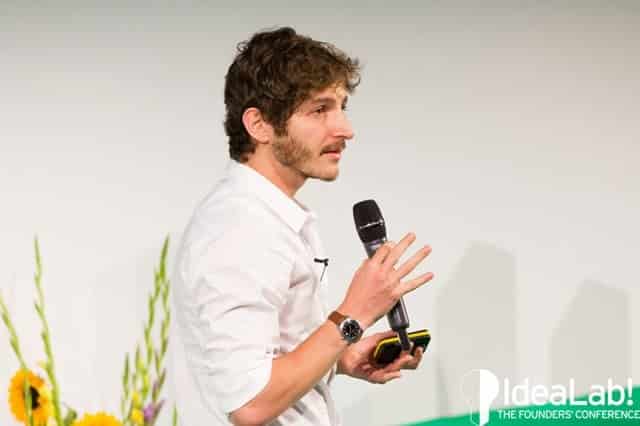
Teaching a machine Tom’s taste
Tailor Brands began in 2014 with Saar, designer Tom Lahat, and technical co-founder Nadav Shatz. The friends wanted to work together and tested ideas. Each test brought back an aggravating preliminary task: before they could sell an idea, they needed to give it a brand. Preparing the wrapping kept taking time away from discovering whether anybody wanted the contents.
Shatz proposed trying to reproduce the thinking behind Lahat’s design decisions in software. Saar and Lahat initially laughed at the suggestion. By the end of the year, they had an algorithmically designed logo. The experiment joined three kinds of experience: Saar’s creative and commercial background, Lahat’s design judgment, and Shatz’s technical knowledge. Their different skills were central to the premise.
The proposition was easy to grasp. A business owner could get a visual identity without commissioning an agency project. That mattered for people whose venture was still small enough that each preliminary expense required a private argument. A logo gave them something visible to put on the thing they were making. It offered a public sign of a decision that might still feel tentative.
By 2017, customers were asking for more than the initial purchase. They bought presentations, social posts, banners, and merchandise. Repeated orders made individual transactions cumbersome, so Tailor Brands moved toward subscriptions. Saar’s explanation was refreshingly practical: customers were already buying the work repeatedly. The payment model followed the way people used the service, rather than requiring them to behave like occasional design clients.
“Try, Fail, Repeat.”
Yali Saar’s shorthand for experimentation
The paperwork after the picture
As the company grew, Saar worked across the Tel Aviv and New York startup communities. In 2016, the team had an office around Park Avenue and 23rd Street, and he described traveling between the two cities every couple of months. He credited the willingness of other founders to help. The company selling independence was itself developing within a network of people making introductions and exchanging experience.
In July 2021, Tailor Brands announced a $50 million Series C led by GoDaddy, with other investors including OurCrowd, Pitango Growth, and Mangrove Capital Partners. Reported funding then totaled $70 million. The round supported a company already expanding its range of tools. Investors were backing a broader relationship with small-business owners, extending beyond the moment someone chose a logo.
That broader relationship changed Saar’s account of the job. People came for a logo because they wanted to launch a business. After the visual identity came formation, licenses, registered-agent requirements, tax identification, and ongoing administration. In his telling, expanding into that work required choosing a bigger problem while the original product was still succeeding. Success had supplied a customer base; it had also supplied a reason to keep asking questions.
By March 2026, Saar described a platform handling more than 20 services and reported that roughly 2% of new U.S. business formations ran through it. The figure is his account of the company’s reach. The more revealing change is in the work being discussed. A founder whose early product addressed taste was spending much of his attention on the orderly completion of obligations.
- 2014Make it visibleAutomated logos and branding
- 2021Build the toolkitBroader services; GoDaddy-led round
- 2026Keep it movingFormation, operations and funding search
The awkward bargain with AI
Saar’s current argument for entrepreneurship carries an uncomfortable complication. The software that helps a person run a business can also reduce the number of people an employer needs. He has publicly discussed automation inside Tailor Brands while arguing that more people will seek income through independent work. He presents business ownership as an increasingly practical response to changes in employment, rather than a pursuit reserved for people who always wanted to be founders.
That argument became a program called Tailor AID. Its published offer is up to 1,000 business-building packages, valued at $1,000 each, for selected workers displaced by AI. Applicants face eligibility requirements, and state fees are excluded. Those details give the $1 million headline its proper meaning: services intended to help someone begin, with specific terms attached.
The distinction matters because a registered business still needs a customer. Assistance with setup can remove expense and confusion, while leaving the commercial challenge ahead. Saar’s answer has been to extend the guidance surrounding the tools. In May 2026, he described Navi, an AI assistant designed to help users plan and work through tasks across formation, compliance, pricing, and early marketing. The ambition reaches further into the decisions a beginner must make.
The same month, Tailor Brands announced Funding Search, matching business profiles with potential grants, tax benefits, and other non-loan opportunities. The product includes eligibility information and preparation guidance. It follows the company’s recurring pattern: once an owner completes one task, the next difficulty becomes visible. The paperwork gets filed; then comes the question of how to pay for equipment, supplies, or an initial advertising campaign.
Another beginning, with a list
Alongside the product changes, Saar has developed a public voice through business writing and interviews. His Fast Company work considers entrepreneurship and the changing workplace. He has also emphasized the practical responsibilities of leading a team: explaining the reason for the work, making information accessible, and allowing people to understand the customer behind a task. The founder’s enthusiasm has to become something colleagues can act on.
His earlier accounts of working life are pleasingly ordinary. He organizes his days in lists. When doing too many things at once became counterproductive, he described using music to concentrate on one task. Such habits give some weight to the experimentation slogan. Trying many things over a career still requires finishing a particular thing on a particular afternoon. A good idea receives no exemption from Tuesday.
Look back across those projects and the recurring interest becomes clearer. A party provided somewhere to go. A lecture in a bar provided an easier way into learning. An automated logo offered a small venture a way to present itself. Tailor Brands now handles more of the work surrounding the decision to start. Each project asks what might happen if the first obstacle were made less troublesome.
Saar cannot do the owning for his customers. They must still decide what to make, persuade someone to buy it, and keep going when the early excitement wears off. His chosen business keeps moving closer to those everyday difficulties. The former performer has found a demanding audience: people who have an idea, a limited budget, and quite enough to do before tomorrow.
Follow the next chapter
Tailor Brands ↗LinkedIn ↗Twitter / X ↗Instagram ↗Medium ↗
Read the early founder conversation, the 2026 leadership interview, his Fast Company writing, and the 2026 product conversation.
Watch Saar with Michael Matias on 20 Minute Leaders, or find his March 2022 PEP Talk conversation in the Simon Says podcast archive. Read the Tailor AID terms and the Funding Search announcement.