Somewhere inside a mortgage operation, a perfectly ordinary order is waiting for somebody to do something. An appraisal needs attention. A title provider needs an answer. A loan officer needs to know which of those things happened. Xpanse has built a business around this unglamorous interval: the space between one completed task and the next person picking it up.
- Podium brings lenders and outside service providers into a shared order workflow.
- DASH handles document classification and data extraction; DATA tackles cloud data infrastructure.
- The 2025 MindBox acquisition adds decisioning, pricing and workflow technology.
There is something refreshing about software whose subject is waiting. Mortgage technology can invite grand declarations about reinventing homeownership. Xpanse's more interesting proposition is smaller and more testable: can the people already doing the work spend less time chasing it?
01 / The mortgage insider meets the software team
Founded in 2020, Xpanse emerged with Greg Middleman as its founder. His background included EY's structured finance team and an MBA completed that year. In its early company introduction, Xpanse described a leadership group with experience at Amazon, Facebook, Zillow and Microsoft. The intended combination was mortgage familiarity and software experience from outside the industry.
The company also started during the pandemic. Its early recruiting pitch described tools and processes built for remote work from the beginning. That detail fits the product problem rather neatly. A distributed team and a distributed mortgage transaction both need people to see what is happening without gathering everybody in the same room.
Today, Xpanse identifies itself as an Archwell Holdings subsidiary, serving lenders and servicers. Its position is business-to-business: financial institutions buy the software and services; borrowers experience the consequences downstream. The ambition is to improve existing lending operations, including the systems and specialist providers that institutions already depend on.
02 / Put the handoff on the screen
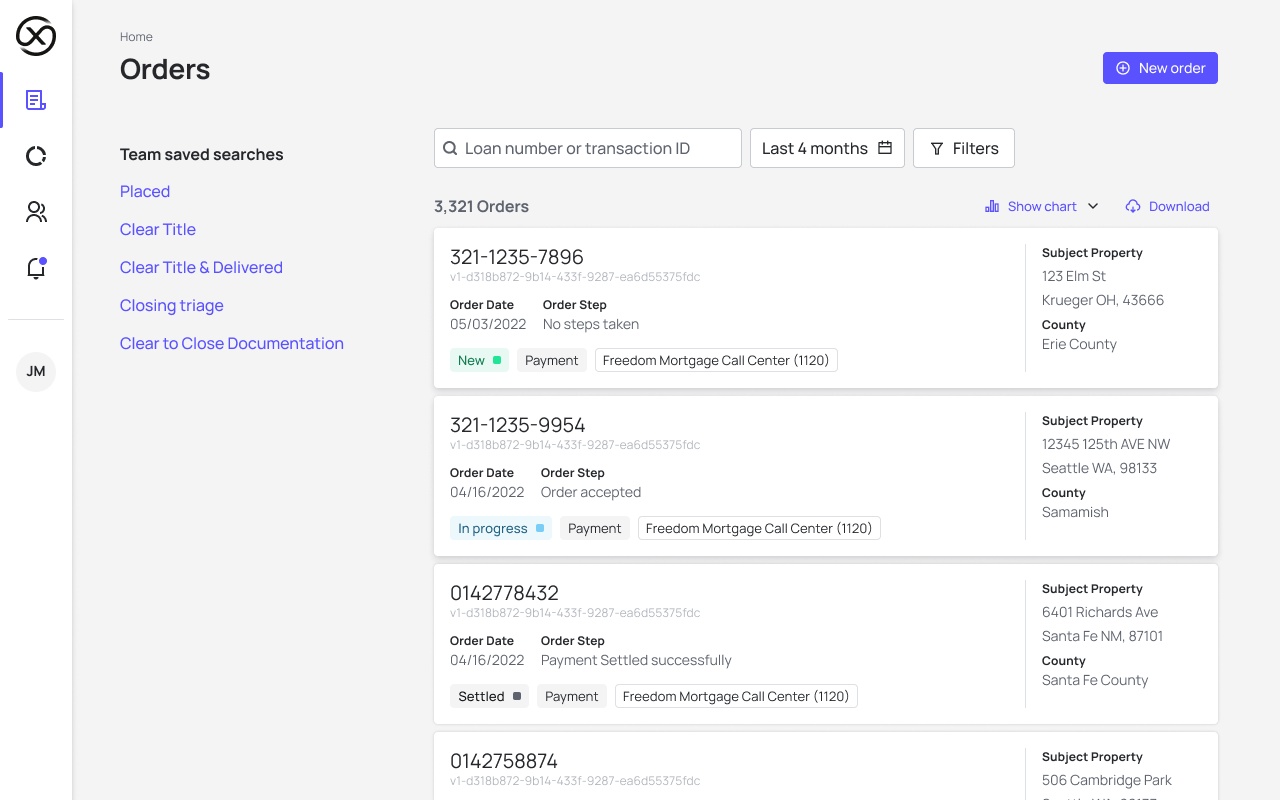
Podium is the clearest expression of that approach. It gives lenders a place to manage orders and communicate with service providers. Its 2022 datasheet describes configurable workflows, loan-level conversations and provider allocation rules. The point is to make the path of an order visible and adjustable.
Consider provider selection. A lender needs more than a contact list: it needs a way to notice when performance changes and redirect work. Podium's service-level agreement scorecards make those comparisons part of the operating workflow. The choice of who gets the next order becomes something people can act on while the pipeline is moving.
“Changing provider allocations used to take weeks.”
Don, lending operations vice president at an unnamed top-five lender, in Xpanse's Podium datasheet
Less time to close, reported for one unnamed top-five lender in Xpanse's 2022 Podium datasheet. A customer example, not a guaranteed result.
03 / The feature that got smaller
Elsea's account of an appraisal-payment project supplies a useful view inside the machinery. The team wanted loan associates to collect payments from borrowers. One early constraint was time: he described receiving only three or four days between kickoff and the start of backend development.
He worked backward from release milestones to make room for research and design. An early engineering review then flagged an optional step, adding further payments to an order, as a threat to the schedule. The team negotiated a simpler approach. The original order flow also asked payment users to navigate complexity designed for other mortgage products.
The lesson is practical: map the sequence, involve engineering early, and remove steps that the immediate task does not need. Yet the account ends without a victory lap. Elsea says the team was laid off a week before the planned production release, leaving him without outcome analytics. It is a reminder that thoughtful product work still depends on the business being able to carry it through.
04 / Read it. Route it. Decide.
Xpanse expanded its public product story in March 2023, announcing the debut of DASH and its DATA advisory practice. DASH applies optical character recognition, AI and machine learning to classify documents and extract information. The launch announcement described nearly 700 programmed document types and a benchmark of 1,500 pages per minute. Those are company specifications, rather than a promise about every lender's files.
DATA addresses the infrastructure underneath: helping organizations migrate to, operate and optimize Snowflake. Snowflake itself publicly recognized Xpanse among partners reaching its Elite tier in 2023. That pairing makes commercial sense. Document automation creates usable information; data infrastructure helps an institution put that information to work.
Documents → data
Orders → providers
Rules → decisions
Capability map, not a claim of one fully integrated product flow.
In February 2025, Xpanse acquired MindBox, bringing in business decisioning, product and pricing, eligibility and workflow technology, along with team members. President Kiran Sahota said the technology fit the company's plans for scalable client solutions. Xpanse committed to uninterrupted service for existing MindBox clients and described further enhancements as future work.
The acquisition extends the scope of the work Xpanse can address. Reading a document, assigning a provider and applying a business rule are different tasks, but they meet inside the same transaction. The opportunity is in connecting them; the operational test is whether each connection reduces another round of manual coordination.
05 / Make the next step worth buying
The business model combines enterprise software with implementation, support and data consulting. That makes expertise part of the offer: someone has to connect workflows, understand mortgage documents and translate an institution's operating rules into software. Xpanse's competitive argument rests on how those pieces work together around lending operations.
Buyers can also consider broader loan origination platforms, specialist document processors and their own internal tooling. A sensible evaluation would follow one real loan through the proposed system and count the interventions it still requires. Integration work, exception review and organizational adoption belong in that calculation alongside any software fee.
The transferable idea is simple enough to borrow before buying anything: make the waiting visible. Give each handoff an owner, put provider performance where allocation decisions happen, and measure the work that returns for another pass. Automation earns its place when the next person can move.