The forum built by the people who walked out of vBulletin
The forum software built by the people who walked out of vBulletin - and why, in an age of algorithmic feeds, businesses still pay for a place to talk.
In 2009, a group of developers walked out of the company that owned vBulletin, then the most popular forum software on the internet. They did not start a newsletter or a podcast. They wrote a competitor. A year later, on 21 September 2010, they announced it. By March 2011 it was shipping, and it was called XenForo.
Fifteen years on, XenForo is the software behind message boards you probably read without ever noticing the plumbing. IGN's community runs on it. So do SpaceBattles, RedCafe, TheForce.net, BigFooty and SmashBoards - some holding tens or hundreds of millions of posts. It is a small, privately held company in Reading, England, selling an unfashionable product in an unfashionable category, and it has outlasted most of the things that were supposed to replace it.
01 / What it isA place to talk that you own
Strip away the branding and XenForo is a package of PHP running on a MySQL database. What you get for that is a full community platform: threaded discussions, member profiles, reactions and likes, a granular permission system that lets administrators decide exactly who can see and do what, a theming engine, and an add-on framework that turns the forum into something closer to a platform. There is a REST API, and there are official importers to migrate a community off vBulletin, phpBB or Invision.
The pitch has been consistent since 2011: own your community instead of renting it. A XenForo board is not a page inside someone else's social network. It is a searchable, permanent archive of a community's conversations that the operator controls, hosts and can move if they want to. In 2011 that sounded conservative. In 2026, after a decade of feed changes, reach throttling and platform shutdowns, it sounds like a strategy.
None of the individual pieces are exotic. Reactions, tagging, watched threads, moderation queues, spam controls - most forum packages have some version of them. What XenForo sells is the assembly: a set of defaults that feel considered, an admin panel that does not fight you, and behaviour that holds up when a board grows from a few hundred members to a few million posts. The unglamorous work of getting those details right is most of the product.
02 / Who uses itFrom hobby boards to boards with 100M posts
XenForo's customers sit on a wide spectrum. At one end are hobbyists running a forum for a few hundred enthusiasts. At the other are some of the largest discussion communities on the English-language web. IGN reportedly moved its boards off a custom in-house system and onto XenForo - a rare case of a major platform choosing off-the-shelf forum software over its own code. In between are fan sites, sports communities, gaming boards and businesses running customer-support forums.
Selected XenForo boards, by size
There is a quiet business lesson buried in those numbers. Forums do not churn the way most software does. When a community has twenty million posts of history, its own vocabulary and its own moderators, leaving the software is not a decision - it is a demolition. That gives XenForo the kind of retention that subscription apps spend fortunes chasing.
03 / The problem it solvesRenting an audience is a bad trade
Every community built on a social network is a tenant. The landlord sets the rules, changes the reach, runs the ads and keeps the data. When the algorithm shifts or the platform winds down, the community goes with it. XenForo solves the tenant problem the old-fashioned way: it hands the operator the keys. The forum, the members, the archive and the URLs all belong to whoever runs the site.
That independence used to be the boring option. Then the feed era made permanence rare. A thread from 2013 is still findable and still ranks; a post on a social feed is gone by lunchtime. For anyone who wants their community's knowledge to accumulate rather than evaporate, that difference is the entire product.
04 / How it's differentThe paid middle of a crowded category
Forum software is not an empty field. At the free, open-source end sit phpBB, MyBB and the newer Flarum. At the modern, VC-adjacent end sits Discourse, with its single-page interface and open-core model. Invision Community competes head-on as a paid suite. And then there is vBulletin - the incumbent XenForo's founders left, and the product they set out to beat.
XenForo's position is the polished, paid middle. It is proprietary and it costs money, which rules it out for people who want free. But it ships a genuinely refined administration experience, a mature permission system and a large ecosystem of paid styles and add-ons that lets operators bend the software to their community without touching code. Where Discourse leans chat-like and phpBB leans utilitarian, XenForo leans "traditional forum, done carefully." For a lot of long-running communities, careful is exactly the ask.
05 / ProductsA core, and the add-ons that make it sticky
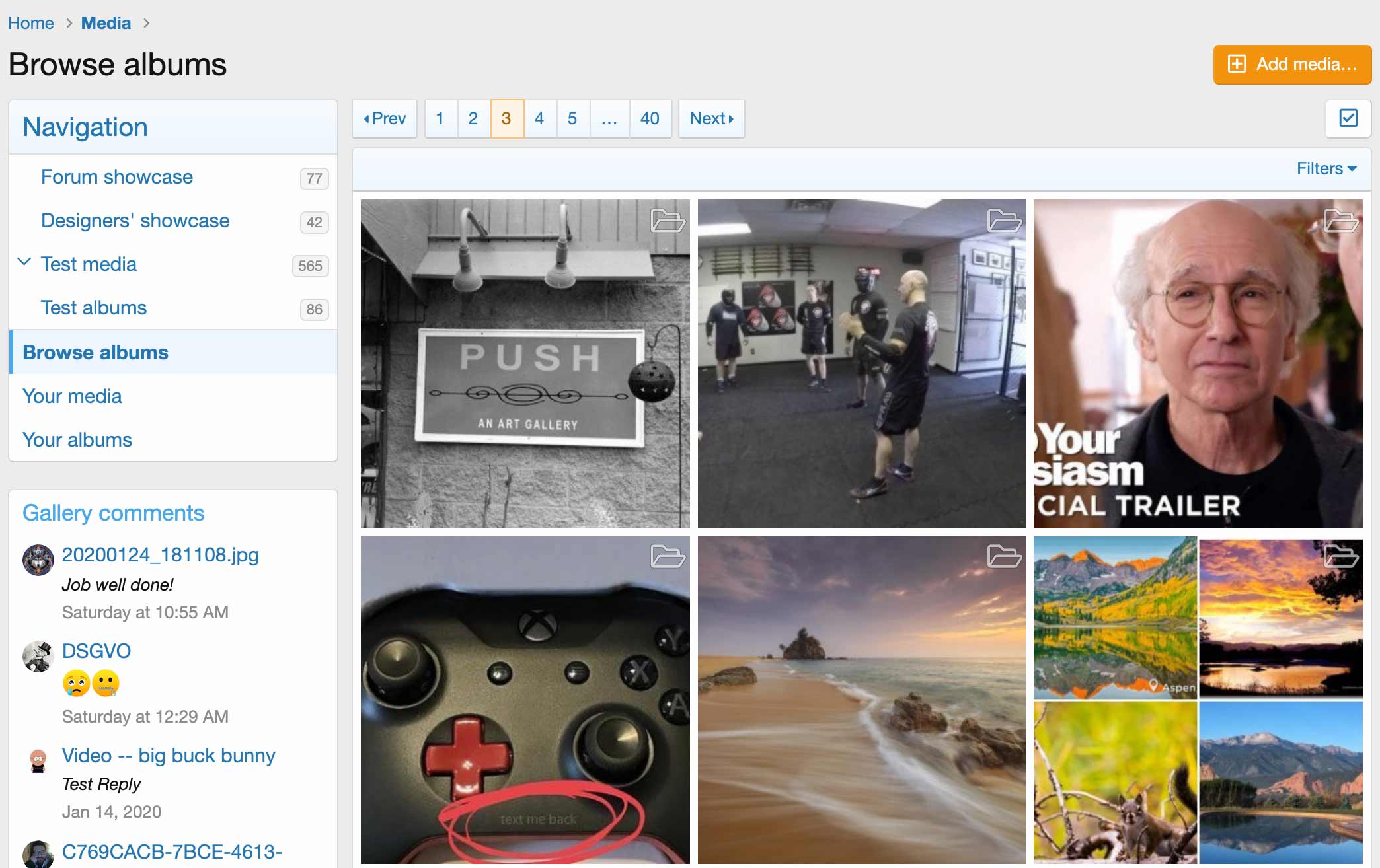
The core product is the forum itself. Around it sits a family of official add-ons that each sell separately and each add reasons to stay. The Media Gallery - which grew out of developer Chris Deeming's Xen Media Gallery when he joined in 2014 - gives members a hub to upload, tag and share images and video. The Resource Manager turns downloads, guides and tutorials into rated, reviewable, watchable resources that live apart from the discussion. Enhanced Search wires the community into Elasticsearch for faster, more relevant results. XenForo Cloud, launched in 2021, hosts and manages the whole thing for operators who would rather not run a server.
06 / Business modelBuy it once, or rent it monthly
In a subscription-everything era, XenForo still sells software you can own. A self-hosted licence is around $195 for one or two sites, with volume discounts, and a roughly $60-a-year renewal keeps updates and ticket support flowing. Prefer someone else to run it? XenForo Cloud is roughly $60 a month for Starter and $100 for Pro. Official add-ons carry their own licence fees on top. Revenue comes from licence sales, recurring renewals and hosting - no funding round required.
One-time for 1-2 sites, volume discounts above. ~$60/year renewal for updates and support. You host, you control the data.
Starter to Pro. Fully hosted and maintained by XenForo, for operators who don't want to run their own servers.
07 / ExpertiseThe moat was the team
XenForo's credibility came pre-installed. Kier Darby had been a lead developer on vBulletin; Mike Sullivan co-founded the company with him. They were not outsiders guessing at what a forum needed - they had already built the category's dominant product once. That pedigree also produced the company's founding drama: Internet Brands, which had acquired vBulletin, took XenForo to court in both the UK and the US. The litigation was settled by February 2013, and XenForo kept building.
The through-line since has been steady, unhurried shipping. Version 2.0 in 2017 modernized the framework and admin interface. Version 2.3, in July 2024, added dark mode and OAuth2 login and refreshed the core add-ons, with the 2.3.x line carrying maintenance releases into 2025. It is not a roadmap designed to generate press. It is a roadmap designed to keep large communities running.
08 / Where it fitsThe forum never died
The internet keeps announcing the death of the forum and keeps being wrong. Feeds, then Discord, then Slack were each supposed to make the message board obsolete. What actually happened is that the forum kept doing the one thing those tools are bad at: building a searchable, permanent, owned archive of a community's knowledge. XenForo's role is to be the well-maintained engine underneath that idea - unglamorous, durable and still under active development.
There is also a lesson about lock-in that has nothing to do with tricks. XenForo is sticky because the thing it stores - years of a community's conversation - is genuinely hard to recreate anywhere else. That is the good kind of moat: the customer stays because leaving would cost them something real, not because the exit is booby-trapped. The add-on ecosystem, the paid styles, the importers that make it easy to arrive and awkward to reproduce elsewhere all reinforce the same pull.
For founders, the company is a small, useful case study. Pick a category everyone thinks is finished. Build the best product in it. Price it honestly. Compound for a decade and a half. It will not make headlines. It will, apparently, run some of the biggest boards on the web.