The software costs nothing. The business begins when somebody has to keep it running. Laravel, the company behind the open-source PHP framework, has spent years turning the less glamorous parts of web development into products people will pay for: preparing servers, deploying updates, and finding the request that made an application crawl.
It is an unusually practical commercial proposition. A developer can download the framework, build a business with it, and never buy a Laravel subscription. But once that business needs reliable infrastructure, the people who built the framework would like to handle the next job, too. Laravel is selling familiarity at precisely the point where a working application becomes an operational responsibility.
That proposition became considerably better funded in September 2024, when Laravel announced a $57 million Series A from Accel. Founder Taylor Otwell remained CEO. The money supported a broader engineering and leadership team, including more open-source development capacity. The wager: the company could make shipping and monitoring applications feel as coherent as writing them.
01 / A free tool with a paid second act
Otwell created Laravel in 2011. Its basic job remains straightforward: give developers a structure for web applications, with common machinery already available. Authentication identifies the user. Routing directs a request. Database tools retrieve the right records. Queues move slower work into the background. These are the tasks that turn up in project after project, regardless of whether the customer sells flooring or sports statistics. Laravel’s documentation describes both full-stack applications and API backends as supported uses.
For a small software team, that can mean building a subscription service, customer portal, booking application, or internal dashboard without assembling every foundational component separately. The expertise still required is substantial: someone must understand the business rules, design the data, test the behavior, and maintain the application. Laravel supplies a starting structure, not a finished business.
The framework’s MIT license permits commercial use. That separates adoption from procurement: a programmer can learn it or prototype with it before a manager approves a software budget. Paid products enter the picture when customers want more assistance with operating the result. The commercial model works because the surrounding work keeps recurring after the initial download.

02 / The investor had to keep calling
Laravel was already a profitable, bootstrapped business when Accel pursued it. In the investor’s account, reaching Otwell took a year of persistence and 21 cold calls, followed by breakfast in Little Rock. Accel also attended Laravel gatherings in Portugal, India, and the United States. The courtship offers a useful clue: the developer community existed before the venture cheque.
What changed the equation was the scope of Otwell’s ambitions. Accel described a founder who wanted to do more for that community and needed resources to connect the pieces. The investment announcement made his continued role explicit. The funding was an expansion of a working business, with a familiar founder still curating the framework.
“First, I’m not going anywhere.”
TAYLOR OTWELL / ON THE ACCEL INVESTMENT, 2024
03 / The minute between a laptop and the web
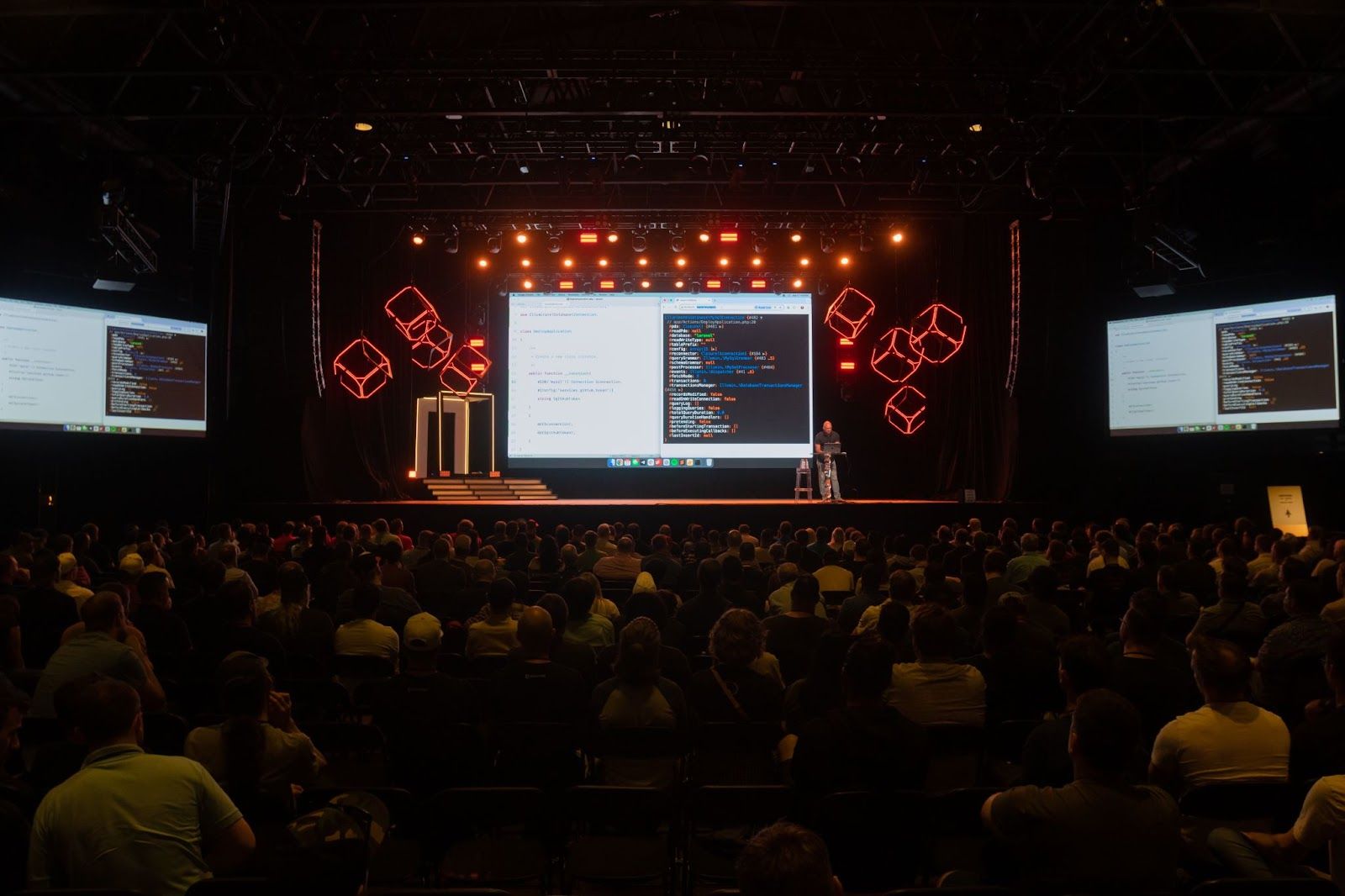
Cloud turned that ambition into a different kind of engineering assignment. In Joe Dixon’s account of building the platform, Otwell set a target: a new user should get an application online within a minute. Three engineers initially owned the web application, build service, and compute work. Laravel Cloud reached general availability on February 24, 2025, less than a year after its first commit.
Experience with Vapor, Laravel’s AWS serverless deployment product, did not make Lambda an automatic choice for Cloud. Long-running processes and other application requirements pushed the team toward Kubernetes on AWS. The team also accelerated MySQL support before launch, deciding that a PostgreSQL-only opening would be too restrictive. Both choices reveal the product discipline: accommodate the applications customers have, including their inconvenient bits.
Today, Cloud’s managed platform combines deployment with resources such as databases, storage, and workers. Preview environments let teams inspect changes before merging them. Scaling features address traffic that rises and falls. Those conveniences are the product: they move routine infrastructure decisions into a system designed around the application’s needs.
Application code
Deployment choices
Production insight
04 / Three hosting answers, several different bills
The product names can make the ecosystem sound more mysterious than it is. Forge automates server provisioning and management, including deployment scripts, certificates, queues, and scheduled tasks. It suits customers who want a server-oriented workflow. Cloud offers a more managed application platform. Vapor deploys into a customer’s own AWS account and charges separately from AWS usage.
As of September 9, 2026, Cloud’s published plans start at $5 a month plus usage, with $5 in monthly usage credits on Starter. Growth is $20 plus usage; Business is $200 plus usage. Those figures are platform fees, not universal estimates of what a live application will cost. Compute, databases, and other resources shape the final bill. Spending limits can pause compute, making budget control a decision about availability as well as money.
Vapor lists $39 a month or $399 a year, excluding AWS charges. Nova follows another pattern: a purchased administration panel with a year of updates and optional update renewals. It helps developers build the screens staff use to manage records, inspect metrics, and support customers. Its public testimonials include Lemon Squeezy and Chipper CI. Laravel’s paying audience extends from infrastructure buyers to developers tired of rebuilding a back office.
05 / When the background job outlasts the plan
PyleSoft supplies a concrete example of why deployment choices matter. Its B2B ecommerce workload included inventory and pricing jobs that exceeded Lambda’s 15-minute timeout. A hybrid setup became expensive and awkward. In Laravel’s customer account, the company reports moving six applications to Cloud over 12 weeks, deliberately pacing the migration around important data. It reports saving $5,500 monthly against an $11,000 infrastructure bill.
That result is a customer case, not a promise for every application. The copyable step is to inspect job duration, existing workarounds, and the complete infrastructure bill before comparing platforms. PyleSoft’s problem was a mismatch between the execution model and the work it needed done. A smaller, intermittent workload could produce a different answer.
The scale argument has another illustration. Sportmonks reports running 12 applications on Cloud and serving 600 million API requests a week. Its sports-data workload spikes around live matches, with more than 1,000 jobs dispatched per second. That is evidence that Laravel can serve demanding applications; it is not a benchmark of how an untouched starter project performs. Application design, databases, caching, and operations remain part of the result.
06 / The advantage is knowing the application
Laravel competes with Symfony within PHP, and with ecosystems such as Django and Ruby on Rails when teams choose a language and framework. All offer structure for web development. Laravel’s case is the combination of that structure with a family of related operational products. For an established team, switching costs and existing language expertise may matter more than any feature comparison.
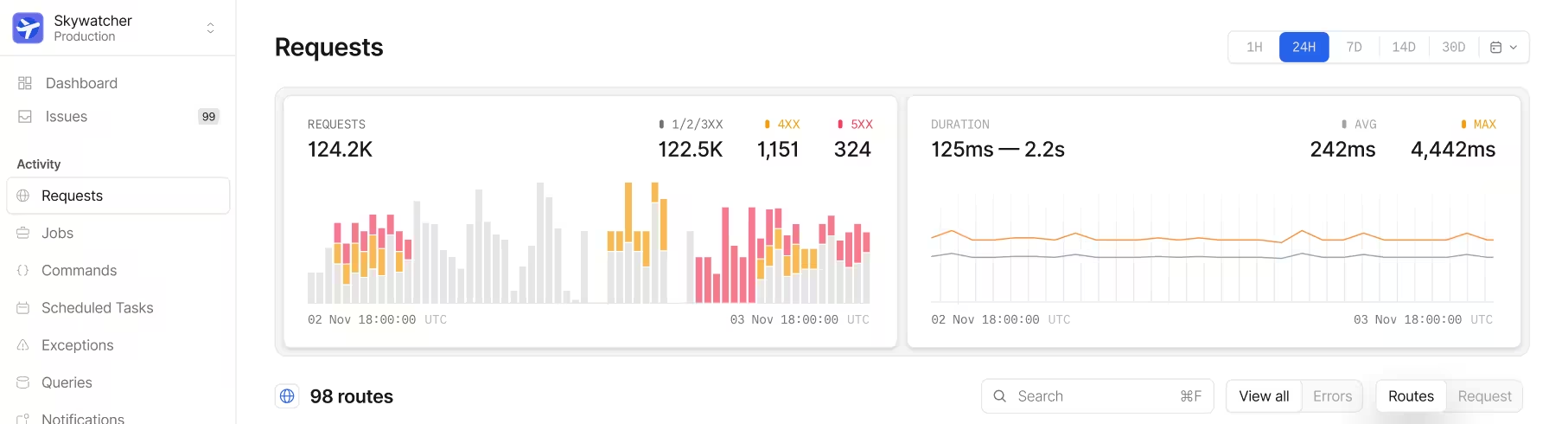
Nightwatch makes the integrated approach tangible. It monitors Laravel applications across hosting platforms, tracing activity such as requests and jobs to help teams investigate errors and performance. The value is context: an application-aware view can help connect a symptom to the code responsible. Buying monitoring still leaves developers with the job of understanding and fixing what it reveals.
The wider company also relies on other businesses doing the hands-on implementation. Its partner directory lists agencies including Vehikl, Tighten, and 64 Robots for development, migration, and review work. That matters to a buyer who needs an application built rather than another tool subscription. Laravel supplies the framework and platform; a partner can supply the project team.
07 / A community with a stage, and work without an office
Laravel’s careers page describes a fully distributed team, with private health benefits, local holidays, retirement contributions tailored by country, and stock option eligibility. These are specific statements about how the company recruits. They also suit a product whose contributors and customers are spread across borders. A single office photograph would tell only a small part of that story.
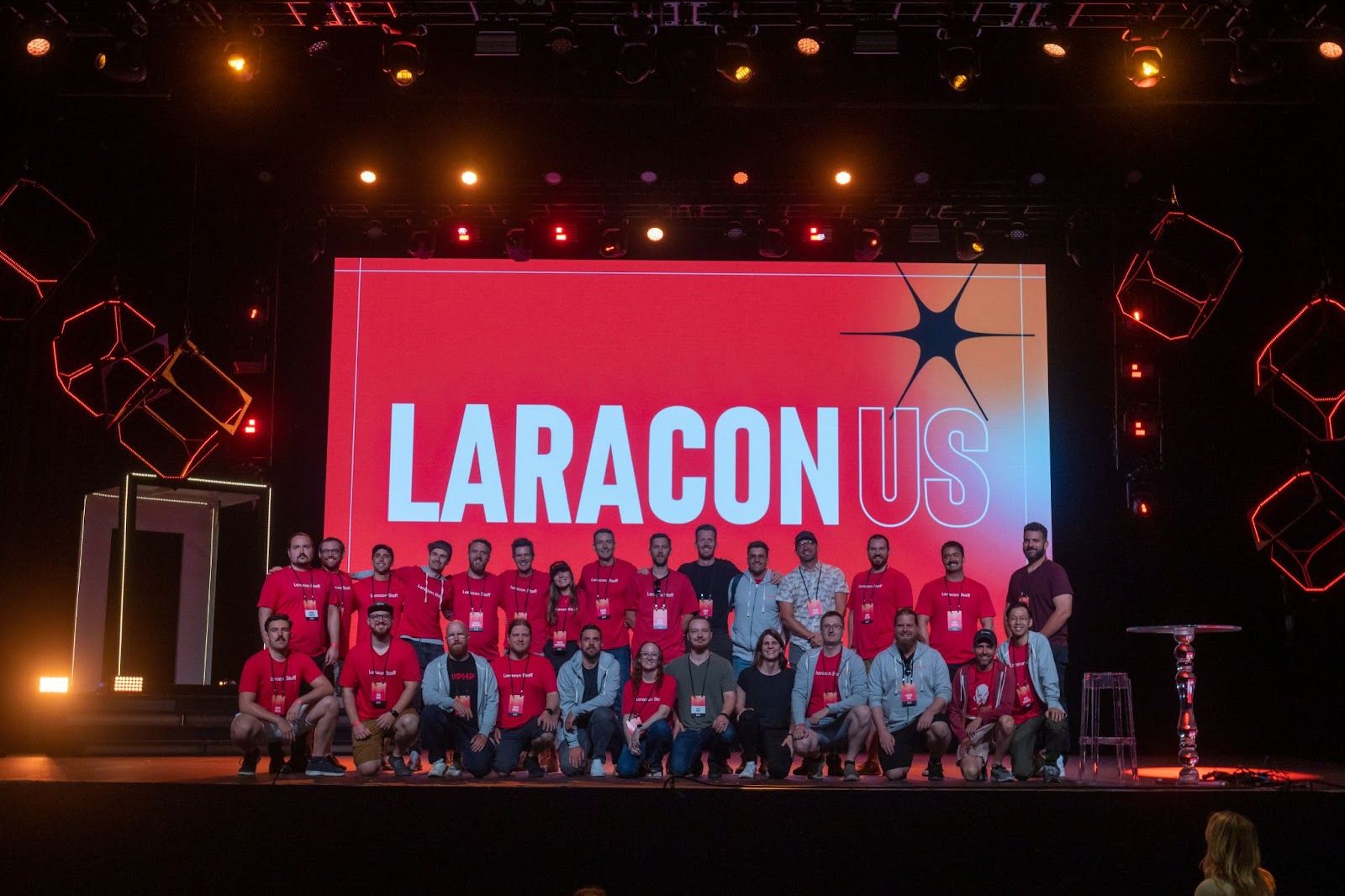
The community has a physical life at Laracon conferences and local events. Those gatherings give developers a place to see products demonstrated and meet the people who maintain them. For Laravel, the commercial implication is straightforward: a company selling to developers benefits when those developers already know its tools and one another. The conference crowd is part of the context in which a paid product gets considered.
08 / The next chapter includes knowing what to delete
Laravel’s 2026 updates extend that story. Its July Laracon announcements included managed queues, broader scale-to-zero capabilities, and Next.js and Nuxt hosting on Cloud. The latter lets teams place their JavaScript frontend beside a Laravel backend. That expansion follows how applications are assembled in practice, rather than insisting every component speak PHP.
There is a smaller, revealing example in the company’s AI tooling. In a September engineering post, Pushpak Chhajed described deleting a semantic search layer for Boost’s project rules after five days. A modest collection of convention files did not justify embeddings, an index, and the maintenance burden. The replacement used Markdown and a generated table directing agents to relevant rules. He described improved behavior in exploratory testing, while leaving controlled evaluation as future work.
The useful habit is to measure the problem before adding machinery. Laravel’s business asks customers to make a similar calculation: which jobs deserve their engineering time, and which can a specialist handle? A team comfortable operating its own infrastructure may keep doing so. One burdened by deployments, monitoring, or awkward background jobs may buy help. Laravel gets paid when that help is worth more than another subscription costs.