It took a year and 21 cold calls for Accel to get a meeting with Taylor Otwell. The eventual setting was eggs and biscuits in Little Rock, Arkansas. By then, the investors had attended Laravel gatherings in Portugal, India and Nashville. Consider the unusual sales process: the people offering money were doing the travelling.
Otwell had reasons to be difficult to recruit. He had created Laravel, a free PHP framework, in 2011 and built a profitable business around helping people use it. He could work from Arkansas, develop products he understood and serve a community that had grown around his own programming preferences. Outside investment would bring another set of expectations into an arrangement that already worked.
On September 5, 2024, Laravel announced a $57 million Series A with Accel. Otwell remained CEO and the primary curator of framework features. The announcement also pointed to more engineering capacity for open source. He was accepting a larger company, with the complications that entails, to attempt products the smaller operation could struggle to support.
The interesting figure is the thirteen years before the cheque. Long enough to develop a business. Long enough to become comfortable. Long enough for the question of what comes next to acquire a little weight. A founder who has already found a way to live has a different decision to make when someone offers him a way to grow.
02Before the cloud, freight
Otwell grew up in Hot Springs, Arkansas. His early websites concerned video games and Pokémon. He studied information technology at Arkansas Tech University, attending from 2004 to 2008, then worked at ArcBest Freight with .NET and COBOL. The setting was ordinary business software: systems expected to do useful work, with little reason to care whether the wider technology world found them fashionable.
PHP became a way to launch side projects. Dissatisfied with the available frameworks, he began building his own. Laravel supplied a repeatable structure for web applications, handling jobs that programmers otherwise have to arrange again and again: directing requests, working with databases, checking users and running background tasks. Its appeal started with a familiar irritation. Otwell wanted to spend more time building the thing he had in mind.
At UserScape, where Ian Landsman hired him in 2011, he could develop Laravel while working on applications. That connection to actual projects mattered. A framework is a collection of decisions other programmers inherit. Every convenient convention can save a user effort; every awkward convention can become somebody else’s daily nuisance. Otwell had to live with his own choices.
03Ninety people were enough to start
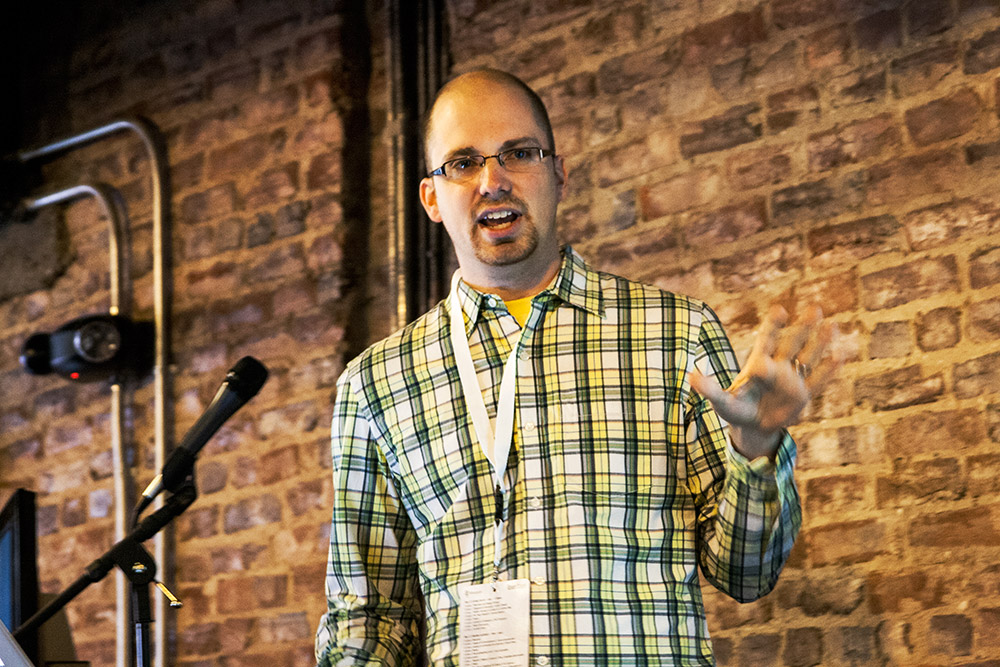
Landsman also proposed the first Laracon. Otwell wondered whether enough people would come. In Washington, DC, in 2013, 90 did. A photograph from the event shows him at a microphone against exposed brick, wearing a checked shirt and conference badge. The beginnings of a developer gathering look reassuringly like a developer gathering.
By the Dallas event in 2024, attendance was roughly 950. The community had acquired teachers, conference organisers, package authors and business owners whose work extended well beyond the company. Jeffrey Way’s Laracasts became an important part of that education network. A person could discover the framework, learn it from someone else and eventually return to teach the next arrival.
Otwell had thought about belonging early. In a 2019 conversation with Justin Jackson, he described deliberately making people feel welcome around a tool. Software leaves room for this kind of attachment. A contributor can point to a change, an answer or a tutorial and say: I helped make that. The resulting loyalty has something more substantial underneath it than a marketing slogan.
Community also changes the founder’s job. Once other people use a framework to earn their living, its future belongs in their calculations. A release affects projects, courses and teams. The personal shortcut becomes shared infrastructure. That is a considerable promotion for a side project, and a less comfortable one for its author.
From 90 to roughly 950
04The script that paid the bills
Laravel itself was free. Forge, launched in 2014, gave Otwell a commercial product: a service for provisioning and managing servers. Customers brought their own infrastructure accounts; Forge dealt with much of the configuration. Within weeks, he said, its income exceeded his day job. He moved to working full time on his own Laravel business in January 2015.
The distinction was practical. Developers could keep using the framework without buying anything. Those who wanted help with the surrounding work could pay for it. Deploying, operating and maintaining an application continues long after the first satisfying afternoon of writing code. Otwell had found a recurring problem adjacent to the free project, and customers were willing to pay for relief.
Other tools followed, including Envoyer, Nova and Vapor. Even the less visible decisions tell something about his judgement. He once completed another product called Laravel Cloud, with a finished interface, and shelved it because its difference from Forge was too slight. The name would eventually return for a different offering. Shipping everything one finishes would have been the tidier story. Leaving a finished product in the drawer was the clearer product decision.
Open-source Laravel supplies the application’s foundations.
Paid tools help customers deploy and operate their work.
05An API with a sense of proportion
Otwell’s attention often settles on what a programmer sees first. He has described sketching an ideal API in a scratchpad before implementing it, working out how an operation should read. Laravel’s characteristic three-line comments began partly as a visual preference. Even the text surrounding the code was allowed to have a little composition.
His references extend outside programming: Dieter Rams, Jony Ive and the documentary Jiro Dreams of Sushi. The connection is craft, the repeated consideration of small choices that users may feel before they can name them. A framework’s internal machinery can be elaborate. Its public gestures still need to make sense to someone trying to get home with a working application.
There is an entertaining footnote to the aesthetic seriousness. Otwell explained that the “Facade” number plate on his Lamborghini served as a reminder about the importance of possessions. It also happens to be a term Laravel programmers know. Few software abstractions get to spend their weekends attached to a sports car.
His less theatrical habits are easier to borrow. He has described planning his days in Todoist, handling customer questions and pull requests before pursuing new work, and watching Jeopardy with his family. The portrait is of someone who enjoys arranging things: an interface, a workday, a sequence of tasks. The visible polish has an administrative side.
06What comfort could no longer finance
By his account, the profitable, lean version of Laravel had taken him through most of the products he could readily imagine building within its limits. Cloud and Nightwatch presented a different scale of responsibility. A fully managed platform needs infrastructure, support and engineering capacity before a founder gets the satisfaction of seeing revenue catch up.
Forge works with servers in a customer’s account. With the newer Laravel Cloud, the company operates the platform. That changes who carries the bill and who must respond when something goes wrong. A pleasant deployment interface is the visible part of an operating commitment. Investment bought room to undertake that commitment with a larger team.
“I felt like I owed it to the community,” Otwell said of the decision to pursue Cloud. The phrase explains why remaining comfortably profitable could begin to feel inadequate. People had spent years building careers and businesses around Laravel. He wanted to offer them a more ambitious next step, even though it meant changing the organisation he had enjoyed running.
The leadership problem arrived with the hiring. By February 2025, the team had grown from ten to fifty. Otwell shared a manifesto to keep people aligned on mission and users while allowing them to work independently. For someone accustomed to expressing decisions in code, writing down intent for colleagues becomes another form of interface design. People need to understand what matters before they can make good choices without you.
I felt like I owed it to the community.
Taylor Otwell, on pursuing Laravel Cloud · 2025
07When the next user is an agent
Then the identity of the person typing started to change. In a conversation recorded at AWS re:Invent 2025, Otwell considered how well AI systems could work with an established framework. Years of examples and consistent conventions gave them something to follow. Laravel’s tooling could supply documentation appropriate to the version an application actually used.
There was some ambivalence in watching agents perform tasks whose manual experience he had spent years refining. Yet the attraction was familiar: a person with an idea could get further, faster. By July 2026, he was discussing AI-assisted programming with Matt Stauffer on the Laravel Podcast. The debate had moved into everyday working methods.
The product releases give that discussion a concrete shape. Laravel’s July 2026 announcements included human approval for AI tool calls, alongside editor tooling and Cloud improvements. On September 23, the Laravel AI SDK reached version 1.0, bringing multiple providers behind a Laravel-native interface. These are company achievements, built by teams, and evidence of the territory Otwell now wants Laravel developers to occupy.
The original concern survives the new vocabulary. Someone wants to build an application and keeps encountering chores between the idea and the result. Otwell has spent his career choosing which of those chores software should absorb. The tools have grown from a personal framework to a company operating infrastructure and supporting agents. The judgement still starts close to the keyboard: what would make this easier for the next person trying?
Read, watch, follow
Explore the tools and hear Otwell describe the decisions in his own words.